Yes, provenance is important when collecting art because it establishes what a work is, who made it, and how it came into your hands. It is not the only measure of a painting’s value, but without it, certainty becomes expensive.
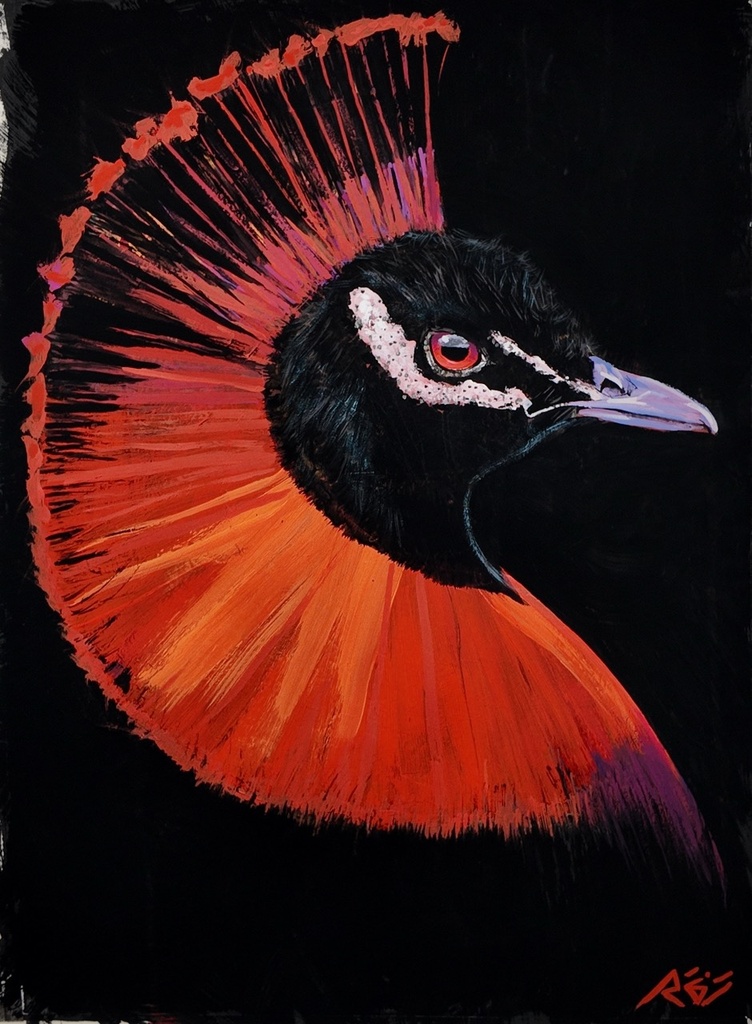
In Hummingbirds, tropical birds hold their color against a black field. The painting does not need an elaborate story to exist. Its surface, its title, its materials, and my authorship are already a record. When a collector acquires a work directly from my studio, provenance begins with a clear fact: the painting came from the artist who made it.
Is provenance important for original art?
Provenance is the documented history of ownership and placement. For an older work, that history may move through estates, galleries, auctions, institutions, and private collections. For a contemporary painting acquired from a living artist, it can begin more simply: an invoice, a certificate or studio record, images of the work, exhibition history where applicable, and correspondence connected to the sale.
That simplicity matters. A direct relationship to the studio gives a collector a reliable starting point, especially when a work later changes hands. It allows the painting to remain legible beyond the room where it first lived. Authorship can be verified. The title can remain consistent. Its medium, condition, and context do not have to be reconstructed from a vague memory or an incomplete listing.
The trade-off is that a recent work may not yet carry a long exhibition record or a sequence of notable owners. It should not pretend to. Provenance is not a borrowed prestige machine. It is an honest chain of facts. A painting with a short, well-documented history can be stronger than one with a dramatic story full of gaps.
The work must come before its paperwork
I do not make paintings to produce documents. I make them because the material has demands.
My process begins with a heavily textured gesso ground. I build ridges and drags that decide how light behaves across the surface. Then come colored pencil, gouache, flat matte acrylic, marker, and gesso again, in the order the painting requires. Every work ends in oil, its final skin. Fat-over-lean governs the oil phase only, not the entire mixed-media process.
This sequence is part of a painting’s identity. It distinguishes an original from an image of one. A print can carry the composition faithfully, and it has its own place in a collection. But it cannot contain the compressed decisions inside the physical surface: the gesso returned to after marker, the matte acrylic beside an oil passage, the pressure of a contour line crossing a chromatic gray.
In I’m Perfect, But Unreal, the title holds an argument before the image is even read. The work is polished in one sense and resistant in another. That contradiction resolves on the surface: perfection is not an absence of friction. It is a form made under pressure, with every layer still present.
Documentation helps preserve that reading. It tells a future owner what they are looking at and why the work cannot be reduced to a flat reproduction. But the record serves the painting. The painting does not serve the record.
What provenance can confirm
For collectors, provenance answers practical questions that become more significant over time. Is this an original work, a print, or a study? Is the title recorded accurately? Did the work come directly from the artist’s studio? Has it appeared in an exhibition? Are the medium and condition described consistently across records?
For curators and institutions, the same information supports loan discussions, cataloging, and exhibition planning. A clean record does not dictate interpretation, but it makes interpretation more responsible. It anchors the work in its actual life rather than in assumption.
For a collector purchasing a work such as Ararinha Azul, Tuiuiú, or Peacock Feathers, studio documentation also preserves continuity across a body of work. These paintings share tropical birds on black fields, but each one is its own object. A precise title and record protect that distinction. They prevent one work from being casually substituted for another because the subject appears related.
The same principle applies to smaller works, including Kratos and Zeus. Small scale does not mean small consequence. A work’s dimensions may affect pricing and placement, but authorship and documentation remain central regardless of size.
Provenance and the body in my paintings
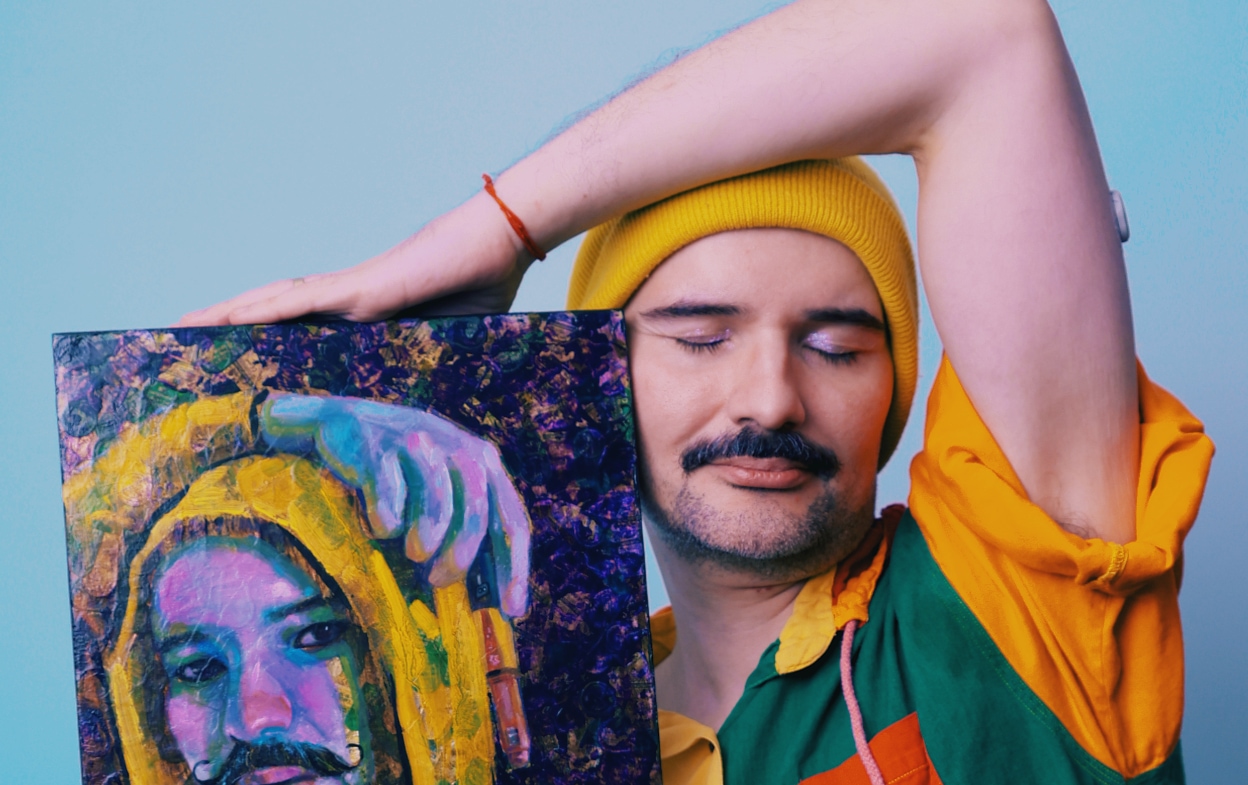
My figures begin with photographic montages of my own body, multiplied and altered through paint. The black contour line carries the narrative. It holds a body together while also admitting its changes.
That source material is not a claim that the painting is a document in a literal sense. Painting transforms its source. A figure in David, Compassion, Stone Woman, or Becoming is not evidence submitted for verification. It is a constructed presence. Still, provenance matters here because it keeps the work connected to the practice that produced it: Brazilian memory, queer self-authorship, figurative discipline, and the recurring question of how a body occupies space.
I learned through three years of Baroque training in São Paulo that representation is never merely resemblance. A painted body is a decision about weight, edge, color, and attention. I carry that training into a Toronto studio and into work that refuses a fixed border between private memory and public image.
The palette is specific. Raw umber, yellow ochre, burnt sienna, ivory black, buff titanium, titanium white, cadmium yellow, cadmium red, magenta, and ultramarine recur through the work. The red of pain is transparent alizarin crimson mixed with raw umber, never cadmium. These are material facts, but they also shape the emotional temperature of each painting.
A provenance record cannot contain all of that. No certificate can replace looking. Yet a record can ensure that the painting remains attached to its maker, its material language, and the conditions of its arrival in a collection.
What I provide from the studio
When an original is acquired directly from my studio, the transaction creates a clear beginning for its ownership history. I retain records of the work’s title, medium, and sale. Collectors should retain their invoice, studio correspondence, condition notes, and any exhibition materials associated with the painting. Photographs made at the time of acquisition are useful as well, particularly for works with layered, textured surfaces.
This is not bureaucracy for its own sake. It is care for an object intended to outlast the first transaction. If a work is later loaned, resold, gifted, or passed through an estate, those records reduce uncertainty for everyone involved.
Collectors should also be realistic about what provenance does not guarantee. It does not guarantee future market performance. It does not make a painting meaningful if the work itself does not hold your attention. It cannot replace condition, quality, or a sustained engagement with the artist’s practice. Buy the work because it continues to ask something of you, then preserve the facts that allow its history to remain intact.
My originals are priced by size through the studio, with prints available for selected works. Commission inquiries are open with a 50% non-refundable deposit and two revision rounds. For collectors following the ongoing arc of this work, join the email list for first access.
A painting should be chosen with the eye first. Then give it the history it deserves: a name, a record, and a clear path from the studio to the life you make around it.