Art certificates are documents that identify a work and connect it to its maker. They support the record around a painting, but they do not replace clear provenance, an invoice, or close looking.
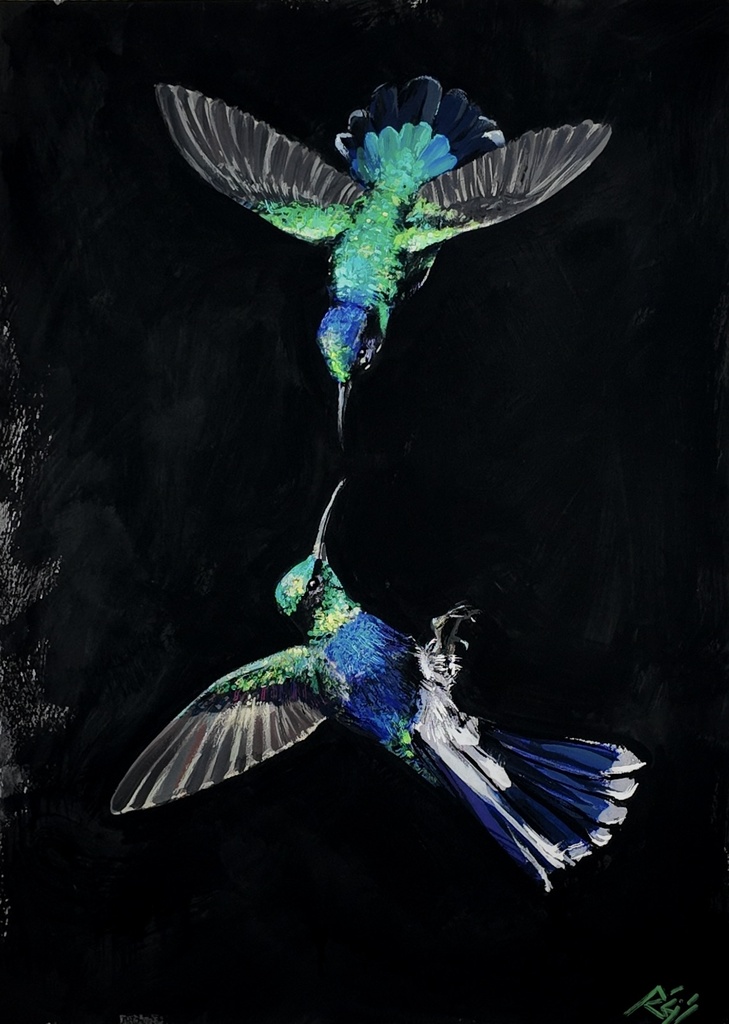
In Peacock Feathers, tropical birds hold their color against a black field. The black is not empty space. It presses the color forward and gives the image its temperature. A certificate should make that particular work legible beyond the first encounter: its title, its medium, its dimensions, its date, and the artist responsible for it.
For a collector, this is not paperwork after the fact. It is part of how an artwork remains identifiable as it moves from studio to home, collection, loan, resale, or estate. The best art certificates are plain, specific, and consistent with the work in front of you.
What art certificates actually establish
An art certificate, often called a certificate of authenticity, is a statement linking an artwork to an artist or authorized representative. It commonly records the title, year, medium, dimensions, signature details, and an inventory or certificate number where one exists. It may also include an image of the work.
Its value is documentary. A certificate says, in writing, what the work is understood to be at the time it is issued. It can make future conversations easier for galleries, insurers, curators, and heirs. It also helps distinguish an original painting from a print, study, or reproduction when images of the work circulate online.
But a certificate is not magic. It does not independently prove every prior owner, guarantee future market value, or settle a question that contradicts the painting itself. A document without a credible connection to the artist is weak. A credible studio record, invoice, exhibition history where applicable, and physical consistency between work and certificate are stronger together.
The paradox is simple: a certificate is only one sheet of paper, yet it asks the whole practice to be accountable. That is why precision matters.
What to check on an art certificate
Start by comparing the certificate to the painting, not just reading it in isolation. The title should match the title given by the artist or studio. Dimensions should state whether they are in inches or centimeters and should accurately reflect the work. If framing changes the outer measurement, that distinction should be clear.
Medium deserves the same attention. “Oil on canvas” and “mixed media and oil on panel” describe materially different objects. In my paintings, oil is always the final skin, but it is not always the only material present. I begin with a heavily textured gesso ground. Its ridges and drags determine how light behaves across the support. Then colored pencil, gouache, flat matte acrylic, marker, and gesso may enter in the order the work demands. Oil concludes the surface.
A certificate should not flatten that process into a vague phrase if the mixed-media structure is central to the work. At the same time, it should not turn a materials line into a technical performance. The useful description is the accurate one.
Look for the following details when they are relevant:
- Artist name and the full title of the artwork
- Date of completion, medium, and dimensions
- A clear statement that identifies the work as original or, for an edition, the edition number and total edition size
- Signature, date, studio mark, or other identifying information
- Certificate date and an inventory reference, if the studio uses one
- Contact information for the issuing artist or authorized studio
A photograph can be useful, especially for works with a complex surface or a title that may be confused with another piece. It should show enough of the image to identify the painting rather than function as decoration.
Original paintings, prints, and editions
Collectors should expect the language of art certificates to change according to the object. An original painting is a singular work. A print may reproduce that image but remains a different object with its own material, size, edition information, and signing practice.
This distinction matters when a painting is also available as a print. Hummingbirds, Ararinha Azul, and Tuiuiú are works whose tropical birds occupy black fields with distinct force and color. A print of one of these works can bring that image into a collection, but it should never be represented as the original painting. Its certificate or accompanying documentation should state the print medium, edition details if applicable, and dimensions of the print itself.
Do not treat an edition number as a hierarchy of quality. It is a factual designation. What matters is whether the work is described honestly and whether the documentation matches the object acquired.
Materials leave their own evidence
A certificate identifies a painting. The painting must still hold its own evidence.
My figurative works begin with photographic montages of my own body, multiplied and reorganized. The black contour line carries the narrative across the surface. In I’m Perfect, But Unreal, the title does not sit outside the image as an explanation. It enters the work through the tension between declaration and construction: body, line, color, and the pressure of the ground.
Material facts can help a collector recognize that construction. Oil paint follows fat-over-lean only during the oil phase. Beneath it, the earlier materials retain their own behavior. Colored pencil catches in the texture differently than gouache. Flat matte acrylic stays dry and direct. Gesso interrupts and revises. The finished oil surface gathers these decisions without erasing them.
Color carries evidence too. My palette includes raw umber, yellow ochre, burnt sienna, ivory black, buff titanium, titanium white, cadmium yellow, cadmium red, magenta, and ultramarine. The red associated with pain is transparent alizarin crimson mixed with raw umber, never cadmium. Chromatic grays structure backgrounds and skin.
These facts do not need to appear in full on every certificate. They belong to the larger studio record and to the painting itself. Still, collectors who understand the materials are better positioned to ask exact questions and notice careless descriptions.
Provenance is not the same as a certificate
Provenance is the documented history of ownership and movement. A certificate may begin that record, particularly when a work is acquired directly from the artist, but it is not the entire record.
Keep the invoice or receipt with the certificate. Retain correspondence related to the acquisition, shipping, framing, conservation, and exhibition. If a painting is later gifted, sold, or inherited, pass that documentation on with it. A clean record protects the work from becoming anonymous to its own future.
This is especially relevant for a practice that develops across bodies of work. Stone Woman, Compassion, David, and Becoming are not interchangeable titles. Each belongs to an ongoing inquiry into embodiment, desire, discipline, and self-authorship. The document should preserve that specificity rather than reduce the work to “figurative painting.”
For collectors acquiring directly from my Toronto studio, the same principle applies whether the work stays in Canada, travels to the United States, or is shipped farther away. Save the documentation in one place. Photograph the front and back before installation. If a question emerges years later, clarity begins with what was kept.
Questions worth asking before acquisition
Ask who issued the certificate and whether that person is the artist or authorized to speak for the artist. Ask whether the title, medium, and dimensions correspond exactly to the available work. If you are considering a print, ask how it is identified as a print and what edition information accompanies it.
For an original painting, ask whether there are any condition notes, prior exhibition details, or special handling considerations. This is not suspicion. It is care. Oil paintings have surfaces, edges, and textures that should be understood on their own terms, particularly when the ground is materially active.
Small works deserve the same attention as larger paintings. A work such as Kratos or Zeus may occupy less wall space, but its title, materials, and authorship should be recorded with equal accuracy. Scale changes the encounter. It does not reduce the work’s identity.
Art certificates are most useful when they remain close to the truth of the object: one work, made at a particular time, with particular materials, by a named artist. Keep the certificate with the invoice and let the painting remain the primary record. This piece is available when noted in the studio shop, and inquiries are open for original works, prints, and commissions.