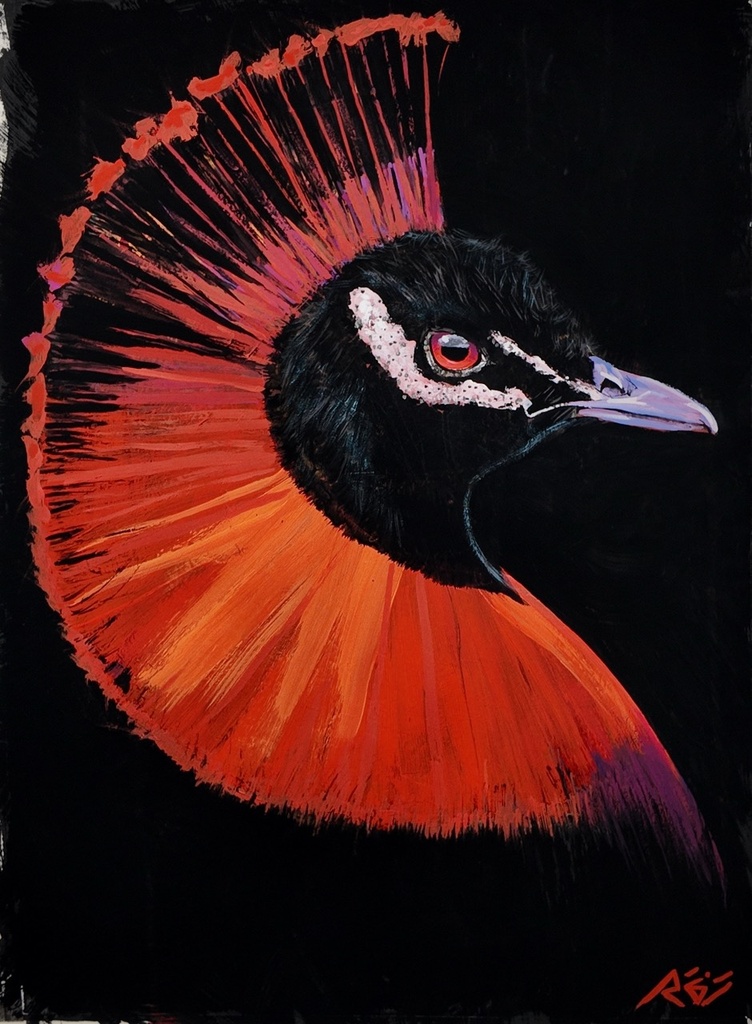
A ridge of gesso catches light differently at noon than it does after dusk. It holds a small shadow. It interrupts the gaze. That physical fact sits at the center of oil paintings versus art prints. The question is not simply which is better. It is what kind of encounter you want to live with.
An original oil painting carries the evidence of its making. A print carries an image into more rooms, more collections, and more forms of intimacy. Both can be serious acquisitions. Both can hold a figure, a history, a charge. They do not ask the same thing of a wall, a budget, or a collector.
Oil Paintings Versus Art Prints: The Material Difference
I begin a painting before the figure arrives. The ground is heavily textured gesso, dragged and built into ridges that determine how light will move across the whole surface. Texture is never background. It is biography.
Then come the layers, in the order the feeling demands: colored pencil for fine line, gouache, acrylic for flat matte passages, markers for graphic insistence, and gesso again as construction. Oil arrives last. It is the final surface, where the painting gathers its depth and pressure. Fat-over-lean governs that oil phase alone.
An original preserves this sequence as matter. Impasto occupies actual space. A scratched sgraffito line has cut through what came before it. Glazes have settled into an accumulated time. The painting changes as you move past it because light is meeting material, not merely describing it.
A print does not reproduce that physical relief. It translates the image of the work into another object with its own virtues: crispness, tonal consistency, scale, and reach. A strong print can preserve the architecture of black contour lines, the tension between a chromatic gray and a saturated field, or the interior glow of transparent alizarin crimson mixed with raw umber. It can bring the visual language of a painting into a home where an original may not be the right acquisition.
This is not a failure of the print. It is a different proposition. The print offers the image. The oil painting offers the image and the event of its construction.
What an Original Oil Painting Holds
An original is singular. There is one surface on which each decision occurred. The raw umber may have been covered, reopened, and allowed to remain at an edge. Buff titanium may sit beside titanium white as a white that is not white. Ivory black may pull a color back from certainty. These are not details added after the fact. They are the record of how the work arrived at itself.
For collectors, singularity has practical and emotional weight. An original often becomes the anchor of a room because it has physical authority. It asks for time. It can sustain repeated looking because its surface is not fixed by a single glance.
Scale matters here. A large original can establish a relation between the figure and the architecture around it. A smaller oil can be no less intense. In close proximity, a compact painting makes its marks feel private and exact. The right choice depends on whether you want the work to command a space or reveal itself gradually.
Original paintings also carry direct provenance from the studio. That relationship matters to collectors building a focused collection over time. You are not only acquiring an image. You are placing a specific chapter of an ongoing practice in your care.
That said, an original is not automatically the correct choice for every collector. It requires a larger financial commitment. It may require more intention around placement, framing, and shipping. Those considerations are part of collecting, not obstacles to be apologized for.
What an Art Print Can Do Brilliantly
A print creates access without reducing the work to decoration. When produced as an artist-authorized edition with careful attention to paper, color, and finish, it can be a considered object in its own right.
For an emerging collector, a print may be the first work that enters the collection. That first acquisition can become a lasting marker of taste and attention. For a more established collector, prints can create conversations across rooms, support a commitment to an artist's practice, or make it possible to live with a particular image at a scale that suits the space.
Prints are especially compelling when the composition depends on line, repetition, and graphic contrast. My figures begin as photographic montages of my own image, multiplied and reassembled. Black contours carry the narrative. In print, those contours can retain their force with remarkable clarity. The image travels while its insistence remains.
Edition information matters. Before acquiring a print, look for whether it is signed, numbered, and issued as an edition or an open release. Ask about the print medium, paper, image size, and framing recommendation. These are not minor specifications. They tell you how the work is intended to exist beyond the studio.
A print is also an intelligent way to collect with specificity. You may be drawn to one image because it names a particular tension in queer life, diasporic memory, or self-authorship. You do not need to wait until you can acquire the largest original to begin living with that connection.
Value Is Not One Thing
Collectors sometimes approach oil paintings and prints as if one contains value and the other contains compromise. That binary is too blunt for contemporary art.
An original painting has scarcity by definition. Its surface is unique, and that uniqueness often shapes demand, acquisition history, and long-term significance. A limited print edition has a different kind of scarcity. Its value rests in edition size, quality, condition, artist authorization, and the place the image holds within the larger practice.
The more useful question is not, “Which will increase most?” It is, “What am I choosing to keep company with?” A work should carry visual intelligence, formal conviction, and a perspective you want near you. Financial considerations belong in the conversation, but they should not flatten the encounter.
Look closely at the work's context. Is the image part of a continuing series? Does it extend an exhibition chapter? Does it reveal something essential about the artist's language? A print from a meaningful body of work can hold more than a decorative role. An original from that same arc may hold the full material force of its making. Each has a distinct place.
Choosing Between an Oil Painting and a Print
Start with the room, but do not stop there. Consider the light, the distance from which you will see the work, and whether you want surface to be an active presence. If the answer is yes, an oil painting may be the right direction. Its texture will keep changing as the day moves.
Then consider the image itself. If one composition has stayed with you, a print can be an exact and lasting way to bring it into your daily life. If you are building a collection around artists whose perspectives matter to you, editions can create a thoughtful foundation rather than a temporary substitute.
Consider your collecting rhythm as well. Some people acquire one original slowly and deliberately. Others begin with prints, learn what they return to, and later pursue a painting with sharper conviction. Neither route is more serious. A collection gains coherence through attention, not speed.
There is also room for both. An original can hold the center of a collection while prints extend its visual and political conversation into other spaces. The relationship can be especially powerful when the works belong to the same artistic world but speak at different volumes.
The Image and the Object
An image can carry desire, defiance, and memory. An object can carry the marks of their making. Oil painting gives you both at once: pigment, texture, revision, and figure held in one singular surface. A print offers another kind of closeness: the chance for an image to circulate with care and remain present in everyday life.
Choose the work that continues to ask something of you. Let the room make space for it. When a painting or print keeps returning your gaze, the acquisition has already begun.