Painted portraits versus photography is not a contest with one winner. Photography records an instant with precision; painting gives that instant a body, a surface, and a duration that changes as the viewer moves.
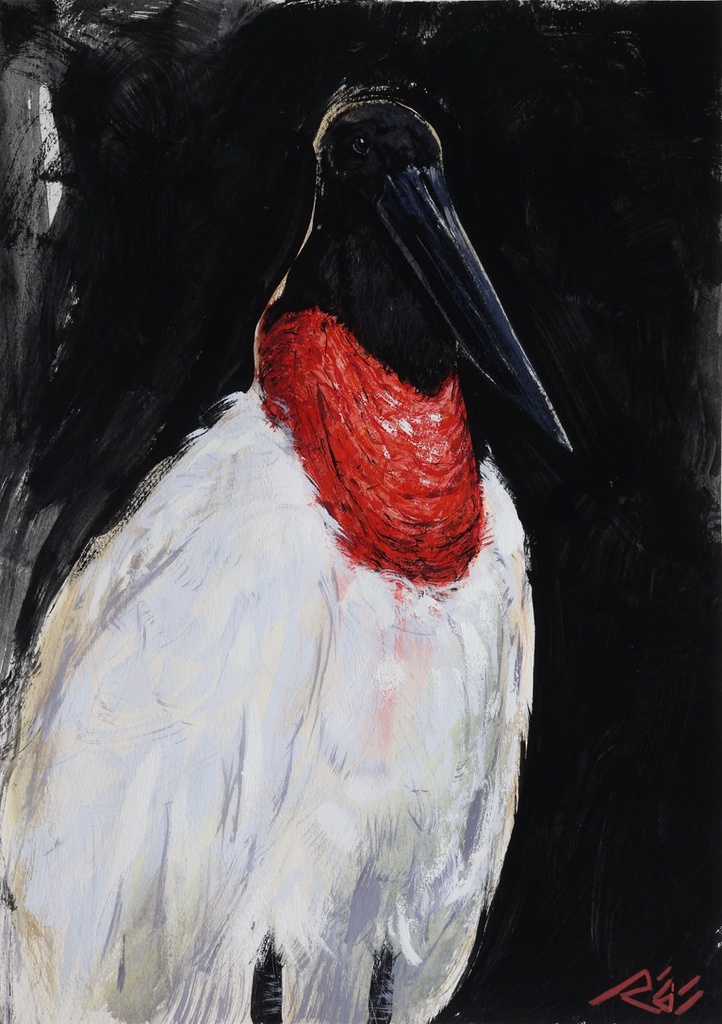
In Peacock Feathers, the bird’s plumage presses forward from a black field, each feather held against darkness rather than dissolved into it. That black is not empty. It is a decision about containment, a stage for color, and a way of making looking slow down. The painting does not ask the viewer to believe it is a photograph. It asks what a photograph becomes after it has passed through a hand, a material, and a life.
What Photography Can Give a Portrait
A photograph has an immediate authority. It catches an expression, an event, a particular arrangement of clothing, weather, posture, or proximity. It is often the clearest record of how someone appeared at a given moment. For family archives, editorial work, fashion, and documentary images, that clarity has its own force.
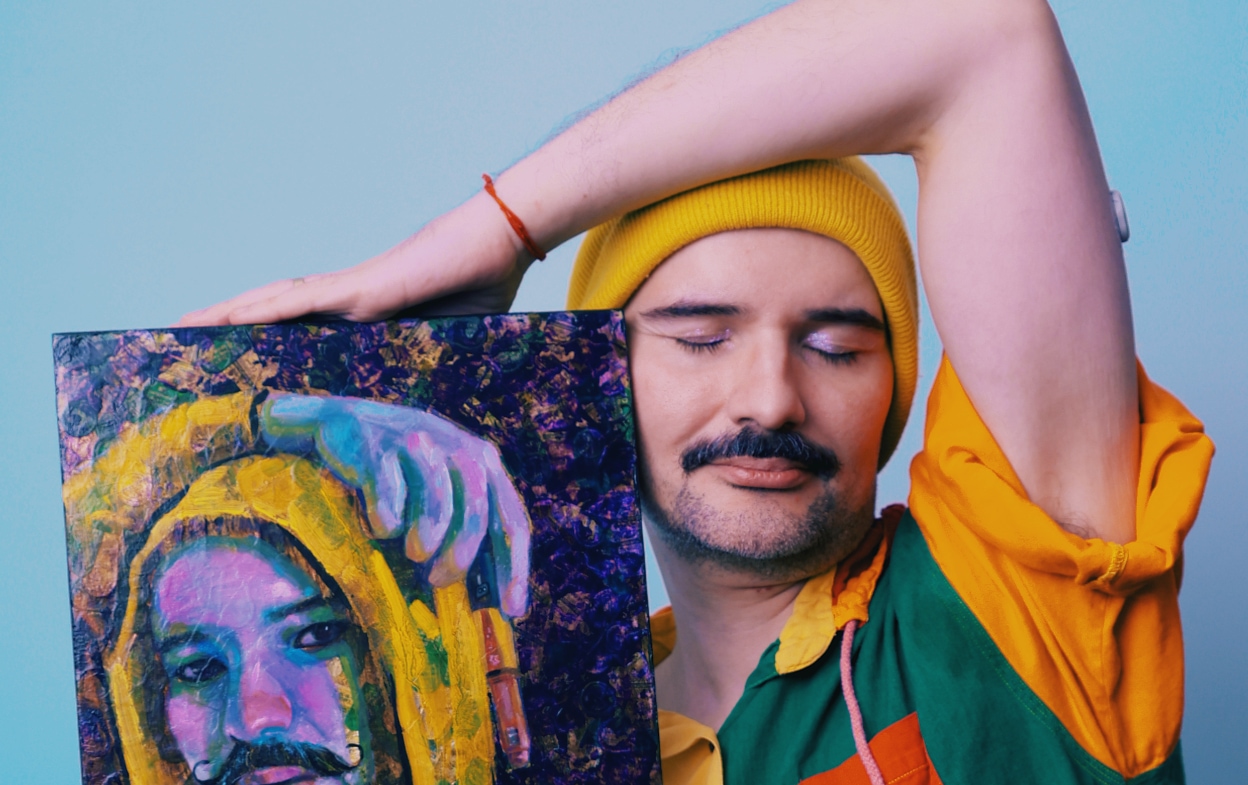
I work from photographic montages of my own body, multiplied and rearranged. The photograph is therefore present inside my paintings, but it is not their endpoint. It provides evidence: a shoulder turned, a hand held open, the architecture of a stance. From there, I decide what must remain and what must be altered.
That distinction matters for collectors. A photograph can preserve an encounter. A painted portrait can interpret one. Neither is more honest by default. They make different promises.
Photography can also offer scale through reproduction. An image can circulate quickly, be printed in editions, appear on screens, and live in multiple places at once. A painting resists that speed. Even when a print extends the image’s reach, the original keeps the accumulated decisions that reproduction can describe but not fully carry.
Painted Portraits Versus Photography in the Studio
The difference begins before the face is resolved. I start with a heavily textured gesso ground. Its ridges and drags determine how light will behave later, including in areas that may appear quiet from across a room. This is not a decorative prelude. It is the first structure of the image.
Then I work with colored pencil, gouache, flat matte acrylic, marker, and gesso again, in the order the work demands. Every painting ends in oil, its final skin. Fat-over-lean governs the oil phase only. The sequence matters because each material carries a different resistance: pencil can insist on a line, gouache can flatten a passage, marker can make a contour refuse softness, and oil can hold color with density and delay.
A camera receives light in an instant. Paint lets me build the conditions under which light is perceived. That is not a rejection of photography. It is a different form of attention.
In my work, the black contour line carries the narrative. It separates and joins at once. A figure can look contained by the line, yet the line can also become the route through which the figure exceeds containment. The body is singular in the source image and plural in the painted field. Painting fixes the image, then keeps it moving.
Material Changes the Meaning of a Face
A portrait is never only a likeness. It is a set of choices about what deserves emphasis: the gaze, the mouth, the tension in a wrist, the pressure of a background color, the space around a body. Photography makes such choices too, through framing, exposure, timing, focus, and editing. Painting makes them visible over time because the decisions remain embedded in the surface.
My palette is direct but not simple: raw umber, yellow ochre, burnt sienna, ivory black, buff titanium, titanium white, cadmium yellow, cadmium red, magenta, and ultramarine. I use chromatic grays in backgrounds and skin because neutral-looking passages are rarely neutral. They hold other colors in suspension.
The red of pain in my paintings is transparent alizarin crimson mixed with raw umber, never cadmium. Cadmium red has a different insistence. Alizarin crimson and raw umber allow the red to sit deeper in the image, closer to stain than announcement. That decision cannot be separated from the subject. Color is not applied after meaning. It is where meaning begins to take form.
A painted face may look less literal than a photograph, yet feel more specific because it has been edited through material. This is the paradox I return to: a painting can depart from appearance in order to stay closer to presence.
When a Photograph Is the Better Choice
There are situations when photography is exactly right. If the purpose is to preserve a precise event, show a rapidly changing subject, or create many identical copies, photography answers that need efficiently and beautifully. A strong photograph can hold intimacy without needing translation into another medium.
Painting becomes the better choice when the buyer wants interpretation to be part of the object. An original painting occupies a room differently from an image on a screen or a photographic print. Its scale, edge, texture, and changing response to daylight are active parts of the experience. The work keeps giving information as the viewer returns to it.
For a collector, the question is less “Which medium is superior?” and more “What relationship do I want with this image?” A photograph may be the record one wants to keep close. A painting may be the object one wants to live with, argue with, and see change across years.
The Portrait as Self-Authorship
My figures come from my own body, but they are not private diary entries made public. They are constructed presences. The multiplication of a body allows desire, discipline, contradiction, and queer resilience to become visible without reducing the figure to a single biography.
Brazil is present in this work as cultural memory, not scenery. It arrives through names, colors, and the pressure of images carried across distance. Ararinha Azul and Tuiuiú belong to that continuing arc. Their birds are not illustrations of origin. They are forms of attention, held against black fields where color must declare itself.
The same tension appears in human figures such as Stone Woman, Compassion, David, and Becoming. A body can be monumental without becoming fixed. It can be vulnerable without becoming passive. The painted contour is where I test that balance.
Choosing an Original Painted Portrait
An original portrait should be chosen with time, not as a substitute for a photograph but as its own encounter. Look closely at the surface. Notice where a matte acrylic area meets oil, where a pencil trace remains visible, where a black line interrupts a field of chromatic gray. Those decisions are not background details. They are the painting’s way of thinking.
For collectors drawn to a more concentrated scale, small works such as Kratos and Zeus offer that encounter without requiring a large wall. For a more theatrical color field, Hummingbirds and I’m Perfect, But Unreal extend the conversation between image, ornament, and self-invention. Originals are priced by size in my shop, and prints make selected images available in another form.
Commission inquiries are open for collectors who want a portrait shaped through this process. I begin with a 50 percent non-refundable deposit and include two revision rounds, so the commission has a clear structure while the painting remains a living act of interpretation. Join the collector list for first access to new work.
The right portrait is not the one that proves most faithfully what was there. It is the one that continues to ask you to look.