Original artwork versus limited prints is a choice between the singular object and a more accessible edition of its image. Neither is a lesser way to collect, but each gives you a different relationship to the work.
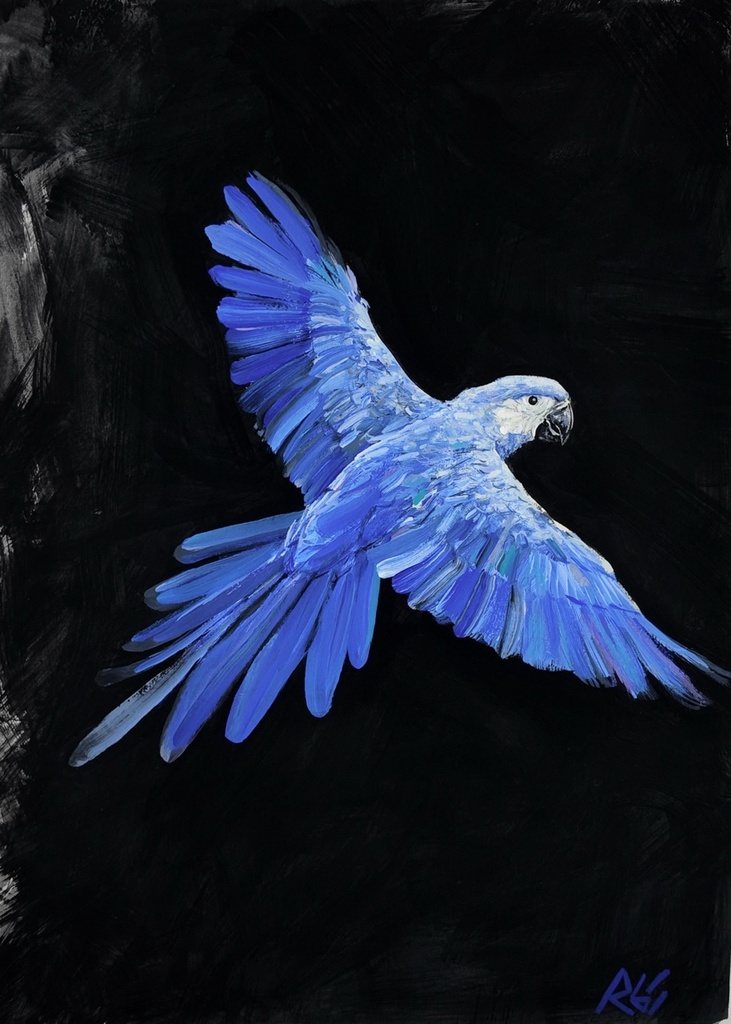
In Hummingbirds, tropical birds hold their color against a black field. The painting is available as an original and as a print, yet the original contains the actual decisions that made the image: the pressure of a pencil mark, the interruption of marker, the final oil skin over a worked surface. The print carries the image forward. The painting carries its history.
Original Artwork Versus Limited Prints: The Material Difference
An original is the one object I made in the studio. It has a particular scale, a physical edge, and a surface that cannot be duplicated by reproduction. I begin with heavily textured gesso, building ridges and drags that decide how light behaves before a figure or bird is fully present. That ground is not preparation in the background. It directs the painting.
Then the work moves as it needs to move: colored pencil, gouache, flat matte acrylic, marker, and gesso again. Every painting ends in oil. Fat-over-lean governs the oil phase, not the entire process. The final layer does not erase what came before it. It seals the sequence while allowing earlier marks to remain active.
This is where an original holds something a print cannot fully translate. A chromatic gray may sit quietly in a background, but on the painting it changes as you move past it. Buff titanium can interrupt titanium white. Raw umber can make an edge recede. A transparent red made from alizarin crimson and raw umber carries a different density from cadmium red, which I do not use for pain. These are material facts, not effects added afterward.
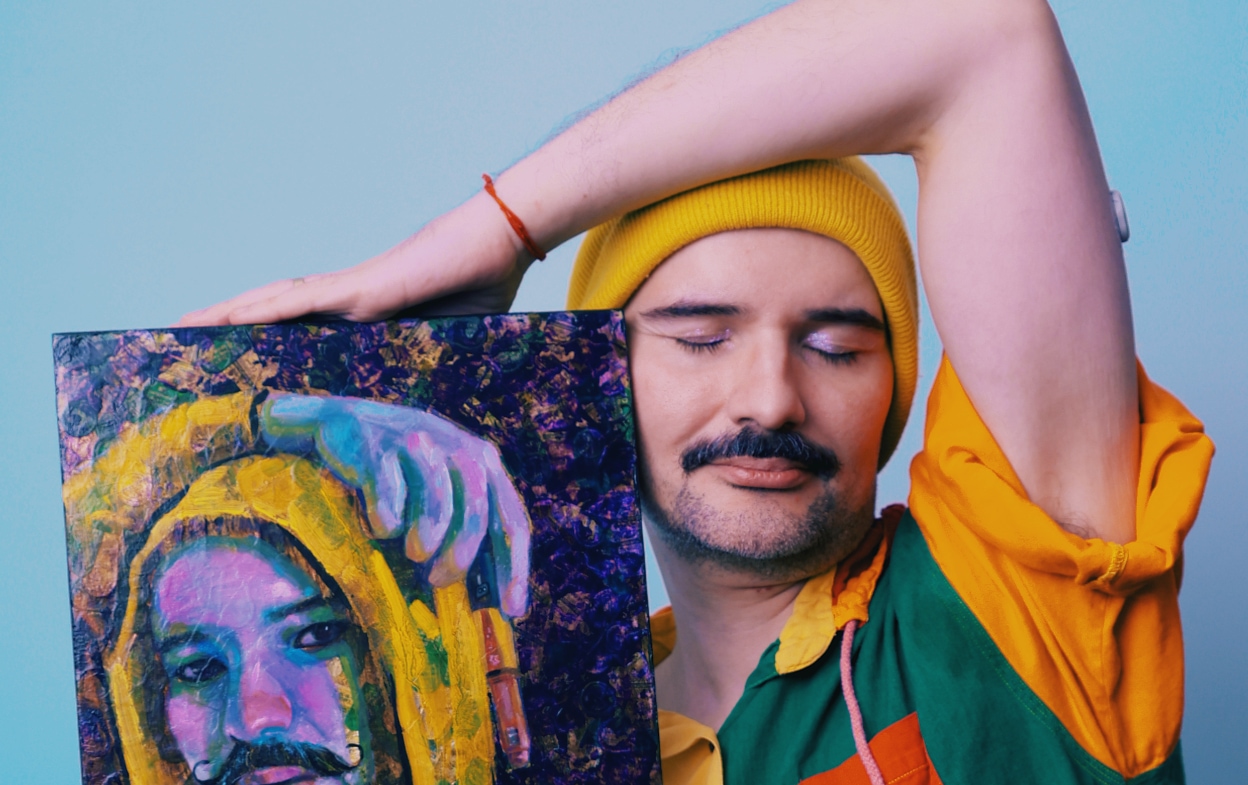
The paradox is simple: an original is singular, yet it contains many selves. My figures begin as photographic montages of my own body, multiplied and reorganized. The black contour line carries their narrative across the surface. In the original, that line has a pace. It tightens, breaks, and returns.
A limited print gives access to the composition, color structure, and pictorial force of the work without requiring ownership of the one painted object. It is not a substitute for a painting. It is another way of living with its image.
What You Collect When You Choose an Original
Collectors often choose an original because they want direct contact with the studio process. That can mean a major work such as I’m Perfect, But Unreal, or a smaller painting such as Kratos or Zeus. Scale affects the encounter, but it does not determine intensity. A small work can make its own demand on a room through a compressed line, a particular color, or the nearness of a face.
An original also has the authority of its unrepeatable surface. No second version will have the same gesso drag, the same point where gouache meets oil, or the same accumulation of revisions. For a collector building a focused collection, that singularity matters. The work becomes an object with its own record of decisions, held in the home, collection, or institutional context where it will continue to be seen.
Original paintings are priced by size in my shop. That structure makes the choice clearer: you can begin with a smaller work or pursue a larger canvas when scale and placement are central to the acquisition. The question is not whether a large work is inherently more serious. It is whether the physical encounter belongs to what you want to collect.
Works such as Stone Woman, Compassion, David, and Becoming belong to a continuing inquiry into body, desire, discipline, and self-authorship. Their subjects are not illustrations of a fixed identity. They are bodies in negotiation. In an original, the surface carries that negotiation literally.
When the original is the right decision
Choose an original when the object itself is essential to you: its texture, scale, layered medium, and singular presence. It is also the stronger choice when you are responding to one specific work and do not want a version of it. You are acquiring the painting, not simply its image.
For design-conscious collectors, an original can also establish the visual center of a room. A black ground does not behave like a neutral backdrop when it is built through paint. A contour line is not simply graphic when it moves across an actual surface. These distinctions become clear over time, not only at first viewing.
What a Limited Print Can Offer
A limited print is often the practical entry point into an artist’s world. It can bring an image into your collection at a different budget and scale, while preserving the compositional language that drew you to the work. For a new collector, that may be the beginning of a longer relationship with the practice.
This matters when a painting’s image speaks immediately but the original is outside your present plans. A print can place that image in daily view without pretending to be the original object. It can also sit alongside other works with precision, especially where wall space calls for a smaller format or a grouped installation.
Before acquiring any limited print, look closely at the edition information, dimensions, paper or production details, and the distinction between the print and the original. These details establish what is being offered. A limited edition has its own collectibility, but its value is different from the unique painted work from which the image comes.
For me, prints extend access to paintings without flattening their material lives. The tropical birds of Ararinha Azul, Tuiuiú, and Peacock Feathers can travel beyond the one canvas. Their black fields, saturated color, and Brazilian memory can enter more homes. The original remains a complete material event. The print allows the image to have another public life.
When a limited print is the right decision
Choose a limited print when you are led first by the image, when your available wall space favors the print format, or when you want to begin collecting my work with a clear and considered acquisition. It can be the right choice for an apartment, an office, a gift, or a collection that is growing deliberately rather than quickly.
A print can also be a strong decision for collectors who already own an original and want to live with another work from the same visual language. Collecting is not only about scarcity. It is about attention, return, and the images you choose to keep near you.
How I Would Make the Choice
Start with what you are responding to. If you are moved by the physical evidence of paint, the shifting behavior of a surface, and the knowledge that no other object has that exact sequence of marks, choose the original. If the image, its figures, and its place in your life are the priority, a limited print may be the more exact acquisition.
Do not treat the decision as a test of seriousness. Collecting can begin with a print and grow toward an original. It can begin with a small original and remain devoted to intimate scale. The useful question is more specific: what do you want to encounter every day - the unique body of the painting, or the image it releases into the world?
My available originals include Hummingbirds, Ararinha Azul, Tuiuiú, Peacock Feathers, and I’m Perfect, But Unreal, alongside smaller works. Prints of the same works are also available. For a portrait commission, inquiries are open; commissions begin with a 50% non-refundable deposit and include two revision rounds.
A collection becomes personal through the choices it preserves. Join the collector list for first access when the next work in this ongoing chapter arrives.