Oil paintings versus digital art are not competing answers to the same question. They are different conditions for an image: one remains editable as light, one fixes its decisions in matter.
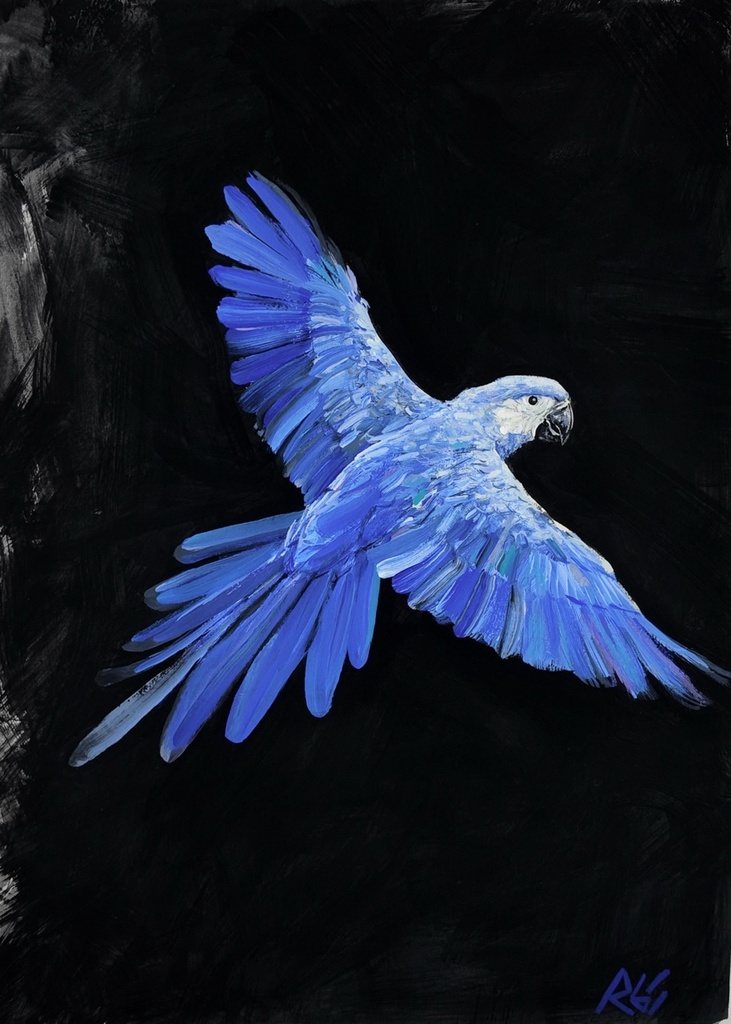
In Hummingbirds, small tropical birds hold themselves against a black field. That black is not an empty backdrop. It presses forward around the birds, making the image feel contained and alert. The piece is available as an original and as a print, but those two forms do not offer the same encounter.
Oil Paintings Versus Digital Art: Where the Difference Lives
Digital work begins with a screen's light. It can be revised without a visible record of revision, multiplied without loss of image quality, and carried across formats quickly. I use it where it is exact: in photographic montage, composition, video, and the shifting architecture of an image before it enters the studio.
Oil painting begins with resistance. The support has weight. A mark can be covered, but it does not disappear from the history of the surface. Drying time changes the pace of thought. Viscosity changes the line. The painting asks me to accept that each decision has a body.
This is not a claim that one medium is more serious than the other. Digital work can be intimate, rigorous, and formally demanding. Oil can be decorative, careless, or empty. The difference is not virtue. It is consequence.
A digital image can preserve a version. An oil painting preserves an event. That event includes the ground, the pressure of my hand, the sequence of materials, and the slow arrival of the final skin. The paradox is simple: oil painting is fixed, yet it keeps changing as a viewer moves before it. The surface does not move. The light does.
For collectors, this distinction has practical force. A digital file, a print, and an original painting may share an image, but they have different material identities. A print carries the composition into another scale of access. The original carries the accumulated decisions that produced it.
The Surface Decides Before the Image Does
My paintings do not begin with oil. They begin with a heavily textured gesso ground. I build ridges and drags into the support because those marks decide how light will behave later. The material leads before the body enters. A smooth field and a resistant field cannot ask the same thing of a figure.
Then I work across colored pencil, gouache, flat matte acrylic, marker, and gesso again, in the order the work demands. There is no fixed recipe beyond attention. A painting may need a dry pencil line to hold an edge, a matte acrylic plane to interrupt reflection, or another layer of gesso to refuse an earlier decision.
Every painting ends in oil. Oil is the final skin, not the first layer. This matters technically. Fat-over-lean governs only the oil phase, after the earlier materials have established the painting's structure. I do not use oil terminology as ornament. A glaze has a job. Impasto has a job. Each affects depth, reflection, and the distance between a viewer and the support.
In Peacock Feathers, color has to remain active against black without becoming merely decorative. In Ararinha Azul and Tuiuiú, the birds are not illustrations detached from their surroundings. Their presence depends on the pressure of the field around them. The black contour line carries the narrative. It separates forms, but it also connects them.
Digital art can simulate texture persuasively. It can model grain, shadow, brushwork, and depth with extraordinary control. Yet simulation and surface are not identical. In an original oil painting, the cast shadow of a raised passage belongs to the object itself. It changes with the room, the hour, and the position of the viewer. That is not an argument against digital work. It is an argument for naming what an original physically is.
The Body Has Different Stakes in Each Medium
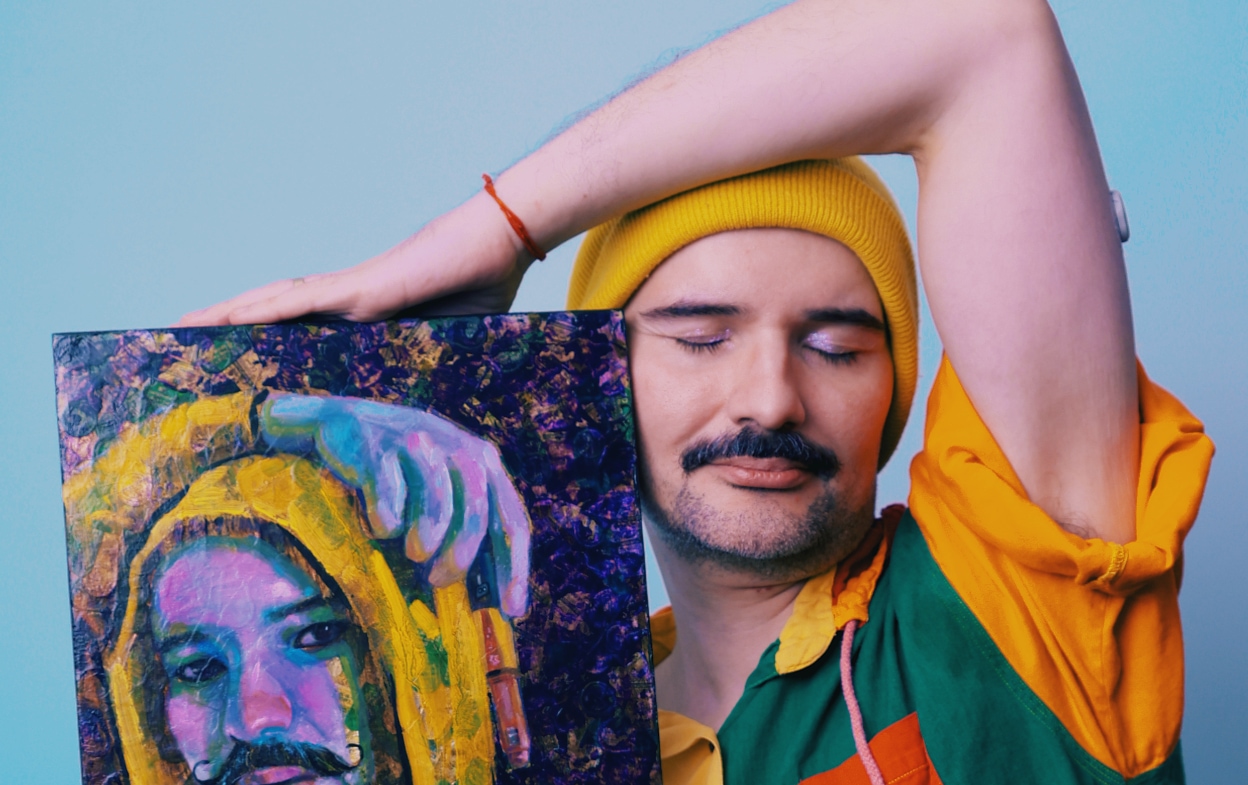
My figures come from photographic montages of my own body, multiplied and rearranged. Digital processes allow me to construct those images with precision. A hand can repeat. A torso can divide across a composition. A pose can become a structure rather than a single portrait.
But the painting alters that source material. A photographic montage can be adjusted until it feels resolved on screen. On canvas, the body has to negotiate the textured ground, the contour line, and the interruptions of each material. It becomes less like an image transferred from one place to another and more like an argument made in layers.
Works such as I'm Perfect, But Unreal, Stone Woman, Compassion, David, and Becoming belong to this continuing arc. They consider self-authorship, desire, discipline, and queer resilience without reducing the figure to an emblem. The body is specific before it becomes symbolic.
Brazil remains present in this work as memory and visual language, not as a decorative shorthand. My Baroque training in São Paulo taught me to look closely at weight, shadow, and staged intensity. The word corpo matters here because it names more than anatomy. It names a body in relation: to history, family, public space, and its own chosen form.
Digital construction can make multiplication immediate. Painting makes multiplication material. When the same body appears more than once, each passage of paint must still be made separately. Repetition becomes labor. Labor becomes visible.
What Collectors Are Actually Choosing
The question is rarely whether an oil painting is better than digital art. It is whether a buyer wants the original object, the editioned image, or both. Each can be a meaningful acquisition when its terms are clear.
An original painting has singularity. It contains the physical record of its making, including textures and marks that cannot be fully translated into reproduction. This makes it especially suited to collectors who want an artwork to operate as an object in a room, not only as an image they recognize.
A print offers another relationship. It makes a work available at a different scale of collecting while retaining the composition, color structure, and visual charge of the original. It is not a lesser original. It is a different work in a different form.
Small originals such as Kratos and Zeus offer another kind of proximity. Their scale asks for close looking. Large paintings command space differently, but size alone does not determine intensity. The right work depends on the wall, the collection, and the kind of attention a buyer wants to give it.
I price original works by size, and I make prints of the same works available through my studio. For commissions, I work with a 50% non-refundable deposit and two rounds of revisions. That structure protects the commission as a serious exchange rather than an open-ended exercise in alteration.
An Image Is Not Finished When It Is Shared
Screens have changed how paintings circulate. A collector may first encounter a work as a thumbnail, a detail, or a photograph viewed late at night. Digital presentation is not secondary to contemporary painting. It is part of how painting enters public life.
Still, the screen should not flatten the object it presents. A photograph of Hummingbirds can carry its black field, its color, and its composition. It cannot deliver the exact drag of gesso beneath the final oil layer, or the way the surface holds light at an angle.
That remaining distance is productive. It gives the original work something to reveal over time. If one of these paintings belongs in your collection, inquiries are open. Join the collector list for first access to new work, exhibition news, and available originals.