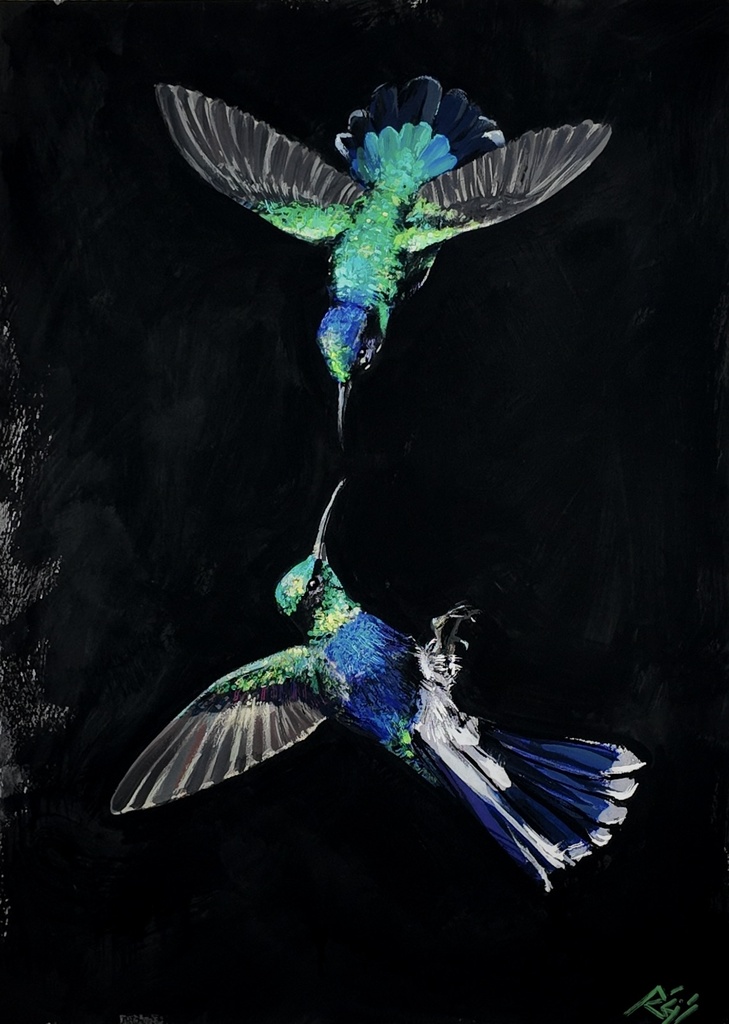
Hummingbirds painting analysis begins with a refusal to treat the bird as decoration. In my painting Hummingbirds, the birds establish a field of attention: alert, precise, and difficult to possess.
The work places tropical bird forms against black. That contrast is its first physical fact. The color does not describe a distant landscape or offer nature as ornament. It presses the birds forward, making each shift of hue, contour, and spacing accountable. I want the painting to be looked at slowly, because its surface is not a backdrop for an image. It is where the image has to earn its presence.
Hummingbirds Painting Analysis: Matter Before Symbol
I begin every painting with a heavily textured gesso ground. The ridges and drags are made before the final image is settled. They decide how light will behave later, and they give the painting a physical resistance that cannot be replaced by a smooth support.
In Hummingbirds, the black field holds that resistance close. Black can appear absolute from across a room, but it becomes more particular at viewing distance. It is a worked space, affected by the ground beneath it and by the neighboring colors. The birds do not float in a neutral void. They meet a surface that has weight.
The black field is not empty. It is crowded with refusal.
That refusal matters because tropical imagery is often expected to perform immediate pleasure. I am interested in another condition: color that carries appetite, discipline, and distance at once. The painting does not make a claim for Brazil as scenery. It holds Brazilian visual memory as something lived through, carried forward, and revised from elsewhere.
My palette is specific. Raw umber, yellow ochre, burnt sienna, ivory black, buff titanium, titanium white, cadmium yellow, cadmium red, magenta, and ultramarine each have a different job. Chromatic grays prevent the black ground from becoming dead or merely graphic. They also keep bright color from becoming an easy answer.
The result depends on proximity. From farther away, the work reads as a sharp encounter between birds and darkness. Closer in, the material decisions interrupt that first reading. The viewer finds layered marks, shifts in opacity, and a surface that will not behave like a printed image.
Color Is Not a Tropical Shortcut
Hummingbirds are often associated with speed, radiance, and lightness. Those associations are available to me, but I do not accept them without pressure. The bird can signal beauty. It can also signal vigilance. Its scale makes that tension more pointed: a small form can command an entire field when its color is exact.
Cadmium yellow and cadmium red bring a dense, direct force. Magenta and ultramarine can move toward a different kind of intensity, one that changes according to the colors placed beside them. Yellow ochre and raw umber pull the image back toward earth. I use these relationships to prevent the picture from settling into a single mood.
That is why the black ground is necessary. It does not simply dramatize the birds. It tests them. Saturated color has to survive against it, and every small decision becomes visible. A bird form with an imprecise edge or an unresolved color would collapse immediately against such a field.
This is also where the painting belongs to a continuing body of work. Ararinha Azul, Tuiuiú, and Peacock Feathers share the confrontation of tropical birds and black fields, but they do not repeat one another. Each species brings a different silhouette, pace, and cultural charge. In Hummingbirds, the compressed energy of the birds changes the scale of looking. The painting asks the eye to move quickly, then asks it to stay.
The Surface Determines the Image
My process does not follow a fixed recipe after the gesso ground. I work with colored pencil, gouache, flat matte acrylic, marker, and gesso again, in the order the work demands. A passage may need the dry drag of pencil. Another may require gouache to alter the density of color, or marker to establish a line that cannot be softened into atmosphere.
Then oil arrives as the final skin. Oil is not the beginning of the painting for me. It is the last material layer, where previous marks are preserved, partially covered, or made to push through. Fat-over-lean governs only this oil phase. It is a technical rule with practical consequences, not a decorative phrase.
The difference between matte passages and the final oil surface is central to how I build presence. Matte acrylic can stop light. Oil can hold it differently, allowing color to deepen without making the entire work uniformly glossy. These contrasts let the painting remain active under changing conditions of viewing.
A collector may first meet Hummingbirds as a vivid image, especially from a distance. Living with an original offers another experience. The physical ground, the shifts between materials, and the final oil skin continue to alter the work as daylight changes and as the viewer moves. A print carries the composition and color relationship; the original carries the full record of contact.
Contour, Multiplicity, and the Body
Across my figurative paintings, the black contour line carries narrative. The figures are photographic montages of my own body, multiplied through the image. That method gives the body a concrete source while refusing the idea that identity is singular, settled, or easily read.
Hummingbirds approaches this concern indirectly. There is no need for a human figure to make embodiment present. The bird forms are not substitutes for a body, but their movement sharpens questions that recur throughout my work: who is visible, who is watched, and what kinds of presence are allowed to occupy a field without explanation?
In works such as I’m Perfect, But Unreal, Stone Woman, Compassion, David, and Becoming, the body takes a more explicit role. The line can divide, repeat, or bind a figure to its surroundings. In Hummingbirds, that same discipline of contour is redirected toward birds. It makes them less illustrative and more insistent.
Queer resilience, painted, does not require a single emblem. Sometimes it appears as a body that multiplies itself. Sometimes it appears as a bright, small form that refuses to disappear into black.
A Painting for Sustained Looking
The work asks for more than an immediate reading of bird imagery. It holds color, diasporic memory, and self-authorship in the same frame, but none of those themes comes before the material fact of the painting. The ground is first. The body, whether shown or implied, follows. Meaning gathers through those decisions rather than arriving as an illustration placed on top.
For collectors and curators, that sequence is part of what makes the work durable. Hummingbirds can hold a room through contrast and color, yet it does not exhaust itself at first glance. Its black field remains active. Its birds remain specific. The surface keeps its record.
Hummingbirds is available as an original, with prints of the work also available. Originals are priced by size in my studio shop, and inquiries are open for collectors seeking a work from this continuing chapter. Join the collector list for first access to new paintings, exhibition news, and available works.
A hummingbird is often seen only in passing. This painting asks for the opposite: stay long enough to see what the darkness has made visible.