How artists finish oil paintings is less about a final coat than a final decision: the oil layer must make every earlier mark legible. I finish when the black contour has its pressure, the chromatic grays have their temperature, and the body can no longer be reduced to an image.
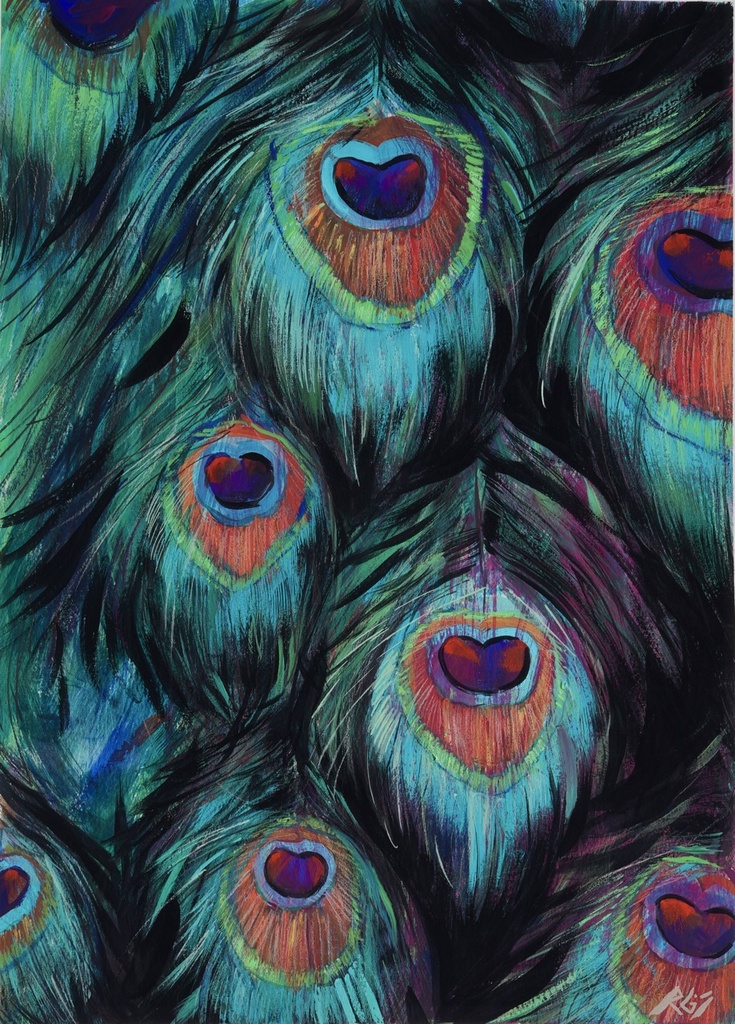
In Peacock Feathers, the feathers press against a black field that does not behave as empty space. It holds color back, then gives it force. The final oil layer had to preserve that refusal: bright passages could not become decorative, and darkness could not become a backdrop. The painting is available through my studio.
A finished painting should not look polished into obedience. It should look resolved enough to keep resisting the eye.
How artists finish oil paintings: the oil is the final skin
My paintings begin before oil. I build a heavily textured gesso ground first, making ridges and drags that decide how light will behave across the surface. That ground is not preparation in the passive sense. It is the first argument of the work.
From there, the image moves through colored pencil, gouache, flat matte acrylic, marker, and gesso again, in the order the painting demands. Sometimes a dry colored-pencil line needs to remain visible beneath paint. Sometimes gouache establishes a flatness that oil must later interrupt. Sometimes marker gives a contour its first speed, only for gesso to obscure it and make me find it again.
Every painting ends in oil. Oil is the final skin, not the whole history of the surface. That distinction matters. A viewer may see the confidence of an oil passage, but beneath it are revisions, abrasions, blunt matte areas, and lines that have survived because they had something necessary to say.
The finish is therefore not a cosmetic event. It is where I decide what remains exposed. The earlier materials are not mistakes to hide. They are evidence of the painting thinking through its own body.
Fat over lean applies only when oil begins
Artists often hear fat-over-lean presented as a rule for an entire painting. In my practice, it governs the oil phase only. The layers before oil are mixed media: gesso, pencil, gouache, acrylic, and marker each carry their own material behavior. I do not pretend they are all oil painting simply because oil arrives at the end.
Once I begin working in oil, the principle is direct. Leaner passages come before fatter ones, allowing the final layers to remain flexible over what sits beneath them. This is not an ornamental bit of studio language. It affects whether a passage has the physical stability to hold its place over time.
But technical correctness alone does not finish a painting. A perfectly sound layer can still be dead. It can cover too much, soften a needed edge, or make the figure too easily available. I stop when the oil carries enough weight without sealing off the friction that made the painting necessary.
A protective varnish, when appropriate, belongs to a different decision. It can unify surface sheen and offer protection, but it cannot resolve an unresolved painting. The image must already stand on its own before any final protective layer is considered.
The contour tells me where to stop
The black contour line carries the narrative in my work. It is not merely an outline around a figure. It can divide one body from another, create a barrier, or turn a shoulder, hand, or face into a site of insistence.
My figures begin as photographic montages of my own body, multiplied and rearranged. The source is personal, but the final image is not a self-portrait in the simple sense. A body can repeat without becoming the same body. That is where the painting opens.
When I finish in oil, I look closely at what the contour is doing after color has arrived. If the line disappears everywhere, the painting loses its syntax. If it is equally heavy everywhere, it becomes a cage. The final layer often asks for restraint: an edge reinforced here, a contour allowed to break there, a translucent veil of oil placed beside the line rather than over it.
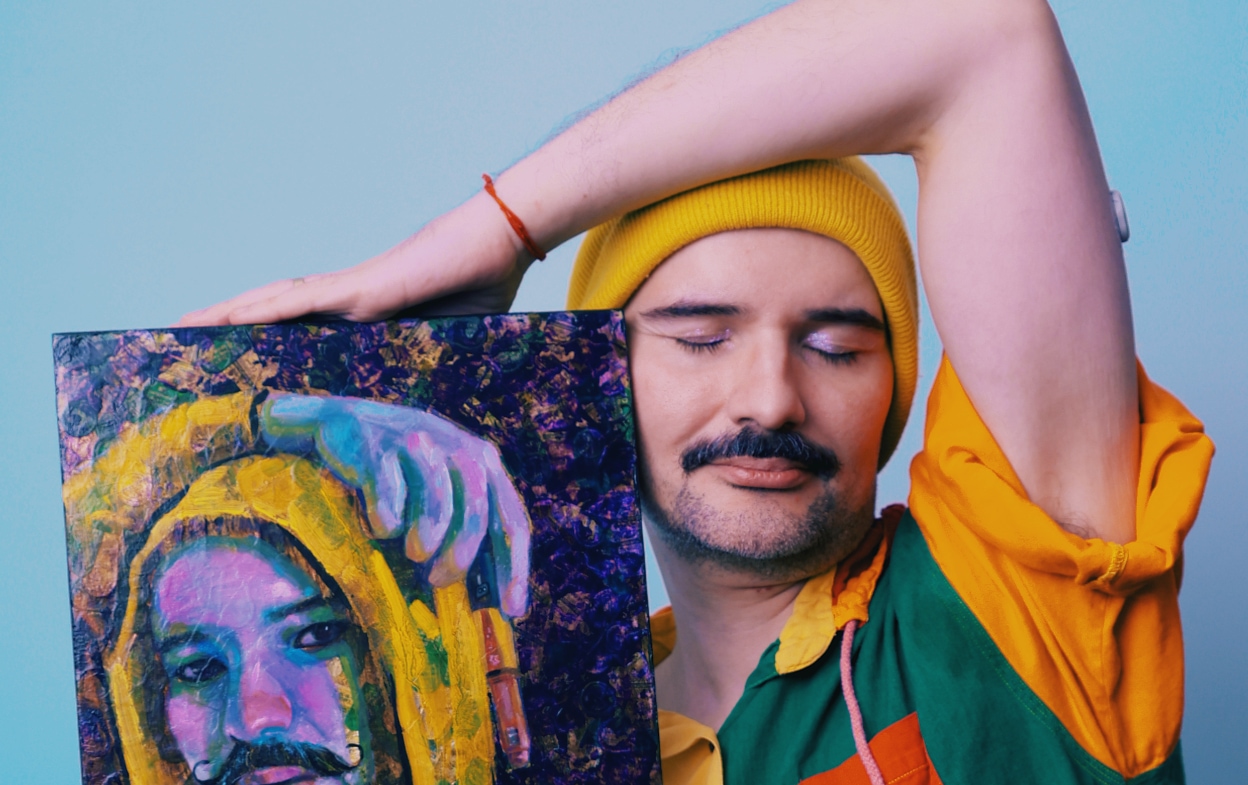
In I’m Perfect, But Unreal, that tension is central. The title makes a claim and immediately unsettles it. The finished surface cannot simply illustrate perfection. It has to let the figure remain composed while making the construction visible. The work is available through my studio.
Color has to retain its history
My palette is specific: raw umber, yellow ochre, burnt sienna, ivory black, buff titanium, titanium white, cadmium yellow, cadmium red, magenta, and ultramarine. These colors do not arrive as a fixed recipe. They are adjusted according to the ground, the figure, and what the painting has already made possible.
Chromatic grays are essential in backgrounds and skin. Gray is not an absence of color. It is color under pressure. A gray built from competing hues can make a brighter passage feel sharper without adding more brightness to the entire canvas.
The red of pain is transparent alizarin crimson mixed with raw umber, never cadmium. Cadmium red has a different authority. It declares itself quickly. Alizarin crimson with raw umber can enter the image more quietly, with depth rather than announcement. That red needs to remain transparent enough for the layers beneath it to continue speaking.
This is one of the reasons an oil painting can take longer to finish than expected. The last layer is not always an added detail. Sometimes it is a correction in temperature. A small adjustment to a gray beside a face can change the entire emotional register of the figure. A restrained darkening around a hand can return its force without making it theatrical.
Finishing means refusing the easy answer
There is a point when a painting asks to be left alone, and another when it is merely asking to avoid difficulty. Those moments can look similar. I separate them by returning to the material facts of the work.
Does the textured ground still activate the image, or has oil flattened its decisions? Does the black contour move the eye with intention? Do the skin tones contain enough chromatic variation to remain alive? Has a passage of white clarified the figure, or simply made it louder? These are studio questions, but they are also questions of meaning.
In Stone Woman, Compassion, David, and Becoming, the bodies do not arrive as closed symbols. They carry accumulation. The completion of each painting is part of the same ongoing arc: queer resilience, diasporic memory, desire, discipline, and self-authorship made physical through paint. The work does not begin with a message waiting for illustration. The message is discovered in the surface, after the surface has resisted me.
That is the paradox I return to: I finish a painting by preserving what cannot be fully finished. The final oil layer gives the work its authority, but it must leave enough open for the viewer to remain inside it.
What collectors can see in a finished surface
A finished oil painting rewards close looking. From across a room, the figure may hold as one clear image. At a nearer distance, the surface reveals its changes of pace: a matte interruption under oil, a pencil trace, a dense black contour, a thin transparent red, or a rough gesso ridge allowed to remain present.
This is especially true in works such as Hummingbirds, Ararinha Azul, and Tuiuiú, where tropical birds appear against black fields. The black is not a neutral frame for color. It is an active field that makes each saturated mark accountable. Small works such as Kratos and Zeus ask for the same attention on a more intimate scale.
For a collector, the finish is not simply proof that a work is complete. It is where the painting declares its conditions: what it reveals, what it withholds, and what it will continue to change as light moves across it. Originals are priced by size through my studio, and prints are available for selected works. Join the collector list for first access to new paintings and exhibition updates.
The final layer should not make a painting easier. It should make it impossible to forget.