Two Kinds of Black: How I Paint Figures and Birds on Dark Grounds
In my studio, black background figurative painting happens in two registers, and they could not be more different in the hand. The first is absolute: acrylic gouache on watercolor paper, a matte black field with nothing built beneath it. The second is constructed: a darkness assembled in layers over textured gesso and finished in oil. Same black from across the room. Two different arguments up close.
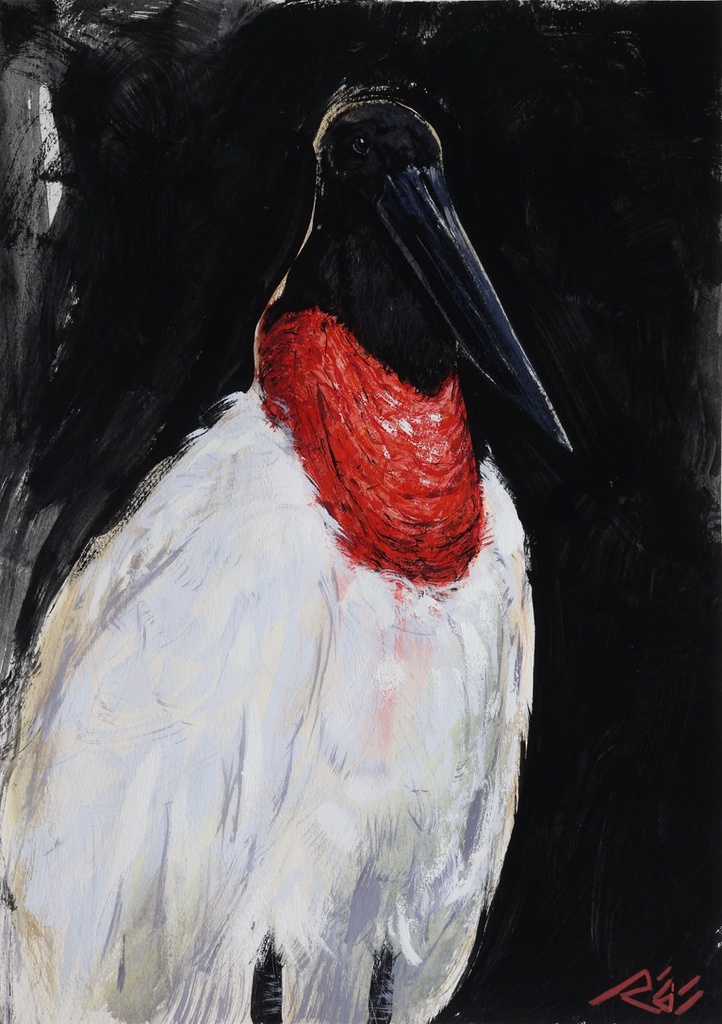
Most of the dark-ground works in my practice belong to the first register — the tropical birds of Ten Seconds of Light, Act I of Beyond the Contour. So that is where this has to start.
The Absolute Black of the Gouache Birds
Gouache dries matte and total. It does not gloss, does not vary with varnish, does not let the ground perform texture it doesn't have. When I paint a hummingbird against that field, the black is flat on purpose — and the flatness is the meaning.
These paintings come from a specific memory: a child on his grandmother's leather sofa in the interior of Brazil, watching hummingbirds drink honeyed water at the window. Ten seconds — maybe thirty — of intense color before an aunt calls from the kitchen and the moment scatters. The black field is that memory doing what memory does: selecting, isolating, protecting. No landscape. No distraction. Darkness insists that we look only at what is most precious.
A common rule says a flat, uniform black closes a painting too quickly. In the oil works, I agree with it. In the birds, I break it deliberately. The uniform black is not an unexamined backdrop — it is the frame remembering places around what it chooses to keep. Against it, the gouache does all the talking: light, almost silent strokes building the structure of a feather, then intense color arriving only at the end, the way the bird itself arrived at the window.
Tropical imagery from Brazil has often been extracted, polished, and sold back as a postcard. The absolute black refuses that. It gives the bird no easy elsewhere to decorate. It makes color account for itself.
The Constructed Black of the Oil Figures
The figure paintings work from the opposite premise. There, the first black is rarely black at all. It begins as a heavily textured gesso ground — ridges, drags, scraped passages built before any figure arrives. That surface decides how light will behave. A smooth dark passage absorbs light like a screen; the same dark over a gesso ridge produces movement without adding an image. Texture is never background. It is biography.
Then come the mixed-media layers in the order the feeling demands — colored pencil for fine line, gouache for dry opacity, acrylic for flat matte passages, markers for graphic insistence, gesso returning as construction rather than correction. Oil is always the final skin, unifying and complicating everything beneath it. Fat-over-lean governs that oil phase — it is not a rule imposed backward on the whole build.
In these works, black is made, not chosen. A tube of ivory black is only one possibility. I often build darkness so that raw umber and ultramarine stay active under the surface — a black that reads cool at one edge and warm at another, with a faint interior color that appears only when you approach slowly. Chromatic grays recur in backgrounds and in skin, because neutrality is rarely neutral. A gray can hold green, violet, rust, and blue at once.
The figures themselves begin as photographic montages of my own body, multiplied and rearranged, held inside black contour lines that protect a form and expose its instability in the same gesture. In queer figurative painting, visibility is often treated as a clean arrival. It is not. The contour holds the body together while admitting that identity is movement.
Color Needs Its Darkness — But Not the Same One
The palette runs through both registers: raw umber, yellow ochre, burnt sienna, ivory black, buff titanium, titanium white, cadmium yellow, cadmium red, magenta, ultramarine. Against the gouache black, a cadmium yellow flares like the ten seconds it commemorates. Against the built oil black, color has to negotiate — with texture, with contour, with the grays that make a saturated note feel earned.
And in the oils, the red of pain is never cadmium red. I build it with transparent alizarin crimson and raw umber, so it glows from inside the layers — a red that has stayed in the painting a long time. Cadmium keeps its own authority for the rare blunt, immediate signal.
What Collectors Can Look For
The two registers ask different questions at close range.
With a gouache bird, the black should stay perfectly quiet so the paint can be loud. Look at the drawing inside the color — the control of the fine stroke, inherited from years of colored pencil — and at how the matte field holds the bird the way memory holds an instant. These are works on paper, the most accessible originals in the studio, and a natural first acquisition for a collection beginning with intention.
With an oil figure, do the opposite: stay with the dark passages. Does the black carry variation, or does it end the conversation? Does light find a gesso ridge where the reproduction showed only a flat field? Does the contour do more than outline a body? A smaller work concentrates its pressure into a private encounter; a larger one makes you physically aware of the figure's territory. Neither is a lesser choice.
Both registers belong to one ongoing arc: bodies — human and otherwise — made visible against fields that are dark but never empty. Original paintings and prints are available directly from my studio. Inquiries are open, and the collector list receives first access to new work.
The figure or the bird may be what first calls you across the room. The black is where the painting tells you why it cannot be replaced.