Archival art care is mostly a matter of controlling light, handling, dust, and the room around the work. This guide to archival art care gives collectors a clear way to protect paintings and prints without turning a home into storage.
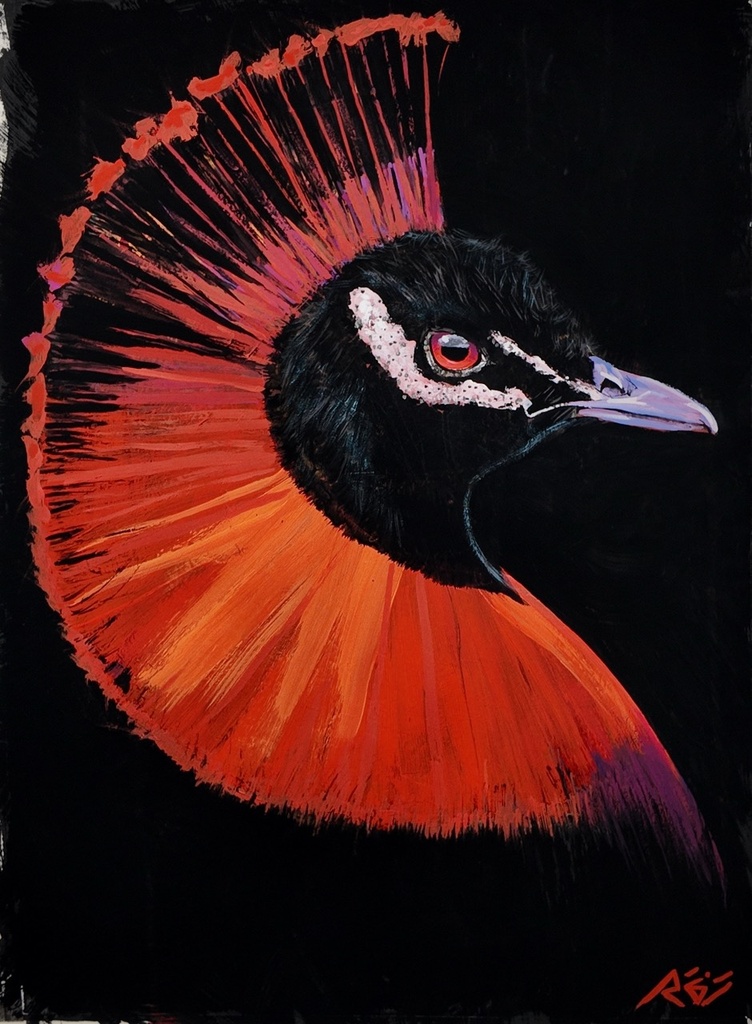
In Hummingbirds, tropical birds cross a black field where color has nowhere to hide. That black ground makes surface dust, hard glare, and an unsuitable frame more visible than they would be on a pale image. The painting asks to be seen clearly. Care begins by giving it the conditions to remain clear.
Guide to Archival Art Care: Begin With Placement
The best place for a painting is not always the wall with the best view. Avoid direct sun, even when it enters for only a few hours. Light slowly changes pigments, paper, and textile materials. The change is cumulative. A work can look unchanged for years, then reveal a difference beside the frame rabbet or beneath an old hanging label.
I recommend a wall away from windows where possible. If a window is central to the room, use a shade or curtain during the strongest daylight. UV-filtering film and glazing can reduce some exposure, but they do not make direct sun harmless. The same rule applies to bright track lighting placed too close to a work.
Keep paintings away from radiators, fireplaces, air vents, and exterior walls that run cold in winter. A stable room is more useful than a perfectly controlled room that changes dramatically every day. The work is durable because it is not indestructible. It lasts through ordinary life when ordinary life does not force it to expand, contract, or collect moisture again and again.
For collectors in Toronto, seasonal shifts deserve particular attention. Do not hang original work in a room that is left unheated for long periods, then rapidly warmed. The concern is not one imperfect day. It is repetition.
Light Is Part of the Collection
A collector often chooses a work because of its color, then accidentally gives that color its hardest opponent: constant light. My palette moves between raw umber, yellow ochre, burnt sienna, ivory black, buff titanium, titanium white, cadmium yellow, cadmium red, magenta, and ultramarine. These relationships are built deliberately. Chromatic grays hold the backgrounds and skin together. They deserve measured light, not a permanent spotlight.
For works on paper and prints, framed glazing is especially useful. Choose UV-filtering glazing and ask for acid-free mats and backing materials. The artwork itself should not be pressed directly against the glass. A proper spacer or mat creates the necessary separation.
The choice between standard glass and acrylic depends on the work and the setting. Acrylic is lighter and less likely to break, which can make sense in a high-traffic space or for a larger framed print. Glass can offer a different visual clarity and is less prone to static. A qualified framer can assess the object in front of them rather than applying one rule to every piece.
Understand What You Are Caring For
My paintings are not made as a single uniform surface. A heavily textured gesso ground comes first. Its ridges and drags decide how light behaves. Then I work with colored pencil, gouache, flat matte acrylic, marker, and gesso again, in the order the painting demands. Oil is the final skin.
That sequence matters when caring for the work. Do not assume a glossy oil surface means the whole painting should be treated like a conventional, smooth oil painting. Do not apply cleaners, water, sprays, furniture polish, or varnish. Do not rub a mark with a cloth. A surface can carry matte passages, raised gesso, and drawn lines alongside its final oil layer. What looks like a small act of cleaning can catch on texture or alter the finish.
Fat-over-lean governs only the oil phase of my process. It is not a general instruction for a collector to intervene in the painting. The collector's role is more exact and less invasive: provide stability, observe the surface, and ask before acting.
This is also why a painting such as I'm Perfect, But Unreal should be handled with attention to its edges as much as its image. The edge is part of the object. When moving a canvas, hold it by the stretcher or frame from both sides, with clean, dry hands. Never lift it by a hanging wire, pull it across a floor, or rest another object against its face.
Dust Without Touching the Surface
Dust is ordinary. Aggressive cleaning is not. For a framed work behind glazing, clean only the exterior glazing with a soft cloth lightly dampened away from the artwork. Never spray cleaner directly onto glass or acrylic while the artwork is in the frame. Liquid can enter at the edges.
For an unglazed original painting, I advise restraint. Keep the room reasonably clean, avoid smoke and cooking residue, and do not position the work where it will receive a direct stream from an air vent. If visible dust accumulates in a textured or delicate area, do not use a household duster, brush, or vacuum. Contact a professional art conservator for guidance based on the specific work.
The same caution applies to a scratch, dent, lifting edge, unusual spot, or change in surface sheen. Take a clear photograph in indirect light, record when you first noticed it, and ask for advice before attempting a fix. Documentation is useful. Improvisation rarely is.
Framing, Hanging, and the Space Around a Work
A frame is not only a visual decision. It is a protective structure. For works on paper, use archival mounting methods and materials that will not discolor or transfer into the sheet over time. Do not use pressure-sensitive tape, adhesive corners from a stationery store, or a backing board of unknown quality.
For canvases, make sure the hanging hardware is suited to the work's size and weight. Two wall hooks usually distribute weight more evenly than one central point. Keep the work high enough that chairs, bags, and passing hands will not repeatedly strike its lower edge. In a household with pets or active gatherings, that small margin matters.
Avoid stacking unframed works face to face. If a painting must be stored temporarily, stand it upright in a dry, stable room with a protective barrier that does not abrade the painted surface. Never wrap a fresh or unknown surface tightly in plastic. If you are uncertain about packing for a move, ask before the move is scheduled. The right preparation is easier than correcting a preventable accident.
Care During a Move or Installation
Moving is the moment when many otherwise well-kept works are damaged. Photograph the front and back before packing. Keep any certificate, invoice, or installation note in a separate folder rather than taping paperwork to the artwork. If a painting is framed, protect the corners first, then use clean packing materials that do not adhere to the surface.
When a work arrives in a new home, let it adjust to the room before making a judgment about the surface. A rapid temperature change can affect how a painting feels and looks temporarily. Do not place it immediately beside a heat source simply to speed up the process.
For a significant original, professional art handling is a sensible choice. This is particularly true for larger works, heavily framed pieces, or paintings traveling between cities. The cost should be weighed against the scale of the object and the complexity of the route.
Let the Work Continue Its Life
Care is not about treating a painting as untouchable. It is about allowing it to remain present. Ararinha Azul, Tuiuiú, and Peacock Feathers were made to hold their black fields, their birds, and their color in sustained view. They can live in a collector's home while still receiving serious attention.
My figures begin as photographic montages of my own body, multiplied. The black contour line carries the narrative. In works such as Stone Woman, Compassion, David, and Becoming, the image asks for duration. A collector participates in that duration through practical decisions: where the work hangs, what light meets it, and when restraint is wiser than intervention.
If you are considering an original such as Hummingbirds or a smaller work like Kratos and Zeus, this piece is available. Choose the wall with care, then let the painting occupy it fully.