The best questions for art dealers establish what a work is, where it has been, how it was made, and what will be required of you after it enters your space. They also make room for the less measurable fact: whether you can continue looking at the work after the first encounter.
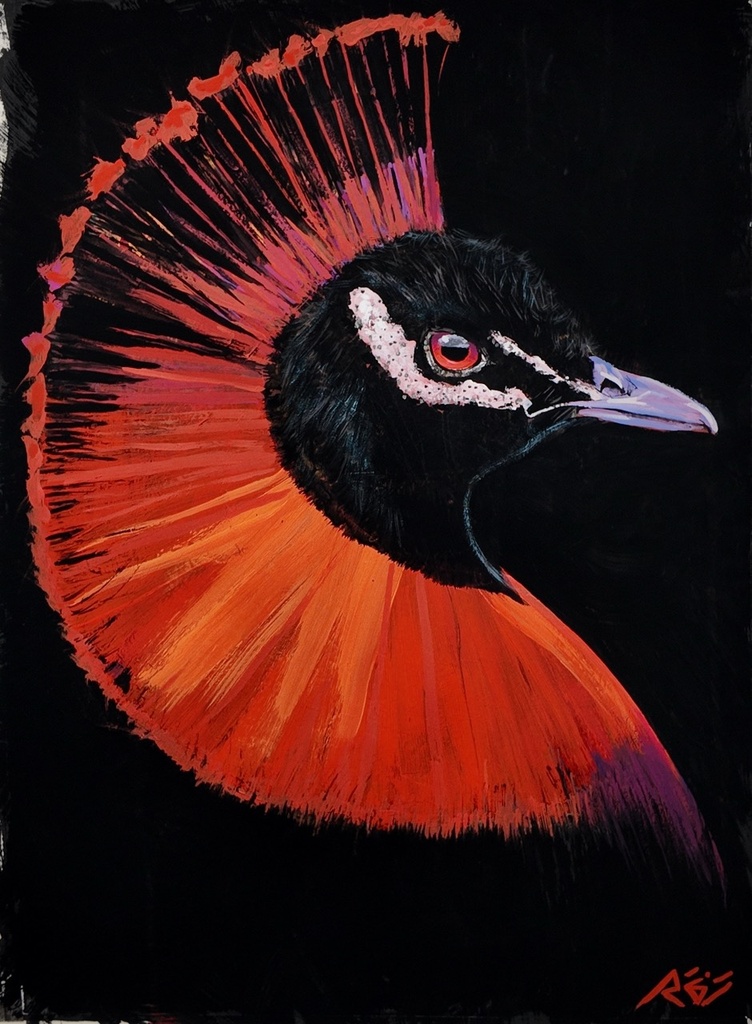
In Hummingbirds, tropical birds hold their position against a black field. The black is not an absence of color. It gives the birds a stage, then asks their color to carry its own weight. Before acquiring a painting like this one, ask the dealer enough to understand the object in front of you, not simply the story around it.
Best Questions for Art Dealers About the Work
Start with provenance. Ask, “Can you describe the work’s ownership history and provide documentation?” Provenance is the record of a work’s passage through studios, exhibitions, collections, and galleries. For a newly available work acquired directly from an artist’s studio, the chain may be short and clear. For an older work, it may require more documentation.
A dealer should be able to identify the artist, title, year, medium, dimensions, and whether the work is unique or part of an edition. Ask to see the invoice, certificate of authenticity where applicable, and any exhibition materials connected to the work. These are not ceremonial papers. They help preserve the work’s history as it moves into your collection.
Then ask, “What is the condition of the work, and is there a recent condition report?” A direct answer matters more than a reassuring one. Paintings can have surface variations, texture, visible revisions, and marks intrinsic to their making. Those are different from damage, instability, or past restoration. A condition report should distinguish between them.
Ask for current images of the front, back, edges, and signature or inscription. If you are acquiring remotely, ask for images taken in natural and raking light. This is especially useful for a materially active surface. Texture changes with light, and a photograph made for a screen cannot tell you everything about how a painting will behave on a wall.
Ask How the Price Was Set
The question is simple: “How was the price determined?” The answer should be specific. Pricing can reflect scale, medium, date, the artist’s exhibition history, rarity within a body of work, and the status of the work as an original or edition. It depends on the practice and the market around it. A dealer does not need to reveal every business conversation, but the logic of the asking price should be legible.
Ask separately what the price includes. Is the work framed? Are taxes, packing, shipping, insurance, or installation separate? Is there a reserve period while payment is arranged? Clear terms prevent the most avoidable friction in an acquisition.
For original paintings from my studio, prices are set by size. Prints make the same images available in another form, but they are not substitutes for the original object. An original contains the record of its own decisions: the changes in pressure, the covered marks, the final passages of oil.
Ask What the Materials Require
A strong dealer knows more than the artist’s biography. They understand the physical life of the work. Ask, “What are the materials, and are there any care instructions I should follow?”
My paintings begin on a heavily textured gesso ground. I build ridges and drags into the surface before an image settles there. Then I work with colored pencil, gouache, flat matte acrylic, marker, and gesso again, in the order the work demands. Every painting ends in oil. Oil is the final skin, and fat-over-lean governs that oil phase only.
That sequence matters when a collector is considering placement. A painting should not live in direct, sustained sunlight or near sharp swings in heat and humidity. It should be handled by the stretcher or frame, never by the painted surface. These are practical conditions, not fragile rituals. Good care allows the work to continue changing with ordinary shifts of daylight without being subjected to avoidable stress.
Ask whether the work has a varnish layer, whether it is framed, and whether a particular hanging system is recommended. If a dealer cannot answer, ask whether they will obtain the information from the artist, gallery, or conservator responsible for the work.
Ask What You Are Seeing, Not What You Are Supposed to Feel
Collectors sometimes worry that a question about meaning will sound naïve. It will not. The useful question is not, “What does this mean?” It is, “What should I notice in the construction of this work?”
That wording returns attention to the painting. In my figurative work, the body is often built from photographic montages of my own body, multiplied into one image. The black contour line carries the narrative. Color has its own structure. I use chromatic grays in backgrounds and skin, and the red associated with pain is transparent alizarin crimson mixed with raw umber, never cadmium red.
These details do not close down interpretation. They give it a ground. I’m Perfect, But Unreal does not ask for agreement with a fixed identity. It holds self-authorship and artifice in the same frame. The paradox is that a constructed figure can be more candid than a naturalistic one, because construction shows its decisions.
A dealer may describe a work through its place in an artist’s practice, its relationship to a series, or its exhibition context. Ask, “How does this piece relate to the artist’s wider body of work?” The answer can help you distinguish a one-off image from a continuing chapter. It can also reveal whether the work’s strongest argument is material, formal, cultural, or all three at once.
Questions for Art Dealers About Display and Scale
A work can be right for your collection and wrong for a particular wall. Ask, “Can you show me the work in relation to a person or a room?” Dimensions listed on paper are necessary, but they do not show presence. Request installation views when they exist, or use a scaled outline in your own space before committing.
Then ask, “What kind of light does the work need?” This is not a request for decoration advice. It is a question about seeing. Paintings with black fields, dark passages, or layered surfaces can change substantially between a north-facing room, a warm lamp, and a bright gallery wall. View the work under conditions close to those in which you plan to live with it.
Ask whether framing is integral to the work or a presentation choice. A frame can establish distance, protect edges, or alter the visual temperature of a painting. Sometimes an unframed canvas is the right decision. Sometimes it is not. The answer should come from the work itself, not from a default interior trend.
Clarify the Dealer’s Role
Ask, “Are you representing the artist for this work, or acting on behalf of a consignor?” It is a direct question, and it establishes who can authorize a sale, provide documentation, negotiate terms, and answer questions after delivery.
A dealer’s job is to create distance between artist and buyer, yet the best relationship often makes the work feel nearer. The distance protects the transaction. The proximity protects the meaning. If you are buying directly from an artist, the same questions still apply, although their answers may come from the person who made every mark.
Ask about the dealer’s return policy, shipping plan, insurance during transit, and timeline for delivery. Ask what happens if the work arrives with an issue. Serious collecting is built through attention to these details, not through suspicion.
Finally, ask yourself one question after the dealer has answered theirs: “What remains unresolved for me here?” The best acquisition is not always the work that explains itself fastest. It may be the one that continues to ask for your eye, your time, and a more precise language.
Hummingbirds is available as an original work, alongside other paintings and prints from my studio. Inquiries are open. Bring questions that honor the object first. A painting can answer them slowly, which is one reason to live with it.