A Toronto exhibition case study should show more than where the work hung. It should make clear how material decisions, the painted body, and the public setting gave one continuing inquiry its form.
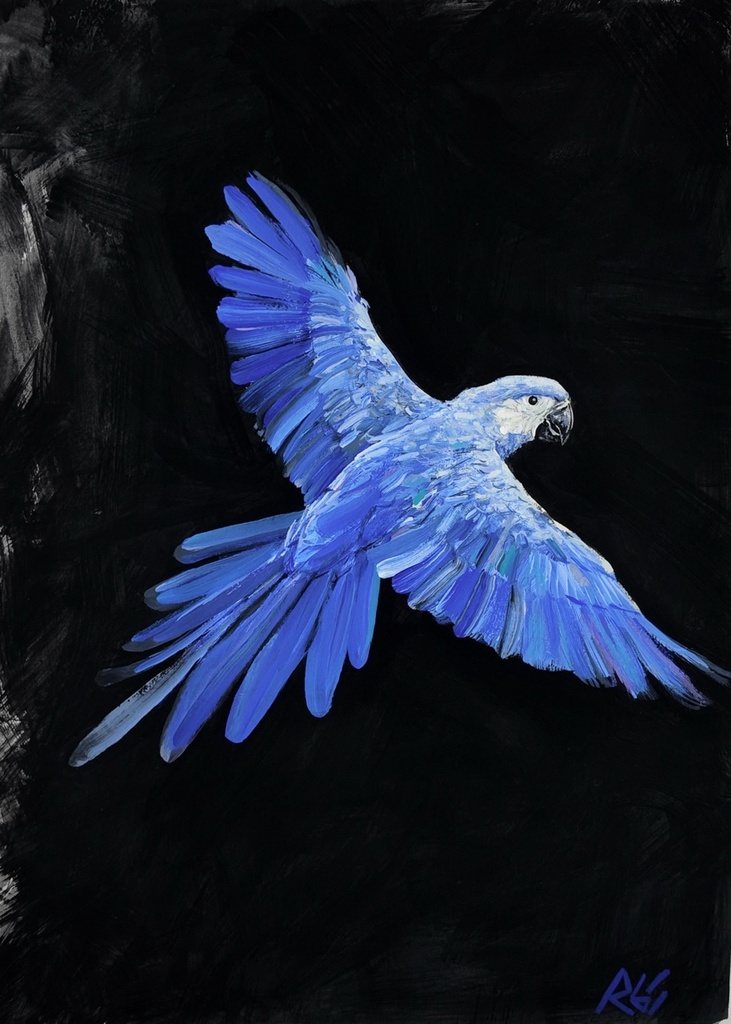
I begin with Hummingbirds, where tropical birds occupy a black field with no landscape offered as permission or escape. The black is not a void. It is an active plane, holding color at the surface and making each mark answer for itself. This piece is available as an original, alongside prints, through my studio.
My 2026 Toronto exhibitions - Beyond the Contour at The Show Gallery in April and Archive of Unstoppable Bodies with Pride Toronto ArtZone at CF Toronto Eaton Centre in June - belong to the same arc. They did not ask me to simplify the work for public view. They made its existing questions more visible: Who gets to appear whole? What can a contour carry when the body inside it has been multiplied, staged, and made from the artist’s own image?
What This Toronto Exhibition Case Study Examines
The central fact is material. Before there is a figure, there is a ground with its own resistance.
I build a heavily textured gesso ground first. Its ridges and drags decide how light will behave across the painting. That decision cannot be corrected later by adding a brighter color or a more expressive gesture. The surface has already established the terms.
Then I work through colored pencil, gouache, flat matte acrylic, marker, and gesso again, in the order the painting demands. These are not separate effects arranged for variety. They are records of pressure, interruption, revision, and return. Every painting ends in oil. Oil is the final skin.
The oil phase follows fat-over-lean. That rule belongs specifically to the oil layers, not to every material that came before them. Precision matters here because the work is physically layered, but it is not mechanically layered. A painting may need a dry matte area beside an oil passage, or a marker line that refuses to disappear beneath later color.
The contradiction is simple: the body looks immediate, but its immediacy is constructed. That construction is where the painting becomes honest.
Beyond the Contour at The Show Gallery
Beyond the Contour was presented at The Show Gallery, Toronto, in April 2026. The title names a problem I return to repeatedly. A contour can define a figure, but it can also impose a limit. I use a black contour line to carry narrative rather than merely close a shape.
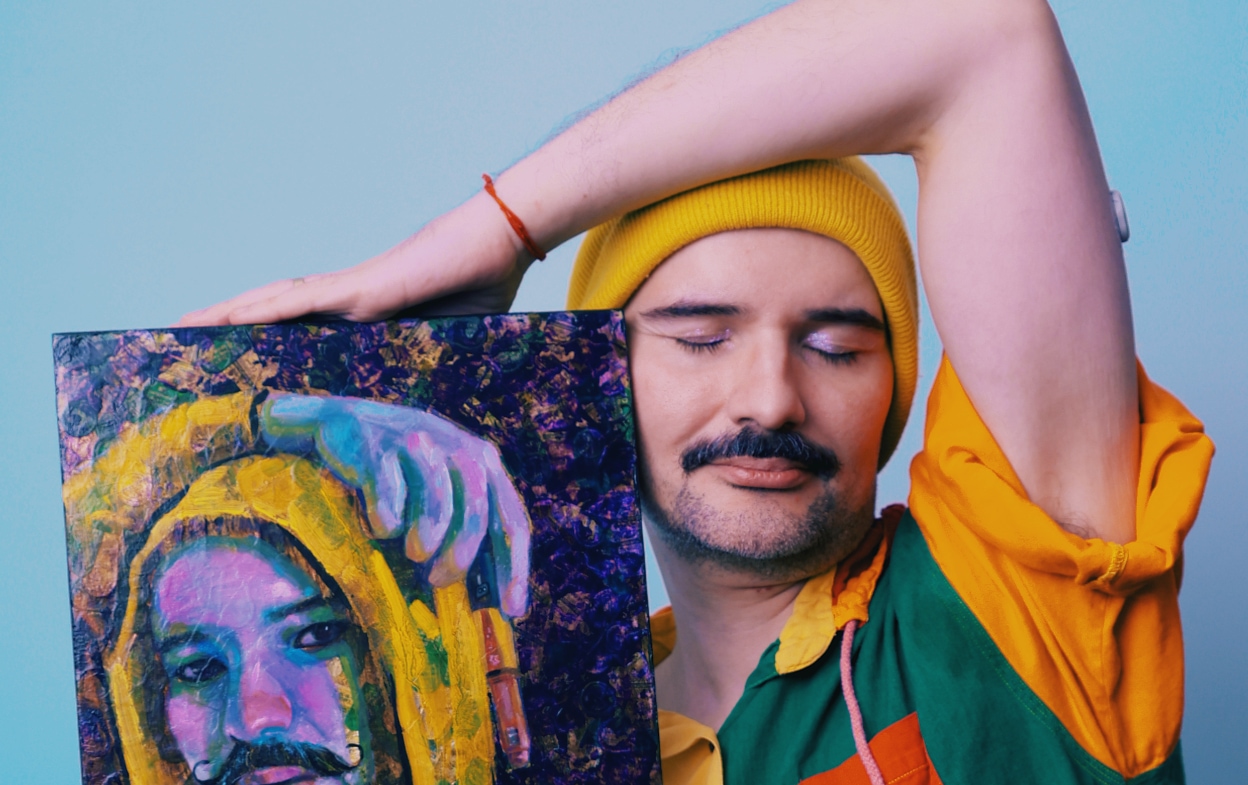
My figures come from photographic montages of my own body, multiplied within one composition. This does not make the work autobiography in a narrow sense. The body is a source, an instrument, and a site of editing. It can become witness, seducer, defender, ornament, or a crowd of one.
That multiplication changes the stakes of figuration. A single body can be read too quickly as a symbol. Several versions of the same body create friction. They deny a fixed role and ask the viewer to stay with the painting longer.
Works such as David, Becoming, and Compassion belong to this continuing inquiry. Their titles are direct, but they do not settle the image. They keep language close to the surface while leaving room for the painting to make its own argument through posture, color, and line.
The palette is deliberately limited and specific: raw umber, yellow ochre, burnt sienna, ivory black, buff titanium, titanium white, cadmium yellow, cadmium red, magenta, and ultramarine. Chromatic grays shape both backgrounds and skin. I do not use gray as a retreat from color. I use it as color under pressure.
Red has its own discipline. The red of pain is transparent alizarin crimson mixed with raw umber, never cadmium. Cadmium red has another task in the work: it can declare itself. Alizarin crimson and raw umber sink inward. They let red remain present without turning it into spectacle.
Archive of Unstoppable Bodies in a Public Setting
Archive of Unstoppable Bodies was shown through Pride Toronto ArtZone at CF Toronto Eaton Centre in June 2026. The exhibition context changed the encounter. A gallery creates a concentrated appointment with art. A public commercial setting introduces movement, noise, interruption, and viewers who may not have planned to stop.
That is not a lesser condition. It is a different one.
Queer figuration in public does not need to explain itself before it can be seen. Yet the setting makes visibility tangible. The work meets people amid errands, transit, conversation, and the ordinary pace of the city. A painted body can be encountered before it is categorized.
The word “archive” matters because an archive is never neutral. It preserves some things and misplaces others. My archive is painted rather than cataloged. It records bodies that refuse disappearance, but it also records uncertainty: the outline that doubles back, the face that carries more than one emotional register, the color that changes under a viewer’s movement.
Brazilian cultural memory remains present in this work without becoming decoration. The title Tuiuiú names the jabiru, a bird with particular force in Brazilian visual memory. Ararinha Azul names the little blue macaw. These paintings, like Peacock Feathers, place birds on black fields, where their color becomes both image and structure. The Portuguese names are not additions to an international vocabulary. They are the names I know.
What Collectors Can See Beyond the Exhibition
An exhibition is not the end point of a painting’s life. It is one condition in which the work becomes legible. After the public installation, the questions of scale, surface, and presence continue in a home, a collection, or an institutional context.
For collectors, original paintings are priced by size through my studio shop. The available work ranges from concentrated small paintings such as Kratos and Zeus to larger figurative and bird works. Prints extend the image differently. They carry the composition, but not the accumulated material record of gesso, matte acrylic, pencil, marker, and final oil.
That distinction is useful rather than hierarchical. A print may be the right entry point for a new collector or a work on paper-focused collection. An original is for those drawn to the physical decisions that cannot be reproduced: the raised gesso, the changed edge, the oil passage settling over an earlier mark.
Commissions are also open for collectors seeking a painting developed in conversation with a particular space or subject. I begin with a 50% non-refundable deposit and include two revision rounds. The process is structured because a commission still has to remain a painting, not an illustration of a predetermined answer.
Painting as a Continuing Public Record
This Toronto exhibition case study is not a claim that two exhibitions explain the entire practice. They clarify a direction. Beyond the Contour placed the line, the montage, and the constructed body at the center. Archive of Unstoppable Bodies carried that inquiry into a setting where queer presence met the daily movement of Toronto.
The work continues from there. Stone Woman, I’m Perfect, But Unreal, and the bird paintings each test different terms of appearance: weight, surface, performance, beauty, refusal. They are chapters in the same body of work, not departures from it.
Collectors and curators who want first access to new paintings, prints, and exhibition news can join my email collector list. The most useful way to meet the work, however, remains slow looking: stay with the black line, notice where the matte paint ends, and see what the final oil skin chooses to reveal.