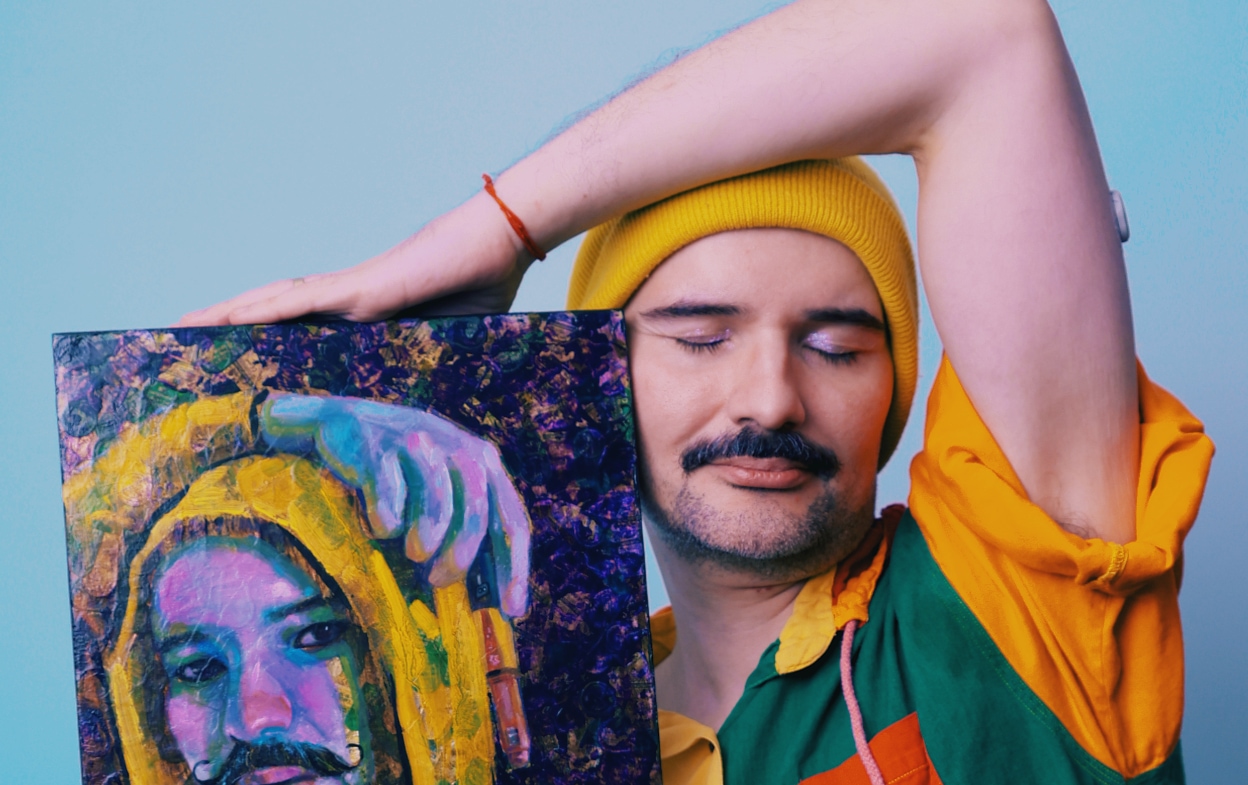
I am a Toronto artist making figurative paintings from the body I know, the images I inherit, and the marks a surface permits. My paintings place queer life in full view without asking it to become simple.
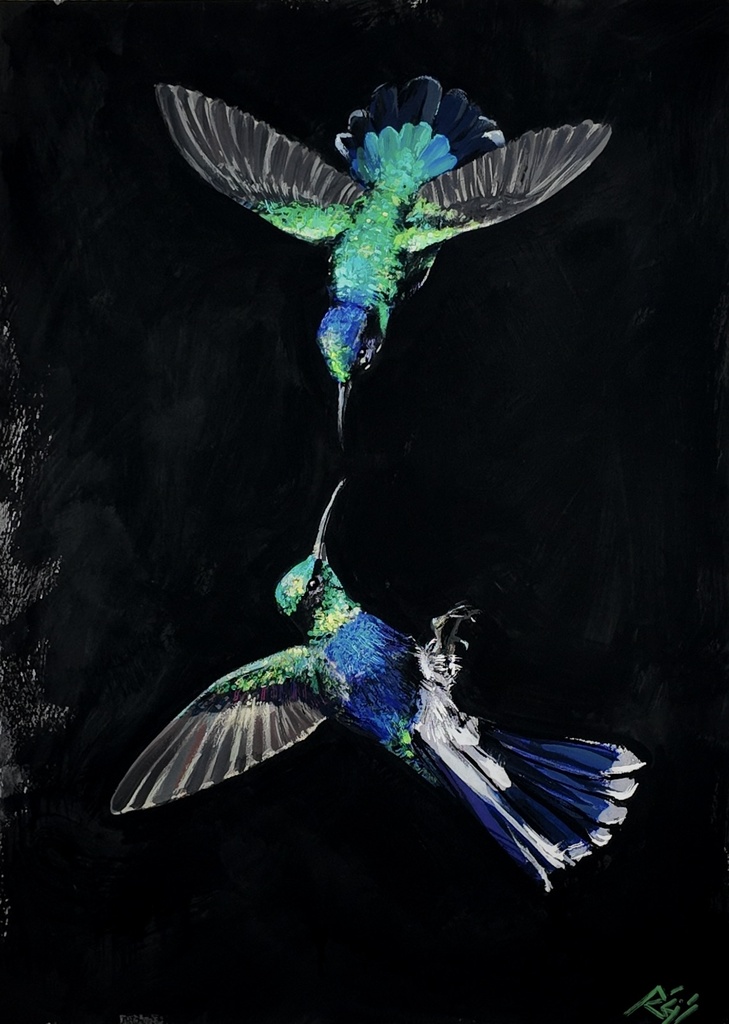
In Hummingbirds, small tropical birds cut across a black field. Their movement is quick, but the field refuses speed. The painting holds brightness against absence, color against a darkness that is not empty but deliberate. This piece is available as an original and as a print.
A Toronto Artist Working From Matter
A painting does not begin with an image for me. It begins with resistance. I build a heavily textured gesso ground first, using ridges and drags that decide how light will behave across the finished work. That decision cannot be corrected later with a good figure or an elegant color. The ground has already established the terms.
Then I work through colored pencil, gouache, flat matte acrylic, marker, and gesso again, in the order the work demands. These are not preliminary gestures waiting for oil to make them legitimate. They remain active beneath the final surface. Oil comes last, as the final skin of the painting.
Fat-over-lean governs the oil phase only. It is a technical rule with a clear purpose: each later oil layer must carry more oil than the layer beneath it. The earlier materials follow another logic. They are chosen for friction, opacity, drag, stain, and interruption.
This is why my surfaces can appear controlled at a distance and unsettled up close. The figure may read immediately, but the painting does not offer a single route through itself. The black contour line looks like a boundary. It is also the line that allows the body to move.
The Body Is Never a Stand-In
The figures in my paintings are photographic montages of my own body, multiplied and rearranged. I do not use the body as a neutral symbol. It is a record of presence, staging, desire, discipline, and refusal. One body can become several. A gesture can repeat until it changes its meaning.
That multiplication matters in works such as I’m Perfect, But Unreal. The title names an impossible demand with plain force. Perfection promises certainty, yet the painted body remains constructed, doubled, and visibly made. I am interested in that gap. Identity is not a fixed portrait. It is movement under pressure.
The same question runs through Stone Woman, Compassion, David, and Becoming. Each work belongs to a continuing arc rather than a separate theme. The body is present, then altered by line, color, and the pressure of adjacent forms. What seems personal becomes cultural because the materials keep insisting on their own history.
My Baroque training in São Paulo remains part of that history. Three years of study taught me to look at structure, flesh, contrast, and theatrical composition with discipline. I did not leave those lessons behind when I moved through mixed media and contemporary figuration. I brought them forward, then made them answer to another life.
Color Carries Its Own Argument
My palette is specific: raw umber, yellow ochre, burnt sienna, ivory black, buff titanium, titanium white, cadmium yellow, cadmium red, magenta, and ultramarine. These pigments are not a fixed formula. They are a vocabulary I return to because they can hold warmth, density, and difficult shifts of tone.
Chromatic grays are especially important in backgrounds and skin. Gray is not a retreat from color. It lets color remain tense. A gray field can carry ultramarine, umber, red, or yellow at once, and it changes according to the light around it.
The red of pain is never cadmium red in my work. I make it with transparent alizarin crimson and raw umber. Cadmium has a blunt authority that serves other passages. Alizarin crimson mixed with umber can remain deep while allowing the layer below to stay visible. The color does not announce itself from the surface alone. It comes through it.
In Ararinha Azul, Tuiuiú, and Peacock Feathers, tropical birds appear against black fields with their own chromatic demands. These paintings come from Brazilian cultural memory, not from a decorative idea of Brazil. The birds have names. Their colors have weight. A tuiuiú is not simply a striking silhouette; it carries a specific presence from a place I know through distance, memory, and return.
Queer Resilience, Painted
Queer life is often asked to arrive as testimony or spectacle. I am more interested in the visual terms of self-authorship. A contour can protect a figure without trapping it. A repeated body can show solitude without becoming isolated. A painted gaze can meet the viewer and still withhold what does not belong to them.
This is not portraiture as a request for recognition alone. It is painting as a frontier. The body enters the work, but it does not end there. It is carried by the ground, interrupted by markers and matte passages, then held under oil. Every decision remains visible if a viewer gives the painting time.
Small works such as Kratos and Zeus make that attention intimate. Scale changes the encounter. A smaller painting asks the viewer to come closer, where pencil lines, gesso, and shifts in opacity can no longer be treated as background information. The work becomes physical in another way: not monumental, but concentrated.
A Continuing Public Record
My studio practice moves between painting, digital work, video art, performance, and writing. These forms belong to the same body of work. My novel, Malakoi, continues questions that also appear in the paintings: embodiment, desire, memory, and the unstable border between what is seen and what is carried internally.
The public chapters of this work have continued in Toronto. Beyond the Contour, my solo exhibition at The Show Gallery in April 2026, brought the line itself into focus: not as decoration, but as a narrative force. Archive of Unstoppable Bodies, presented through Pride Toronto ArtZone at CF Toronto Eaton Centre in June 2026, placed bodies and archives in direct conversation with a broad public.
The 2026 Ontario Arts Council grant also supports this ongoing practice. It does not mark a departure. It gives further room to pursue the questions already inside the work, with greater precision.
Collecting From the Studio
Original paintings are priced by size, with works available directly through my studio. Prints of selected paintings are also available for collectors who want to live with an image in another format. I ship original work and prints worldwide.
For commissions, I begin with a 50% non-refundable deposit and include two revision rounds. That structure protects the work on both sides. A commission is not a reproduction of an existing painting. It is a new work with its own ground, body, and terms.
Collectors, curators, and institutions may inquire about available originals, prints, and commissions. Join my email collector list for first access to new work. The right painting is not simply one that matches a room. It is one that continues to make new demands of the room, and of the person willing to look at it.