To commission portrait art, begin with a clear exchange: tell me who the painting is for, what must remain visible, and where the work will live. I then determine whether the image belongs inside my visual language, agree on the direction with you, and begin only after a 50% non-refundable deposit.
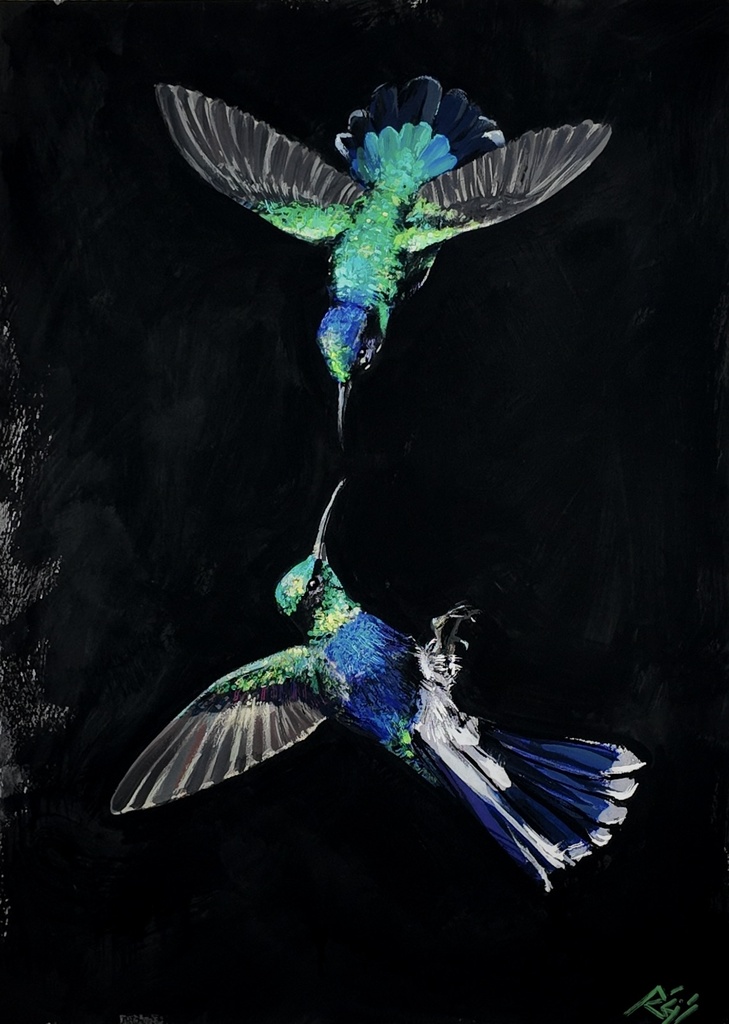
In Hummingbirds, tropical birds hold their color against a black field. The painting does not ask the black to disappear. It makes the black an active condition of seeing. A commission works in a related way: a likeness matters, but it must enter a painted world with its own material decisions, contour, pressure, and color.
How to commission portrait art with a clear brief
A strong commission begins before reference photographs are chosen. Tell me whether you are commissioning a portrait of yourself, someone close to you, or a figure that carries a larger family or cultural history. Tell me what draws you to my work. It may be the insistence of the black contour line, the chromatic grays in skin and background, or a painting such as Stone Woman, Compassion, David, or Becoming.
I do not treat these details as a questionnaire to complete. They establish the terms of the work. A portrait can preserve a recognizable face while refusing the stiffness of a posed record. It can be intimate without being private. That is the paradox I work toward: the painting is made for one person, yet it must stand in public as a painting.
In your initial inquiry, include the intended location of the work, the scale you are considering, and whether you are drawn to oil alone or to the mixed-media structure present in my practice. If the portrait is a gift, say so, along with the date that matters. A requested date can shape the conversation, though the painting must be allowed the time its surface requires.
Reference images are necessary, but more images are not always better. Send a focused group of photographs with clear light, varied angles, and enough detail to understand the person’s features and bearing. Include images that feel true to their presence, not simply polished. Clothing, jewelry, a gesture, or an object may matter. So may the decision to leave them out.
What a commissioned portrait can and cannot be
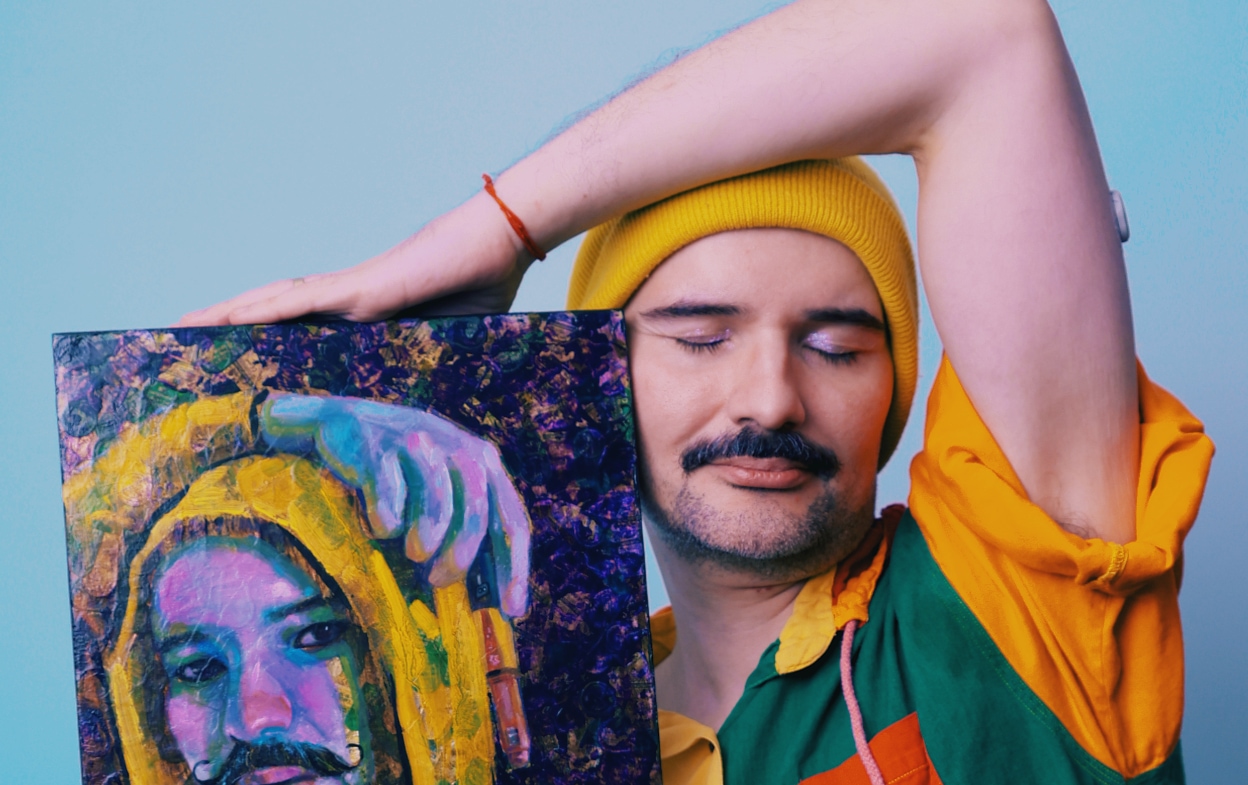
My figures are constructed from photographic montages of my own figure, multiplied and rearranged. That method informs every commission. I am not offering a mechanically faithful copy of a single photograph. I am making a portrait through selection, montage, contour, and paint.
This is useful to understand early. If your priority is exact photographic replication, another approach may suit the request better. If you want recognition held within a contemporary figurative painting - one where the image can carry desire, discipline, diaspora, queer presence, or self-authorship without reducing any of them to an illustration - we have a productive place to begin.
The commission can be direct in its source material and still transformed in the painting. I may use the posture from one image and the face from another, then alter the relationship between figure and ground until the work has its own internal fact. The black contour line carries narrative. It does not merely outline a form; it determines where the figure presses forward and where it recedes.
For collectors in Toronto, across Canada, and in the United States, this direct studio exchange also makes room for questions that a finished work cannot answer on its own. We can speak about placement, viewing distance, and the kind of presence you want the painting to hold in a room. The final decision remains visual, but the conversation gives it precision.
The painting begins with the ground
Once the direction is confirmed, I build a heavily textured gesso ground. Its ridges and drags decide how light behaves across the surface. This is not a neutral preparation hidden beneath the image. It is the first record of the painting’s resistance.
From there, I work with colored pencil, gouache, flat matte acrylic, marker, and gesso again, in the order the work demands. Oil comes last, as the final skin. The sequence is deliberate but not mechanical. One surface may need the dry interruption of pencil; another may require a matte field before oil can take hold.
The oil phase follows fat-over-lean. Before that point, the question is not an oil-painting rule but a material one: what does this particular ground need to keep the figure alive? Impasto, a thin glaze, or an exposed passage of matte acrylic each change the pace at which the image is read.
My palette is built from raw umber, yellow ochre, burnt sienna, ivory black, buff titanium, titanium white, cadmium yellow, cadmium red, magenta, and ultramarine. The red of pain is transparent alizarin crimson mixed with raw umber, never cadmium. Cadmium red has another role in the work. Color is not assigned a fixed emotion. Its meaning comes from what it touches, what it interrupts, and what the ground permits.
Revisions are part of the commission, not a second painting
Every portrait commission includes two revision rounds. They are the point at which you can respond to the developing work and identify what needs adjustment within the agreed direction. I ask clients to be direct: say whether a relationship between colors feels wrong, whether a feature needs more attention, or whether an element of the composition has become too dominant.
Revision does not mean restarting the commission from zero or converting the painting into a sequence of unrelated requests. A painting needs continuity. The ground, the contour, and the developing structure establish commitments that cannot be erased without losing the work’s force. This is why the early conversation matters so much.
The 50% deposit is non-refundable because it secures the commission and begins the labor of planning, sourcing, and making. The remaining balance is due when the work is complete. Originals are priced by size in my studio shop, which offers a useful starting point for considering scale. Prints are also available for collectors who want to live with an image before commissioning an original.
Choosing the right scale and setting
A small portrait can be concentrated and exact. Works such as Kratos and Zeus show how much pressure a smaller surface can hold. A larger painting has room for a more expansive relationship between figure, background, and contour. Neither is automatically more significant. The right scale depends on the architecture of the image and the room where it will be encountered.
Consider the viewing distance. A painting seen from across a living room needs a different organization than one encountered at close range in a hallway or beside a desk. Think, too, about whether the portrait will be alone or in conversation with other works. A dark field can create a strong pause on a wall. A chromatic gray background may ask for more time and closer looking.
You do not need to arrive with every answer. You do need to arrive ready to make choices. The strongest commissions are built through trust, not vagueness. Give the portrait a reason to exist beyond decoration, then let the painting determine how that reason becomes visible.
Inquiries are open for portrait commissions. If the work you have in mind belongs to this continuing arc, bring the person, the images, and the question that cannot be answered by a photograph alone.