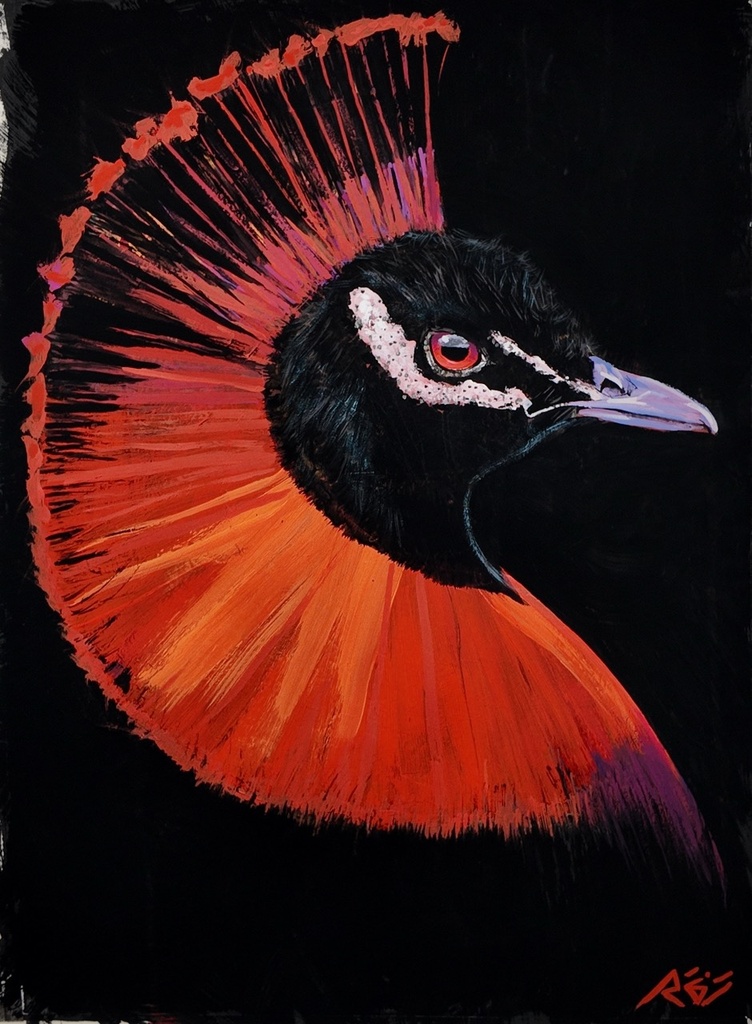
Acrylic versus oil painting changes more than drying time. It changes the surface a collector lives with, the pace of the artist’s decisions, and the way a body carries color across years. In my painting Peacock Feathers, the feather forms hold their place against a black field. That black is not emptiness. It is a pressure that lets every later color declare itself.
I work with both acrylic and oil, but not as interchangeable options. Acrylic helps me build, interrupt, obscure, and set a decision in place. Oil arrives last. It is the final skin of the painting, where depth, reflection, and the visible time of looking become inseparable.
Acrylic versus oil painting: the material difference
Acrylic paint dries quickly, often within minutes or hours depending on thickness, humidity, and additives. It dries through evaporation and becomes a plastic-like film. Oil paint dries slowly through oxidation. That distinction governs almost every practical and visual difference between the two.
With acrylic, I can place a flat matte passage beside colored pencil, marker, gouache, or gesso, then return to it without disturbing what is underneath. The surface sets. A decision becomes architecture. This matters when I am constructing a figure from photographic montages of my own body, multiplied and reassembled. The black contour line has to remain clear enough to carry narrative through the layers.
Oil remains open longer. I can shift an edge, draw one color through another, or build a glaze that changes the temperature of skin without covering the marks beneath it. It asks for patience, but it also gives a painting a particular elasticity. A painted body can hold opacity and transparency at once.
The paradox is simple: acrylic can make a painting feel immediate because it dries fast, while oil can make it feel alive because it refuses to finish quickly. Both are forms of control. They simply control different kinds of time.
My paintings use acrylic and oil in sequence
My process does not begin with a blank canvas and a choice between two tubes of paint. A heavily textured gesso ground comes first. I make ridges and drags that decide how light will behave across the work before the body is fully present.
Then I use colored pencil, gouache, flat matte acrylic, marker, and gesso again, in the order the work demands. Acrylic is essential at this stage because it can sit as a direct, dry, matte statement. It can establish a plane of color, seal an earlier mark, or push a figure forward against a chromatic gray background.
Every painting ends in oil. That rule is not decorative. Oil is the last material because I want it to gather the earlier layers rather than erase them. It can settle into the textured ground, bridge an abrupt acrylic passage, or let a contour remain sharp while the surrounding skin turns atmospheric.
This is also where the technical rule of fat-over-lean belongs. It governs the oil phase only. Earlier water-based layers are already dry before oil enters the work. Within the oil passages, I keep leaner applications below and richer, oilier layers above, so the final surface can move and age as it should.
Surface, sheen, and the collector’s eye
The first visible difference between acrylic and oil is often sheen. Acrylic can dry matte, satin, or glossy, but its surface usually appears more uniform once dry. Oil offers a different range: passages can sink in, remain glossy, or catch light with a depth that seems to sit below the surface.
That depth is one reason oil remains central to my work. I use raw umber, yellow ochre, burnt sienna, ivory black, buff titanium, titanium white, cadmium yellow, cadmium red, magenta, and ultramarine to construct color relationships rather than isolated effects. Chromatic grays are especially important in backgrounds and skin. They keep the figure from becoming a symbol with a single message.
The red of pain is never cadmium red in my paintings. I make it with transparent alizarin crimson and raw umber. It has less insistence and more interior movement. The color does not announce itself as a wound. It stays within the body’s larger field of decisions.
For collectors, this means an oil finish is not simply a traditional preference. It is part of how the painting continues to reveal itself at different distances and under changing light. A matte acrylic area may read first as a firm visual fact. An oil glaze beside it may open more slowly. The painting does not offer one surface. It offers a sequence of surfaces.
Which medium holds detail better?
Both can hold detail. The better question is what kind of detail matters to the painting.
Acrylic is excellent for graphic clarity, flat fields, and quick revision. It supports the declarative line. In works such as I’m Perfect, But Unreal, where self-authorship and artifice meet, that directness matters. The line can remain unapologetically visible. It does not need to imitate a body in order to speak about one.
Oil is better suited to optical transitions: a softened edge around a shoulder, a veil of color over a previous mark, or the shift between warm and cool tones within one plane of skin. Yet oil can also be blunt. It can cover, scrape, and insist. Its reputation for softness is incomplete.
In my studio, detail is not a contest between precision and expression. A contour can be exact and still carry contradiction. A face can be built from photographic reference and still refuse the stability of portraiture. The body becomes a record of decisions made in material, not an illustration of an idea decided in advance.
Drying time changes the painting’s rhythm
Acrylic permits rapid accumulation. It is useful when I need to change direction without waiting for a passage to cure. A new gesso layer can interrupt an image. Marker can sharpen the edge of a form. Gouache can offer a brief, chalky opacity before oil alters the surface again.
Oil changes the rhythm from accumulation to negotiation. Wet paint keeps a passage available. I can return the next day and find that a color has settled into a different relationship with the ground. That delay is not passive. It is part of the work’s discipline.
For a collector, slow drying does not make an oil painting less resolved. It means the artist has chosen a medium that accommodates revision, glazing, and sustained attention. The finished work has already passed through that time. Its presence is immediate, but its making was not.
Why the distinction matters in my figurative work
My paintings concern queer resilience, diasporic memory, desire, and self-authorship, but those subjects do not arrive as captions placed on an image. They are carried by the ground, the contour, the palette, and the final oil skin.
In Stone Woman, Compassion, David, and Becoming, the figure is never separate from the terms of its construction. The black line may hold a body together, but it also shows where the image has been divided, repeated, or withheld. Brazilian memory enters with specificity, not as scenery: through the colors I recognize, through the discipline of drawing, through the pressure of making a body visible on its own terms.
Acrylic versus oil painting is therefore not a question of old against new, or expressive against practical. In my work, acrylic establishes friction. Oil gives that friction duration. The painting needs both to remain unresolved in the right places.
Choosing an original with layered surfaces
When looking at an original, spend time with its material shifts. Notice where the surface is matte and where oil changes the light. Follow the contour line across a figure. Look for the points where a gesso ridge redirects color or where a transparent passage lets an earlier decision remain visible.
This is especially present in the tropical bird paintings Hummingbirds, Ararinha Azul, Tuiuiú, and Peacock Feathers, where saturated forms meet black fields. It also matters in smaller works such as Kratos and Zeus. Scale changes the physical encounter, not the seriousness of the surface.
Original works are priced by size in my studio shop, and prints are available for selected works. Commission inquiries are open with a 50% non-refundable deposit and two revision rounds. Join the collector list for first access to new work.
A painting can meet a room as a single image. Stay with it longer, and its materials begin to show you how that image learned to stand.