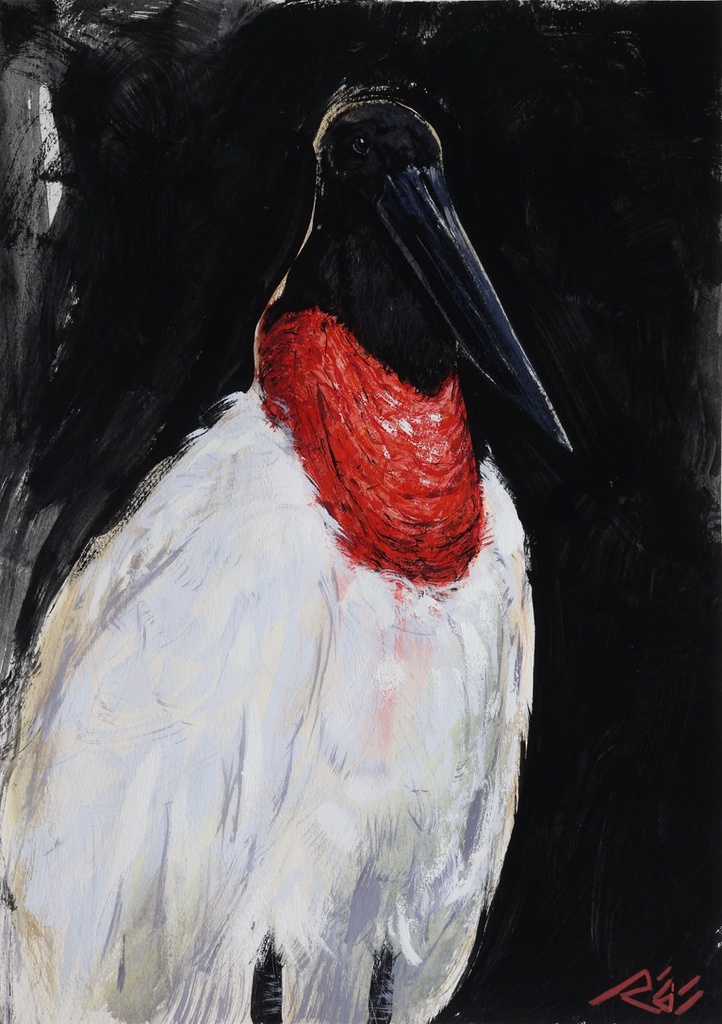
How many decisions does an artist have to make? More than I can honestly count, because one decision changes the conditions of the next. In Ararinha Azul, blue holds its place against a black field, and that apparent simplicity is the result of decisions about ground, edge, density, scale, and restraint.
I do not begin with an image that needs to be illustrated. I begin with a surface that must become specific. The figure, the bird, the contour, and the color arrive afterward, each answer producing another question. A painting may look resolved from across a room. Up close, it records a long argument between what I intended and what the materials allowed.
How Many Decisions Does an Artist Have to Make in One Painting?
The useful answer is: decisions are not separate events. They accumulate. There is no point where I select a background, then select a body, then apply a final meaning as if the work were a checklist. Each choice presses on the others.
The first decision is often physical. I build a heavily textured gesso ground, making ridges and drags that determine how light will behave across the work. This is not neutral preparation. If the ground is too active, it can compete with the body. If it is too quiet, the painting can lose its resistance. I need the surface to carry its own force without becoming decoration.
That ground decides what a line can do. It changes whether a flat area of paint feels held in place or suspended. It affects how raw umber settles into a depression and how titanium white catches on a raised edge. The material has already spoken before I draw the first contour.
A painting is fixed only after it has remained open long enough. That is the paradox of my process. I commit to a ground so that I can later find freedom inside its limits.
The Body Is a Sequence of Decisions
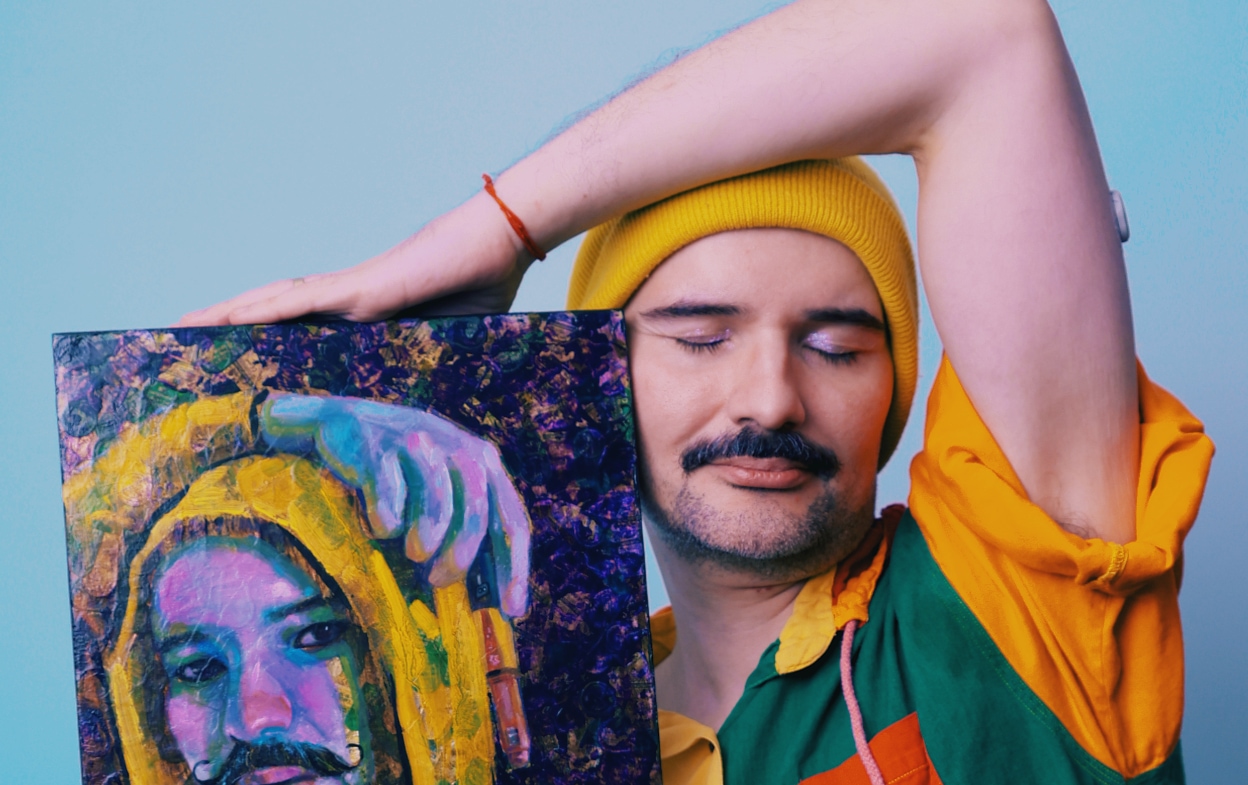
My figures are photographic montages made from my own body, multiplied and rearranged. This gives me a source, not an answer. I decide where one body interrupts another, where a hand belongs, what a face withholds, and how much the pose can carry before it becomes too explanatory.
The black contour line carries the narrative. It is not simply an outline around a figure. It can separate one state of being from another, join bodies that cannot be reduced to one body, or make a gesture feel interrupted. In works such as Becoming, the line is part of the movement. In David, it establishes a different kind of pressure: a body viewed through a history that has rarely made room for queer self-authorship on its own terms.
I make decisions about recognition as well. A body can be legible without being fully available. That distinction matters to me. The painting does not owe immediate disclosure to the viewer. It needs enough visual clarity to hold attention, then enough ambiguity to continue working after the first look.
This is where queerness enters the work as structure rather than illustration. It appears in multiplication, collision, posture, and refusal. Identity is movement. It changes shape under the gaze, but it does not disappear.
The Order of Materials Is Never Automatic
After the textured ground, I work with colored pencil, gouache, flat matte acrylic, marker, and gesso again, in the order the painting demands. Some decisions need the dry drag of pencil. Others need gouache to establish an opaque interruption, or marker to make a line more immediate. A further application of gesso can obscure what came before while allowing its pressure to remain.
Then oil arrives as the final skin of the painting. Oil is not the first material I reach for, even though it is where the work ultimately settles. It changes the temperature of every color beneath it and gives the surface another duration. Fat-over-lean governs only this oil phase. It is a technical rule, but it also asks for patience. I cannot force a later oil passage to solve a decision the earlier layers have not earned.
In I’m Perfect, But Unreal, that final skin matters because the title already sets a demand. Perfection can be a performance. Unreality can be an exposure. The painting needs material contrasts sharp enough to make that tension visible without turning it into a slogan.
Color Carries Its Own Ethics
My palette is specific: raw umber, yellow ochre, burnt sienna, ivory black, buff titanium, titanium white, cadmium yellow, cadmium red, magenta, and ultramarine. I use chromatic grays in backgrounds and skin because gray can hold more than absence. It can keep several temperatures present at once.
Not every red means the same thing. When I paint pain, the red is transparent alizarin crimson mixed with raw umber, never cadmium. Cadmium red has a different insistence. It announces itself. Alizarin crimson with raw umber can stay close to the surface, darkened but still luminous, as if the color has passed through something rather than landed on it.
This is why color is never an accessory. In Stone Woman and Compassion, every adjustment in value changes the emotional distance between the figure and the field. A warmer gray may bring the body forward. A cooler one may make the contour carry more weight. There is no universal correct choice. There is only the choice that allows this painting to remain itself.
The Collector Sees the Result, Not the Hesitation
Collectors often encounter the final decision first: the painting on a wall, the black field behind a tropical bird, the accumulated surface, the body held in a decisive contour. But the finished work contains the decisions that were rejected as much as those that remain.
The tropical bird paintings, including Hummingbirds, Tuiuiú, and Peacock Feathers, use black fields not as empty space but as a condition of visibility. Against black, color becomes more accountable. A feather cannot rely on atmosphere. Its shape, color, and edge must hold.
That same discipline runs through the smaller works, including Kratos and Zeus. Scale changes the number of available gestures. A small painting cannot absorb indecision through excess. It asks for compression. Every mark has to earn its place.
For me, the many decisions in a painting are not evidence of difficulty for its own sake. They are the means by which a work becomes precise enough to carry desire, diaspora, Brazilian memory, conflict, and resilience without flattening any of them. The work must stay open, but not vague.
Ararinha Azul is available, alongside original works and prints from my studio. For collectors who want to follow what comes next, join the email collector list for first access to new paintings and exhibition news.