The best tropical bird paintings do more than describe plumage. They make color, scale, and the pressure of a living body feel inseparable.
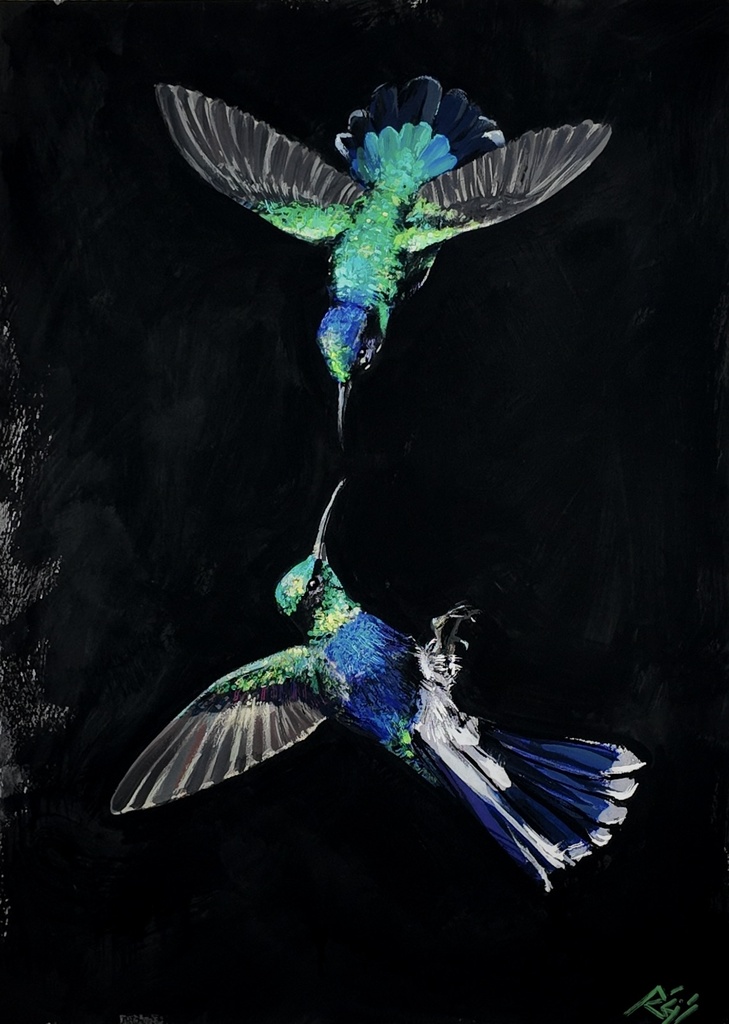
In Ararinha Azul, the blue bird holds its position against a black field that refuses decoration. The blue is not a tropical shorthand. It is a measured interruption in the dark, a concentrated presence with nowhere to disappear. This painting belongs to a group that includes Hummingbirds, Tuiuiú, and Peacock Feathers. Each work asks a simple question: what remains when a bird is painted not as ornament, but as a figure with consequence?
What Makes the Best Tropical Bird Paintings Last
A tropical bird can be immediately legible. Scarlet, cobalt, yellow, green. The risk is that recognition becomes the whole experience. A painting may offer visual pleasure and still stop at the surface of its subject.
The paintings that stay with me give the bird a formal role beyond identification. Its silhouette directs the eye. Its color establishes tension. Its posture holds a charge that cannot be reduced to natural history or interior decoration. The bird is specific, but it is not trapped by illustration.
This matters to collectors because a painting lives over time. It changes as a room changes, as the viewer changes, and as the light shifts across its surface. A work chosen only for its palette can quickly become familiar. A work with a deliberate structure keeps making demands.
In my bird paintings, black is not a background applied after the subject. It is an active field. It presses against color and gives each feathered form its edge. The black field looks like absence, yet it carries the greatest weight in the painting. That tension allows a blue, red, or yellow passage to appear less decorative and more exact.
Color must have a job
The strongest bird paintings understand that bright color needs resistance. Without a dark, muted, or chromatic counterweight, vivid hues can flatten into spectacle. I work with raw umber, yellow ochre, burnt sienna, ivory black, buff titanium, titanium white, cadmium yellow, cadmium red, magenta, and ultramarine. These colors do not arrive as a fixed system. They are adjusted according to what the surface and image require.
My red of pain is transparent alizarin crimson mixed with raw umber, never cadmium. That distinction is material and emotional. Cadmium red can declare itself too quickly. Alizarin crimson and raw umber hold depth without becoming theatrical.
Chromatic grays are equally necessary. They appear in backgrounds and skin, preventing the image from dividing into bright subject and neutral support. In a tropical bird painting, gray can make a blue feel truer. Brown can give yellow its force. The brightest passage needs somewhere to return from.
Best Tropical Bird Paintings Begin With Material Decisions
Before color settles into the image, I prepare a heavily textured gesso ground. Ridges and drags determine how light will behave later. This is not a neutral preparation. It is the first compositional decision.
The process then moves through colored pencil, gouache, flat matte acrylic, marker, and gesso again, in the order the painting demands. Oil comes last, as the final skin. Fat-over-lean governs the oil phase only. It does not describe the earlier materials, which have their own friction and timing.
A collector looking at a painting in person can often recognize this history without needing every step named. The surface does not behave uniformly. Some areas absorb light; others return it. Pencil may hold a line beneath paint. Marker can preserve a sudden decision. Oil closes the work while allowing the earlier marks to remain present.
That material record is central to how I judge a painting. The bird should not sit on the surface like a completed logo. It should seem accountable to the ground beneath it.
The black contour line carries the image
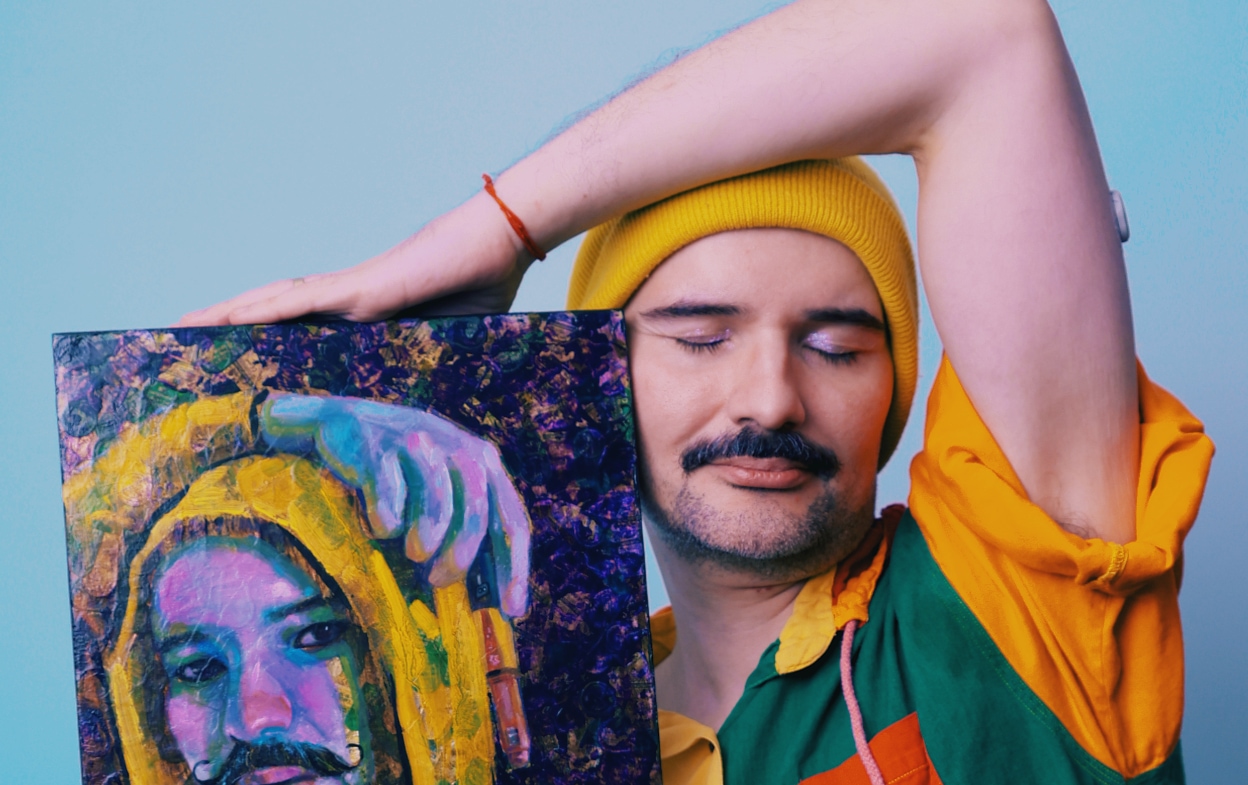
My figures begin as photographic montages of my own body, multiplied and rearranged. The black contour line carries the narrative through those paintings. In the bird works, it continues that discipline. A contour is never only an outline. It decides where a form becomes vulnerable, where it becomes insistent, and where it refuses to resolve.
This is one reason birds belong to the larger arc of my work. They are not a departure from the body. They extend an investigation of identity as movement, self-authorship, desire, and survival. The bird is a distinct form, but it also contains a way of being seen.
Brazilian visual memory is present here without becoming scenery. The ararinha azul is named in Portuguese because that is its true name. The tuiuiú carries its own specific cultural and ecological presence. I do not use these birds to make an image feel generically Brazilian. Their names, colors, and forms arrive with histories that deserve precision.
Four Works, Four Different Pressures
Hummingbirds holds the speed associated with its subject, but speed alone is not its subject. The work is about concentration. A small body can command a large visual field when the surrounding space has been built to answer it.
Ararinha Azul places blue under pressure. Against black, the bird becomes less a symbol of abundance than a presence that must be regarded carefully. The painting asks the viewer to stay with that contrast rather than consume it quickly.
Tuiuiú turns toward a bird whose body carries a different architecture. Its long, decisive structure changes the rhythm of the image. The painting does not need to amplify the subject with excess color. Its force comes from the relationship between form, contour, and field.
Peacock Feathers narrows the attention to pattern. Feathers often invite easy admiration, and that is precisely why they must be handled with discipline. Pattern can seduce the eye, but paint has to give it weight. Repetition becomes meaningful when each mark has a different pressure, edge, and degree of opacity.
These original works are available through my studio, alongside prints of the same paintings. Originals are priced by size. For a collector deciding between them, scale matters, but so does the role a work will play in a collection. A painting with a single concentrated bird may create a sharper encounter. A work built around feathers or multiple forms may sustain a longer, more dispersed reading.
Choosing a Bird Painting for a Serious Collection
The right painting depends on what it can hold after the first encounter. A collector may be drawn to the high contrast of a bird on black, to a particular Brazilian reference, or to the physical density of oil over mixed media. Those are valid entry points. They should not be the final criteria.
Look at the edge between bird and field. Look at whether the color has been earned by the rest of the palette. Look at whether the surface keeps its own intelligence when viewed closely. Then step back and ask whether the image holds its structure from across the room.
For design-conscious spaces, a black field can create a strong visual anchor without requiring a room to become monochrome. For an established collection of figurative work, these paintings can introduce avian form while remaining committed to the body, line, and social subject that run through my practice. Context changes the reading. The material decisions remain.
My current work continues toward Beyond the Contour, my solo exhibition at The Show Gallery in Toronto in April 2026, and Archive of Unstoppable Bodies at Pride Toronto ArtZone, CF Toronto Eaton Centre, in June 2026. The birds belong to that continuing chapter. They are not decorative pauses between figures.
A painting of a tropical bird should remain vivid after its color becomes familiar. The works available from my studio ask for that slower attention. Inquiries are open, and collectors may join the email list for first access to new originals.