Buying an unframed painting means buying the work before a frame interprets it. Look closely at its surface, edges, scale, support, and condition, then choose a frame that protects the painting without reducing its character.
In Tuiuiú, the tropical bird stands against a black field that makes the painted body feel both contained and insistent. The black is not an empty backdrop. It is an active color plane, and an unframed edge lets that decision remain visible. This piece is available as an original.
Why buy a painting without a frame?
A frame can be necessary. It can also be too much. Unframed work gives you a direct encounter with the painting’s actual perimeter: the thickness of the support, the continuation of color around an edge, the places where a painted field stops decisively rather than decoratively.
For a collector, this creates freedom. You can select a frame that belongs to the architecture of your home, collection, or exhibition context. You can also preserve a painting’s unframed presence when the work is made to hold the wall on its own. The trade-off is responsibility: you must consider protection, handling, and installation rather than treating the frame as an afterthought.
A painting without a frame is not unfinished. It is open to a second decision, but complete in its own terms.
Start with the object, not the image
Digital images are useful, but they compress the physical information that often decides a purchase. Ask for the dimensions, medium, year, and whether the work is on stretched canvas, panel, or another support. These facts affect how a painting travels, hangs, ages, and receives a frame.
I begin my paintings with a heavily textured gesso ground. Ridges and drags are established before the figure or bird enters. They decide how light behaves across the surface. From there, I work with colored pencil, gouache, flat matte acrylic, marker, and gesso again, in the order the work demands. Oil is the final skin.
That sequence matters when you are looking at an unframed original. The side of the work may reveal material history. A raised gesso area may cast a small shadow. A matte passage may sit beside an oil passage with a different degree of reflection. These are not flaws to conceal. They are part of the object you are acquiring.
If the painting includes oil, the oil phase follows fat-over-lean. That is a technical principle governing flexibility within the oil layers. It does not describe every material beneath them. A collector does not need to become a conservator, but understanding the construction of a work leads to better questions and a more precise relationship with it.
What to ask before you commit
Ask whether the painting is ready to hang without a frame, whether hanging hardware is included, and whether the edges are intended to remain visible. Confirm the exact overall dimensions, including depth. A work that seems modest online can occupy a wall with great force once its depth and surrounding negative space are considered.
Condition should be described plainly. For a new work, ask how it will be packed and whether any drying time affects shipment. For any work, request current images in natural and raking light if surface texture is central to your decision. Raking light, cast from one side, is especially revealing for impasto and textured gesso.
Also ask what is included with the purchase: a signed invoice, a certificate of authenticity if the studio provides one, and care information. Direct questions are not impolite. They are the beginning of good stewardship.
Read the edges in a guide to buying unframed paintings
The edge is where painting meets the room. Some canvases carry color around the sides. Others hold a clean painted boundary on the face, making the stretcher depth a quiet architectural line. A floated frame, which leaves a narrow visible gap around the canvas, can respect this perimeter better than a conventional frame that covers it.
There is no universal correct choice. A narrow maple float frame can make a vivid work feel measured and contained. A black float frame can extend a dark ground outward, but it may also make the painting feel more severe. A natural wood frame can introduce warmth, although it can compete with raw umber, yellow ochre, or buff titanium already present in the palette.
In my work, chromatic grays carry much of the background and skin. They are mixed colors, not neutral absences. Consider that before choosing a frame in a strong white, bright gold, or heavily grained wood. The frame should create a threshold, not announce itself as a separate event.
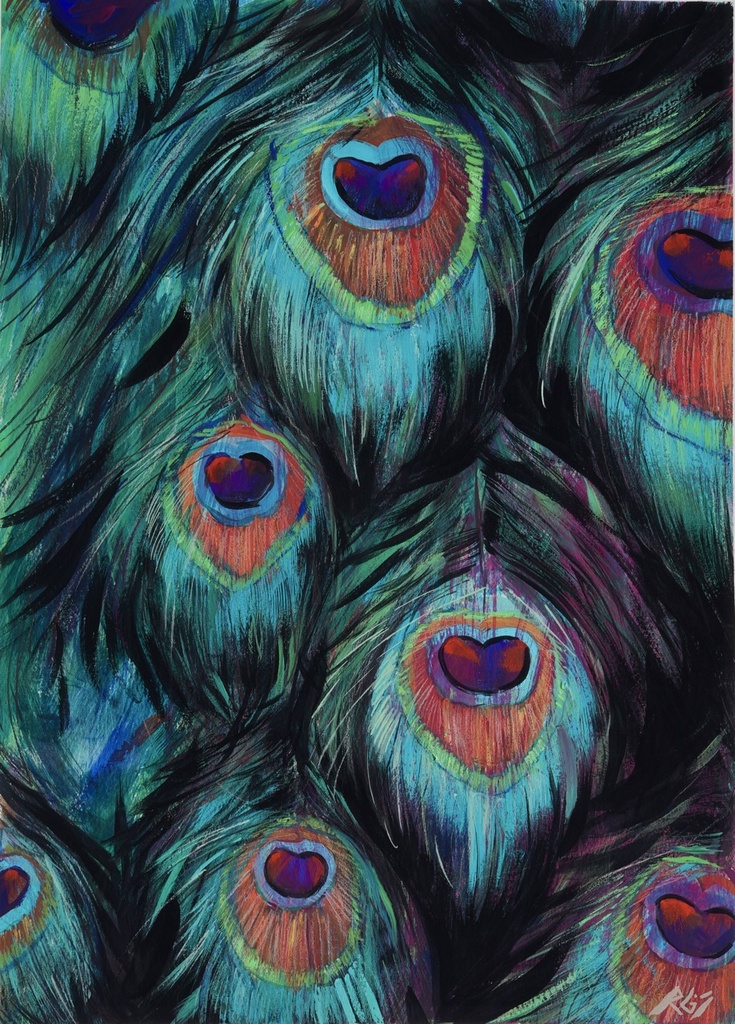
For Peacock Feathers, another available painting from the bird works, a float frame may preserve the tension between the tropical subject and its black field. For a smaller work such as Kratos or Zeus, the question changes. Small paintings can gain visual authority from a generous mat and frame arrangement, but only if the treatment does not make the work appear timid inside a large border.
Measure the wall honestly
Collectors often measure the blank wall but not the visual field around a painting. Leave room for the work to breathe. This is especially relevant for figurative painting, where a body can establish an immediate scale relationship with the viewer.
My figures are built from photographic montages of my own body, multiplied into a single painted presence. The black contour line carries the narrative across that construction. In works such as I’m Perfect, But Unreal, a frame can either preserve the pressure of that line or make it feel trapped. The answer depends on the wall, nearby works, and the frame’s depth.
Before deciding, mark the full dimensions on your wall with low-tack painter’s tape. Include the external dimensions of any proposed frame, not only the canvas itself. Stand back at the distance from which you will actually see the work. Then look from the side as well. Light from windows, sconces, and ceiling fixtures changes a textured surface throughout the day.
Let the frame protect rather than correct
A framer should understand contemporary original painting and use archival materials. The painting should not be pressed against glazing. For oil paintings on canvas, glazing is generally unnecessary and can complicate the relationship between the surface and reflected light. A frame should provide physical clearance and protect vulnerable corners during handling.
If you are shipping the work to a framer, keep the original packing until the framing is complete. Photograph the painting before it leaves the studio or your home, then photograph it again upon arrival. This is practical recordkeeping, not suspicion.
Choose a framer who will look at the painting itself before prescribing a solution. Bring images of the room, nearby works, and materials already present in the space. A good framer will ask where the painting will hang and how it will be lit. They will not assume that every original needs the same black float frame.
Buy the work that continues to ask something of you
The first question is not whether an unframed painting matches a sofa. It is whether its material decisions remain alive after the first impression. A black contour, an alizarin crimson mixed with raw umber for the red of pain, a dragged gesso field, a body divided and multiplied: these are choices that keep unfolding.
My paintings belong to a continuing arc of queer resilience, Brazilian memory, desire, and self-authorship. Yet the work arrives first as matter: pigment, pressure, contour, and surface. Stone Woman, Compassion, David, and Becoming each ask to be seen at that level before they offer larger meanings.
If you are considering an original, inquiries are open. Choose the work whose edge you want to keep seeing, even before you decide what will surround it.