The five questions before commissioning a portrait are direct: what the painting must hold, where it will live, what images can carry it, how the process will move, and what you are prepared to let remain unresolved. A strong commission begins before the first reference image is sent.
In Peacock Feathers, peacock feathers sit against a black field, where their color has nowhere to hide. The dark ground makes every shift of blue, green, and gold accountable. That pressure is useful when considering a portrait. A painting is not a decorative confirmation of a person. It is a constructed surface with its own decisions, weight, and duration.
1. What do you want the portrait to hold?
Start beyond resemblance. Resemblance matters, but it is the entry point, not the whole commission. Ask whether you want the work to hold a particular relationship, a moment of self-authorship, a family history, a gesture, a garment, or a place that has shaped you. The answer affects everything that follows.
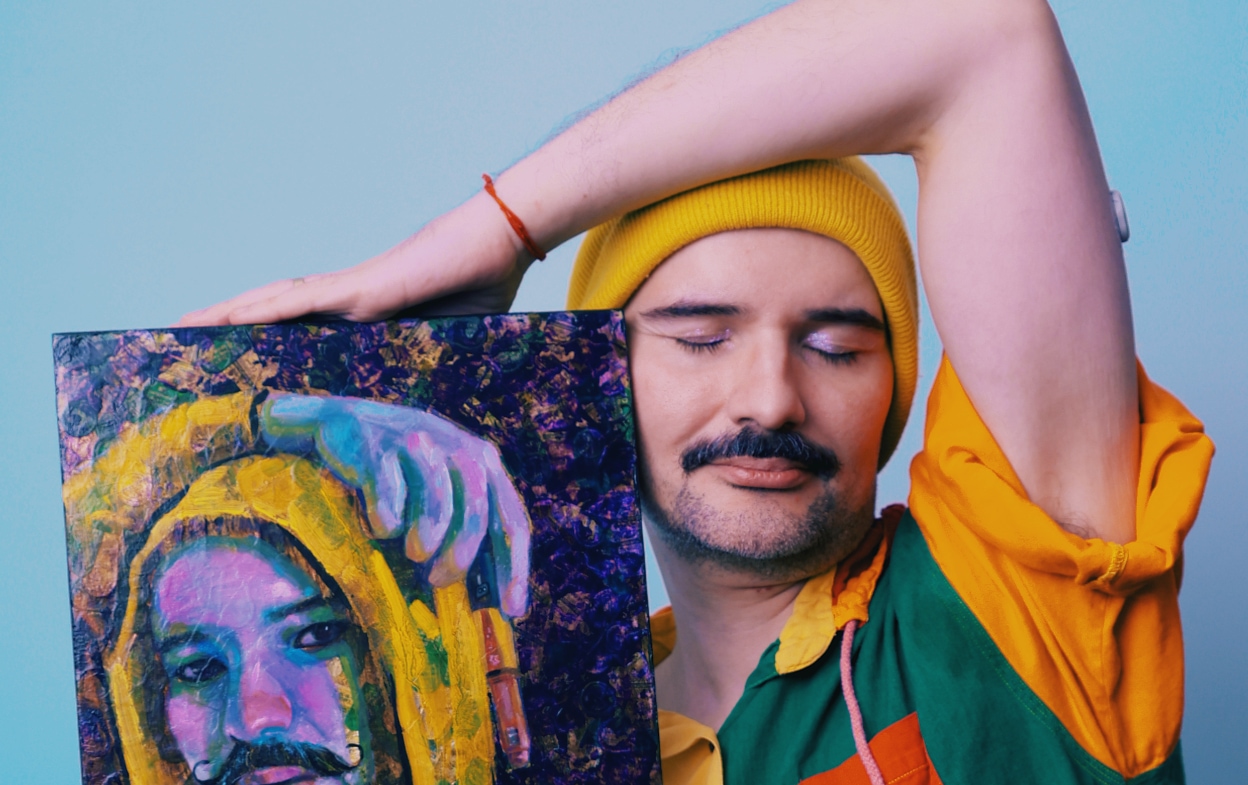
My figures are built from photographic montages of my own body, multiplied and reconfigured. The black contour line carries the narrative. It decides where one body ends, where another version begins, and where a gesture becomes an assertion. In a commission, I need to understand the image beneath the image: not only who is pictured, but what must be visible in the painting.
This does not require a polished statement. It may be as precise as: “I want the posture to remain formal, but not obedient.” Or: “This shirt belongs to my father, and the pattern cannot be simplified.” Specific language gives the painting something to answer.
A commission is intimate at its beginning, yet it must stand on its own as a painting. That is the paradox. The more honestly we define what matters, the less the finished work needs to explain itself.
2. What scale and setting will give it room?
Before commissioning a portrait painting, consider the wall as seriously as the subject. A small work can carry concentration and pressure. A larger canvas can give the body a different authority, allowing contour, gesture, and surrounding color to take up more space. Neither choice is automatically more significant. It depends on how you want to encounter the work each day.
Measure the intended wall and note the furniture, window light, and viewing distance. A portrait seen from across a room asks for a different structure than one encountered at arm’s length in a hallway or study. If the work is for a Toronto apartment, an American home, or a collection that moves between residences, practical dimensions still shape the image. Scale is not administration. It is part of the painting’s syntax.
I price original works by size. Establishing the intended dimensions early allows the commission to be discussed plainly, including the relationship between the painting, its site, and the available budget. A commission should have enough physical room to become more than an enlarged photograph.
3. Which source images tell the truth without becoming instructions?
Reference images are necessary, but they are not the painting. Send photographs with enough information to work from: clear views of the face and body, details of clothing or objects that matter, and images that show how someone occupies space rather than only how they pose for a camera. Several images are usually more useful than one perfect-looking portrait.
Light matters. So does resolution. A photograph taken in soft daylight may reveal a different structure than one made under overhead lighting. If a specific color must remain legible, include an additional image of it. Cadmium yellow, magenta, ultramarine, raw umber, and ivory black do not behave like pixels. Each color has a material presence and changes beside another color.
I work through montage rather than transcription. That leaves room for the painting to decide its own composition. It also means a commission is not a promise to duplicate every photographic accident. The point is not to remove the life from the source image in pursuit of perfect polish. The point is to identify the visual facts that deserve to survive transformation.
If privacy is part of your concern, say so at the outset. Decide what images may be retained for the working process and whether the completed portrait may be shared publicly. Clarity creates the conditions for concentration.
4. Do you understand how the surface will change the image?
My process begins with a heavily textured gesso ground. Ridges and drags decide how light behaves before color enters. Over that ground, I use colored pencil, gouache, flat matte acrylic, marker, and gesso again, in the order the work demands. Every painting ends in oil. Oil is the final skin.
That sequence has consequences for a commission. A smooth photographic finish is not the destination. The ground may interrupt a contour. A matte passage may sit beside a richer oil passage. A chromatic gray may carry more of a face than a local flesh tone would. These are not effects applied after the fact. They are how the painting thinks.
Oil itself follows fat-over-lean only in the oil phase. Earlier materials are part of a separate structure, established before that final skin. When I use red for pain, it is transparent alizarin crimson mixed with raw umber, never cadmium red. The distinction matters because transparency and opacity create different kinds of pressure on the surface.
Look at a work such as I’m Perfect, But Unreal when considering this question. The title already refuses a simple reading of completion. A commission can be beautiful without becoming agreeable. If you are drawn to my work, you are likely responding not only to a figure but to the insistence of its materials.
5. What does collaboration require from both of us?
A commission needs a defined process, not endless adjustment. I request a 50% non-refundable deposit to begin. The work includes two revision rounds. Those rounds are there to address meaningful questions of composition, emphasis, and direction while the painting is developing. They are not an invitation to restart the work after every stage.
Before confirming a commission, we should agree on the subject, dimensions, references, timeline, and any nonnegotiable details. I also need to know where flexibility is welcome. Sometimes a collector cares deeply about a hand position but is open to the background. Sometimes the opposite is true. Naming those priorities protects the work from vague expectation.
The best revisions are concrete. “Keep the collar edge sharper” is useful. “Let the background carry more weight” is useful. “Make it better” is not yet a direction. A painting develops through decisions, and collaboration works when those decisions can be named.
Commissioning as part of an ongoing body of work
A commissioned portrait enters a practice already in motion. Works such as Stone Woman, Compassion, David, and Becoming belong to an ongoing inquiry into body, desire, discipline, diasporic memory, and self-authorship. Queer resilience, painted, is not a slogan placed over the surface. It emerges through material choices, repeated bodies, black contour, and the unstable border between exposure and control.
My Brazilian formation remains present in this work without becoming scenery. Three years of Baroque training in São Paulo taught me to take structure seriously: how a body occupies a picture plane, how darkness can organize color, how attention can be built rather than assumed. The studio is now in Toronto, but the cultural memory does not become fixed there. It moves.
For collectors, commissioning can be a way to bring that movement into a personal space without reducing it to a private souvenir. The portrait has a source. It also has a life beyond that source. That is what makes the decision worth making carefully.
If you can answer these questions with specificity, inquiries are open. For earlier access to available originals, prints, and new work, join the collector list for first access.