A ridge of gesso catches light before a figure arrives. It holds a shadow, interrupts a brushstroke, refuses to disappear. This is where my mixed media figurative artworks begin: not with an image of a body, but with matter that has already made a decision.
Texture is never background - it is biography. The surface establishes pressure, resistance, and tempo. By the time the figure enters, the painting has a history.
Matter Before the Figure
I build each ground with heavily textured gesso. I drag it, gather it, leave it uneven. Some passages rise into relief; others remain almost bare. The ridges determine how light will move across the painting from its first hour to its last.
This is not preparation in the passive sense. Gesso is construction. It sets the terms of the work before color can seduce the eye or contour can name a form. A smooth surface can offer clarity. A worked surface offers consequence. I need consequence.
Impasto occupies physical space. It is the part of a painting that cannot be reduced to an image on a screen. It protrudes. It casts its own small shadows. In my work, it speaks to what a life carries visibly: accumulation, insistence, the refusal to flatten oneself for a cleaner picture.
The ground also prevents the figure from becoming illustration. A figure can be recognizable and still remain unresolved. That tension matters to me. Representation is only the threshold.
How Mixed Media Figurative Artworks Hold Time
After the gesso ground, I add materials in the order the feeling demands. Colored pencil often arrives first, laying down a fine and searching line. Gouache may follow, then acrylic for flat matte passages that hold color without shine. Markers bring a graphic insistence. At times, gesso returns over all of it, not to erase but to build again.
Each material has a different authority. Colored pencil can hesitate. Acrylic can declare. Marker can cut through indecision. Gouache can make a color appear dry, intimate, withheld. These are not interchangeable effects. Their differences allow a painting to carry several registers at once.
Mixed media is often described as variety. For me, it is friction. One material interrupts another. A matte field meets an oily glaze. A pencil line remains visible beneath a later veil. What is concealed still acts on what is seen.
This is why the layers are not a technical flourish. They are the structure of meaning. Sgraffito, for example, is one sensation cutting through another. A line scratched into a painted passage can feel immediate because it is immediate. It exposes a decision rather than polishing it away.
Accumulated glazes hold slow time. They do not announce themselves from across the room, yet they alter the depth of a face, a background, or a hand. They ask for proximity. A painting should reward that kind of looking.
The Final Skin Is Oil
Every painting ends in oil. Oil is the final skin, not the whole story. It gives the surface a particular density and permits glazes that pull light inward, then return it gradually to the viewer.
The oil phase follows fat-over-lean. This principle belongs to oil, not to the earlier mixed-media layers. I use it with discipline because technical care is not separate from expression. A painting needs to endure its own intensity.
My palette is deliberately grounded: raw umber, yellow ochre, burnt sienna, ivory black, buff titanium, titanium white, cadmium yellow, cadmium red, magenta, and ultramarine. These colors create heat, weight, and interruption. They also let chromatic grays recur in backgrounds and skin, where certainty gives way to atmosphere.
A white can be present without behaving as white. Buff titanium can mute a passage without killing it. Black can desaturate, but so can a complementary color placed with restraint. The result is not neutrality. It is tension held in color.
The red associated with pain is not cadmium red. I build it from transparent alizarin crimson and raw umber. It glows from within the layers rather than sitting on top of them. That difference is essential. One red signals. The other remains.
The Figure Is a Montage, Not a Single Witness
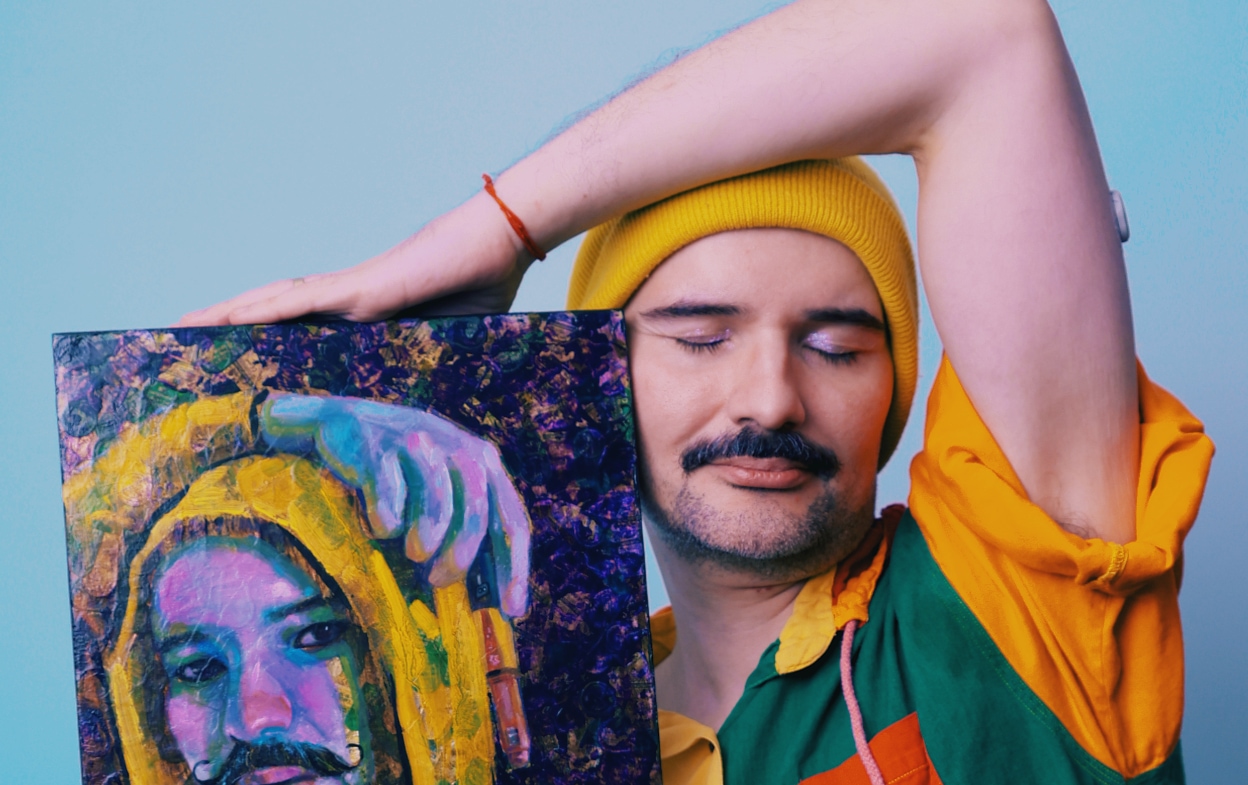
The figures begin with photographic montages of my own body, multiplied and rearranged. I am present, but never alone in the image. A shoulder may repeat. A face may turn toward another version of itself. Limbs can establish a rhythm that exceeds portraiture.
This multiplication gives the figure a different kind of agency. It does not stand in for a fixed identity. It becomes a site of movement, contradiction, desire, and self-authorship. Queer life is not an accessory to the formal work. It is carried by the formal decisions: repetition, contour, overlap, refusal of a single stable pose.
Black contour lines carry the narrative. They organize the figure while also allowing it to rupture. A contour can protect a form. It can also trap it. I use that double function deliberately.
The resulting image may appear direct at first glance. But directness is not simplicity. The painting asks what happens when a body is both archive and invention, both familiar and continuously remade.
Brazilian Memory, Toronto Light
My relationship to Brazilian visual memory is specific. It lives in the tonal intelligence of earth colors, in graphic pressure, in the crowded coexistence of beauty and difficulty. It is not a decorative reference. It is a way of seeing that stays with me.
Working in Toronto has sharpened that perception. Light here can be crisp, pale, and severe; it reveals the surface differently. The studio holds both geographies without forcing them into agreement. Diaspora is not a split screen. It is a layered ground.
That is part of the continuing arc of Prismatic Identity and the work moving toward Beyond the Contour. The paintings do not restart with each series. They continue to test how a figure can contain history without becoming trapped by it.
What Collectors Receive From the Surface
For collectors, mixed media figurative work offers more than a subject to live with. It changes across distance and time of day. From across a room, the figure may command the composition. Up close, pencil, gesso ridges, scumbled color, and scratched marks take over. The painting has more than one pace.
That complexity asks something of the space around it. A highly textured work benefits from shifting natural or directional light. A quieter room can make its layered passages more legible. Yet the work should not be treated as fragile decoration. It has been built to hold attention, not merely complement a wall.
Acquiring directly from an artist also preserves the work's context. Dimensions, materials, year, and exhibition history matter. So does knowing that a painting belongs to an ongoing practice rather than an isolated image. The object carries its own record of decisions.
Original paintings and prints are available directly from my studio. For collectors and curators following new chapters as they emerge, the collector list offers first access. Inquiries are open.
A painting does not need to explain every layer to be felt. But when you stand close enough to see gesso beneath pencil, or alizarin crimson breathing under oil, the image becomes more than a figure. It becomes evidence that presence is made, remade, and held.