A ready painting is the right choice when you want to respond to a finished artistic decision. A custom portrait is the right choice when your presence belongs inside the work from its first decisions.
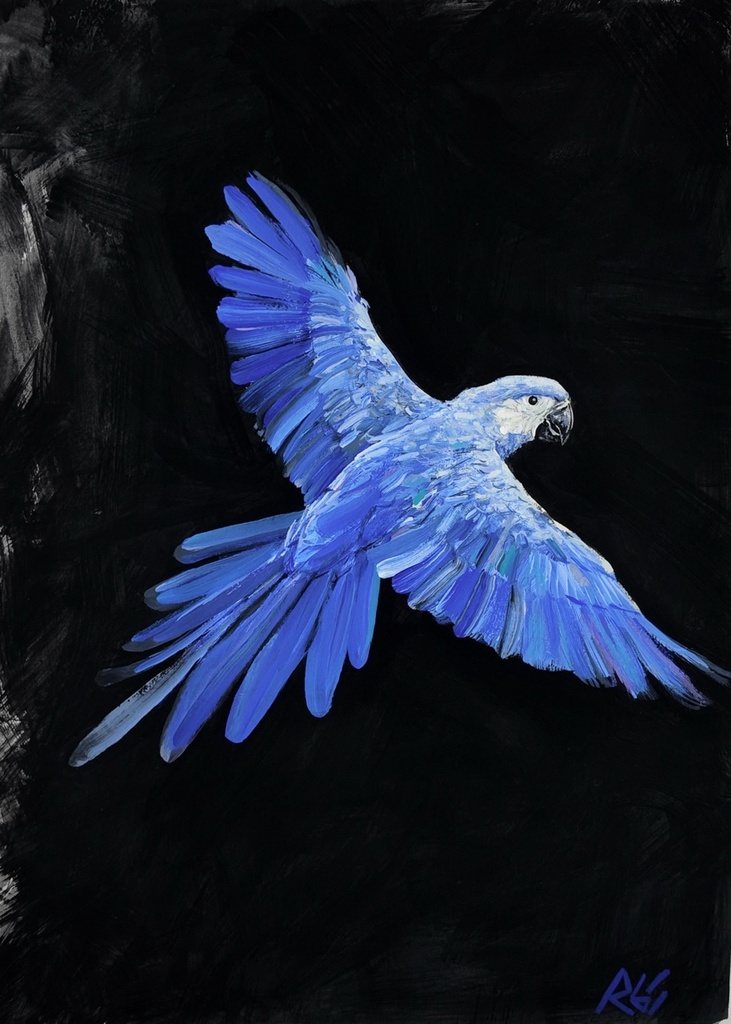
In Ararinha Azul, a blue bird holds its place against a black field. The image is already complete in its refusal to decorate the room politely. Its color, scale, surface, and silence were resolved in the studio before anyone asked for it. That is the essential distinction: one work asks to be recognized; the other asks to be made in relation.
Custom Portraits Versus Ready Paintings: The Real Difference
The difference is not simply personal subject matter versus a painting already on the wall. Both can be intimate. Both can become central to a collection. The question is where the conversation begins.
With a ready painting, the conversation begins with the painting itself. You see the evidence of a completed sequence: a heavily textured gesso ground, its ridges and drags deciding how light will behave; colored pencil and gouache; flat matte acrylic; marker; another return to gesso; then oil as the final skin. The order changes according to the work. Oil comes last, and fat-over-lean governs that oil phase only.
You are not commissioning an image you already know. You are choosing a surface that has already established its terms. A work such as I’m Perfect, But Unreal carries its own condition before it enters a collector’s home. It does not need to resemble you in order to be exact about a life.
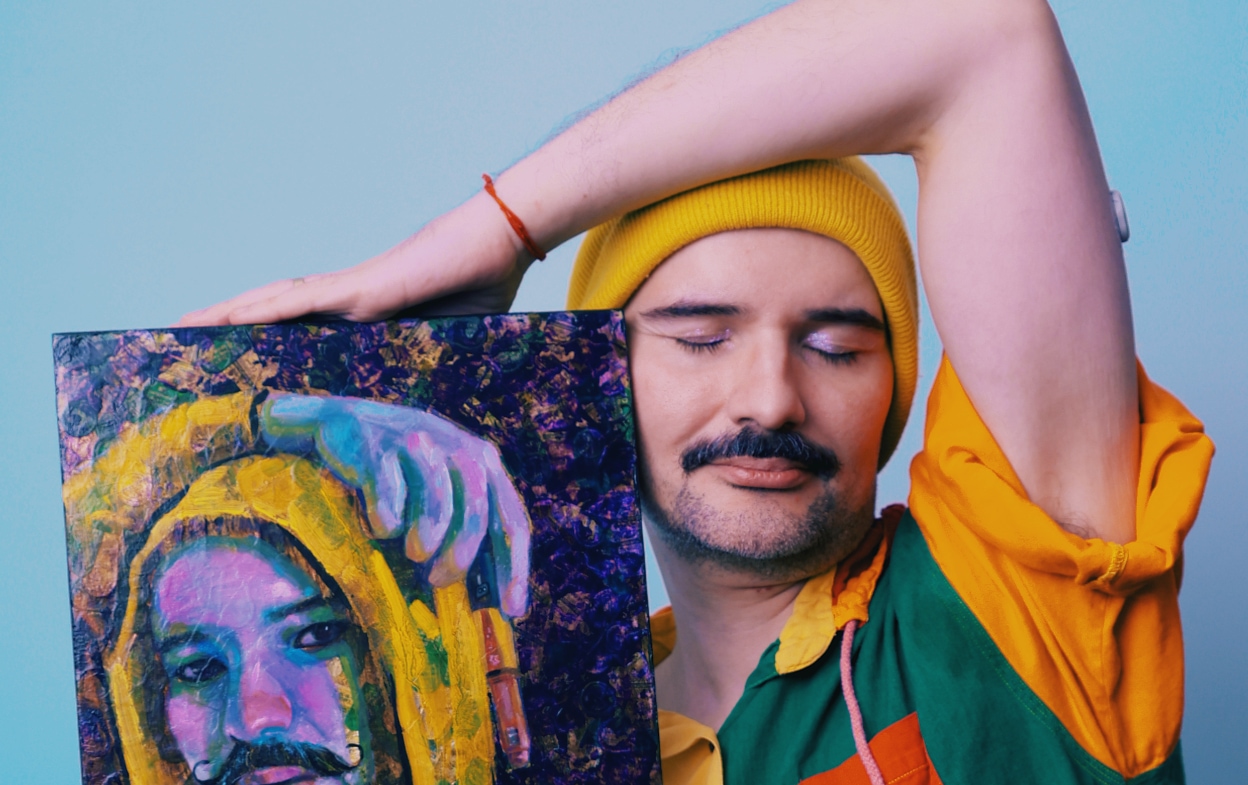
A custom portrait begins earlier. It begins with correspondence, reference material, a conversation about scale and placement, and the question of what must remain visible. That does not mean the collector directs every mark. It means the painting has a particular point of contact with a particular person, family, or space.
Commissioning is collaborative, but it is not customizable in the retail sense. That is the paradox: a portrait becomes more personal when it is not treated as a product specification. My responsibility is to make a painting, not to imitate a photograph without consequence.
What You Receive From a Ready Painting
A ready painting offers immediate visual and material certainty. You can respond to the actual work rather than a proposal for a future work. You know whether the black contour line has the pressure you want, whether the chromatic greys in the skin hold the room at a distance or draw it closer, whether the surface asks for a sustained look.
This matters for collectors building a considered group of works. A painting already in progress within an artist’s practice arrives with a history. Hummingbirds, Tuiuiú, and Peacock Feathers belong to a group of tropical birds on black fields. They are not illustrations of place. They carry Brazilian visual memory through compression, contrast, and the theatrical refusal of the black ground.
The same is true of smaller works such as Kratos and Zeus. Scale can alter the physical encounter, but it does not reduce the painting to a study or accessory. A small work can hold a concentrated decision. It may be the right acquisition for a collector who wants proximity to the hand, the contour, and the layered ground without asking the artist to redirect an existing chapter of work.
Ready paintings also make sense when timing is practical. An original is available, its dimensions and materials are known, and its place in the studio is clear. For a designer or collector working with an established wall, that certainty can be decisive. The work has already answered the formal questions. Your task is to decide whether its answer belongs with you.
What a Custom Portrait Makes Possible
A commissioned portrait makes room for a subject that cannot be found in the existing body of work. It may be a person, a relationship, an interior history, or a form of self-authorship that needs a different image. The portrait does not erase the artist’s language to make room for the sitter. It tests that language under new pressure.
My figures begin as photographic montages of my own body, multiplied and rearranged. The black contour line carries the narrative. In a commission, reference material becomes part of the conversation, but the painting still passes through this method: fragmentation, multiplication, contour, and an encounter between body and ground.
Color is also specific. My palette includes raw umber, yellow ochre, burnt sienna, ivory black, buff titanium, titanium white, cadmium yellow, cadmium red, magenta, and ultramarine. The red associated with pain is transparent alizarin crimson mixed with raw umber, never cadmium red. That difference is not a technical flourish. Transparency changes the emotional weight of the color, allowing the ground and earlier layers to remain present.
For a portrait, these decisions become part of the commission’s meaning. A collector may recognize their own experience in the finished painting, but likeness is only one form of recognition. The stronger question is whether the work has made a body visible without making it simple.
Commissions require a 50% non-refundable deposit and include two revision rounds. These revisions are for the development of the agreed direction, not an endless negotiation after the painting has found its structure. Clear boundaries protect the work and the relationship around it.
Choosing by Relationship, Not Category
There is no hierarchy in which a commissioned portrait is automatically more meaningful than a ready painting. A work made before you encountered it can still seem to have been waiting for your wall. A portrait made with you can become too literal if the process leaves no room for the painting to resist expectation.
Consider a ready painting when you are drawn to a work’s completed presence, its formal decisions, and its place in an ongoing body of work. Consider a commission when the subject itself is necessary and you are prepared to give the process time, trust, and specificity.
For curators and institutions, the distinction can be equally useful. A ready work may clarify a sequence already visible in paintings such as Stone Woman, Compassion, David, or Becoming. A commission may create an occasion for a new relation to site, audience, or collection. In either case, the strongest acquisition is one that does not ask the painting to become merely illustrative.
The Painting Must Keep Its Autonomy
Whether I make a portrait from a commission or offer an existing original, the painting must remain autonomous. Its surface cannot become background information. Its body cannot become a symbol with only one reading. Queer resilience, painted, is not an assigned message. It is a visual pressure held in the contour, the repeated body, the black field, and the insistence of color.
That autonomy is what lets a work continue after the first encounter. It can belong to a home while retaining its own terms. It can hold diasporic memory without becoming a souvenir of Brazil. It can make desire visible without reducing it to confession.
Original paintings are priced by size, and prints are available for collectors who want to live with an image in another format. For those considering a portrait, inquiries are open. For those waiting for the right finished work, join the collector list for first access.
Choose the painting that gives you more than recognition. Choose the one that continues to ask something of your eye.