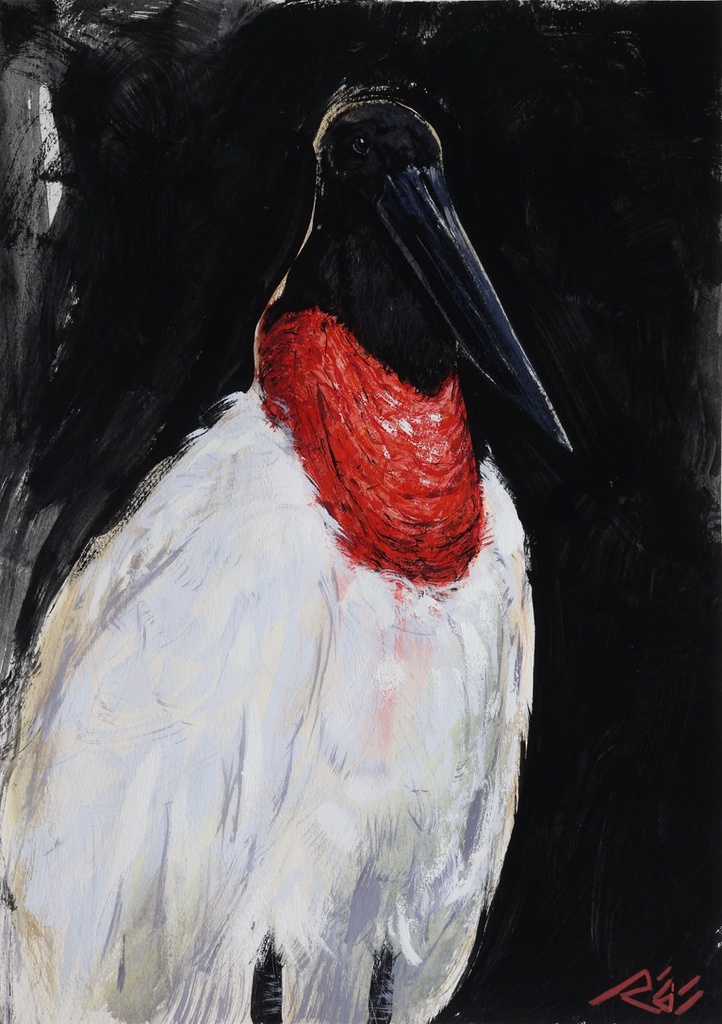
A ridge of gesso catches light before any figure arrives. It interrupts the smooth certainty of a blank panel. It makes a decision visible. That is where the question, why do artists use gesso, becomes more than a technical one. Gesso is not simply preparation. It is the first event in a painting.
I begin there: with a heavily textured gesso ground. I drag it, build it, leave ridges where light can later collect or refuse to settle. The figure comes after. The color comes after. Texture is never background - it is biography.
Why do artists use gesso as a painting ground?
At its most functional, gesso prepares a surface for paint. It creates a stable, receptive ground over canvas, wood panel, or paper made for painting. Without it, paint can sink unevenly into a porous surface, lose brilliance, or behave in ways the artist did not choose.
But function is only the beginning. Gesso also changes the character of the surface. A smooth application offers clarity, control, and an almost photographic sharpness. A rough application catches pigment, breaks a line, and puts atmosphere into the work before the image exists. The same oil paint can appear measured on a sanded ground and restless on a ridged one.
This is why a white ground is not neutral. It already has temperature, absorbency, and light. It already has a history of touch.
For painters working in oil, gesso also helps separate the painting layers from the raw support. A properly prepared surface supports adhesion and gives the work a more dependable structure over time. The exact method depends on the support and materials involved. Acrylic gesso is widely used because it is practical and flexible. Traditional grounds behave differently and demand a more specific process. There is no universal ritual, only materials that must be understood on their own terms.
Gesso controls light before color does
A painting does not begin with color theory. It begins with how light meets matter.
On a flat, white gesso ground, light moves broadly and cleanly. The surface can make transparent passages feel open and bright. On a textured ground, light fractures. It lands on the raised edge of an impasto mark, slips into a trough, and makes shadow part of the composition. A figure may be painted in a restrained palette, yet the ground can keep the entire work active.
That distinction matters in figurative painting. A contour line may describe an arm, a shoulder, a face, or a doubled pose, but the ground determines whether that line sits quietly or has to contend with a physical terrain. I want that contention. Black contour lines carry narrative in my paintings, but they do not float above a passive field. They cross a surface that has already declared itself.
A smooth ground can be right for precision. It can serve a sharply observed portrait, a luminous glaze, or a composition that needs visual silence. Heavy texture brings another charge. It makes paint physical. It allows the painting to hold what cannot be reduced to illustration.
In my process, gesso is construction
The gesso ground is the first chapter, not an undercoat to be covered up. I build it before the photographic montage of my own figure enters the painting. Its ridges and drags decide how light will behave across the whole surface.
Then the layers arrive in the order the feeling demands: colored pencil for fine line; gouache; acrylic for flat matte passages; markers for graphic line; gesso again as construction. This return to gesso is essential. It can conceal, interrupt, raise an edge, or make a plane feel excavated rather than filled.
Only then is the work finished in oil. Oil is the final surface, the layer that gathers what came before without erasing it. Fat-over-lean belongs to this oil phase. It is not a rule imposed across every mixed-media decision beneath it. Materials have their own logic. Respecting that logic gives the painting freedom rather than limiting it.
The sequence changes from work to work because feeling does not move in a straight line. Still, the ground remains the site of commitment. It is where I decide that the painting will retain evidence of pressure.
Impasto occupies physical space in a life. Accumulated glazes carry chronic, slow time. Sgraffito is one sensation cutting through another. Gesso makes room for all three conditions before oil brings them into relation.
Gesso can reveal as much as it conceals
Many artists use gesso to cover a previous mark, correct a passage, or reclaim a surface that has become too resolved. That act is often misunderstood as erasure. In practice, it can be a way of preserving tension.
A veil of gesso may mute a drawing without eliminating its insistence. Marker lines can show through as a memory. A raised white passage can force the next layer to move around it. What looks concealed is still present, pressing from underneath.
This is especially powerful when a painting concerns identity, desire, and self-authorship. These subjects do not need to be announced to be felt. A surface that has been built, covered, scraped, and rebuilt can hold contradiction with more force than a polished image alone. The material does the speaking first.
In my palette, chromatic grays recur in backgrounds and figures. Raw umber, yellow ochre, burnt sienna, ivory black, buff titanium, titanium white, cadmium yellow, cadmium red, magenta, and ultramarine each meet the ground differently. A warm white can make an ochre passage feel close. A cooler ground can sharpen ultramarine and magenta. Desaturation through black or complementaries lets brightness remain earned rather than automatic.
Even red has to be built with care. The red of pain is not cadmium. I use transparent alizarin crimson with raw umber, allowing it to glow from inside the layers. On a textured gesso ground, that glow catches and breaks. It refuses to become a flat signal.
The trade-off: preparation can become control
Gesso offers possibility, but it can also create habits. A heavily sanded surface may encourage caution. A textured one can become mannerism if every painting receives the same terrain. The question is not whether texture is better than smoothness. The question is whether the ground belongs to the work being made.
Too much absorbency can pull the life from early paint layers. Too much texture can compete with a delicate drawing. Too many coats can make a support feel sealed and distant. Too few can leave the artist fighting the raw material instead of using it. These are not failures of gesso. They are conversations between process and intention.
For collectors, the ground is worth looking at closely. Notice where light gathers on a raised passage. Notice whether a contour crosses smoothly or catches at an edge. Look for the places where a later layer has allowed an earlier decision to remain visible. Those details are not decorative finish. They are part of how a painting holds time.
A ground is a position
Gesso gives paint somewhere to arrive, but it also asks the artist to arrive first. Before the figure becomes legible, before the palette declares its temperature, the surface establishes what kind of resistance the work will carry.
That is why I return to it. Every new painting continues an investigation already in motion: what a figure can contain, what a contour can withhold, what a surface can remember. The ground does not wait quietly beneath the image. It remains active, catching light and insisting on its own presence.
When you encounter a painting, look beneath the color without trying to separate it from the image. The first decision may still be there, in a ridge of white, holding the entire composition up.