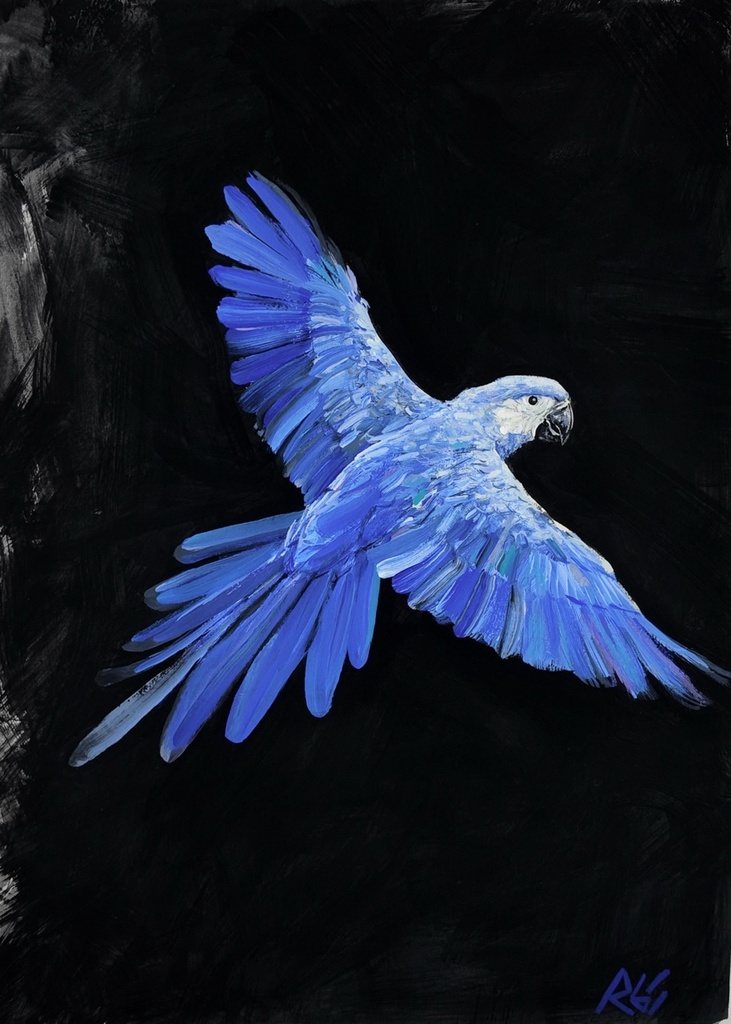
A print begins with a surface. Not a promise. Not a smaller substitute for a painting. Paper receives pigment differently than canvas receives oil. Its white has a temperature. Its edge sets a boundary. Art print value begins there: with the physical decision to let an image live again, through another material and at another scale.
I make work from accumulation. A heavily textured gesso ground comes first, before the figure. Ridges and drags decide how light will behave. Then come colored pencil, gouache, acrylic, marker, and gesso again as construction. Oil arrives last, the final skin. When a work becomes a print, that history is translated, not erased. A strong print carries the pressure of the original forward.
Art Print Value Is More Than an Image
Many people can reproduce an image. Value enters when reproduction remains tied to authorship, intention, and a discernible body of work. A print made from an artist's painting is not simply decorative access to a composition. It is a different encounter with the painting's color, contour, and rhythm.
The distinction matters. An open, unsigned reproduction made for broad circulation has one role. A print created by the artist, produced with care, marked as part of a defined edition, and connected to a continuing practice has another. Neither needs to be dismissed. But they should not be confused.
For collectors, the question is not only, “Do I want this image on my wall?” It is also, “What does this object carry?” A meaningful print carries a relationship to the artist's hand, choices, and visual language. It carries a place in time. It may belong to a particular exhibition, series, or moment in a practice that continues to develop.
In my paintings, black contour lines hold the narrative together. The figures begin as photographic montages of my own body, multiplied into relation. Their gestures are not illustrations of identity. They are identity in motion. A print can make that language available in a more intimate format, while preserving the tension that made the original necessary.
What Determines Art Print Value?
Edition structure is one of the clearest signals. A limited edition states that a specific number of prints will be produced at a particular size and with a particular process. The number is not magic by itself. An edition of 20 is not automatically more compelling than an edition of 50. What matters is clarity, consistency, and the artist's commitment to the terms of the edition.
A collector should be able to understand what they are acquiring: the edition size, the print dimensions, the paper or support, the production method, the year, and whether the work is signed and numbered. These details establish provenance from the start. They turn a print into a documented artwork rather than an anonymous copy.
Material quality also matters, though it should not become a fetish. Archival paper, stable inks, precise color management, and careful handling protect the work's presence over time. Yet a technically polished print without visual force remains only technically polished. Material supports value. It does not invent it.
Scale changes the experience as well. A small print asks for proximity. It enters a reading corner, a desk, a private wall. A larger print can reorganize a room, allowing a figure or field of color to assert itself across distance. Neither scale is inherently superior. The right scale depends on how the composition breathes and where the collector wants to live with it.
Then there is the image itself. A print has lasting resonance when it carries a visual proposition beyond a passing trend. The ochres, raw umber, buff titanium, and chromatic grays in my work do not function as atmosphere alone. They create friction between warmth and restraint. Transparent alizarin crimson mixed with raw umber makes a red of pain that glows from inside the layers. Even in print, that red must hold its depth. If it becomes merely bright, the work has lost part of its truth.
The Original and the Print Have Different Jobs
An original painting contains its literal surface. Impasto occupies physical space. Sgraffito records one sensation cutting through another. Glazes gather time in thin veils. No print can duplicate every ridge of gesso or every shift in oil. It should not pretend to.
A print offers another kind of closeness. It gives collectors access to an image and its ideas without requiring the same spatial or financial commitment as an original painting. That is not a lesser form of collecting. It is a distinct one.
For an emerging collector, a print can be the first work that establishes a long relationship with an artist. For an established collector, it may sit beside an original, extending the conversation between different periods or series. For a curator or design-conscious buyer, it can introduce a specific visual language into a space with precision.
The trade-off is directness. With an original, you encounter the object that received every mark. With a print, you encounter the artist's image through a carefully made translation. Value does not require those experiences to be identical. It requires the distinction to be honored.
Context Gives a Print Its Place
A print gains depth when it belongs to a visible arc. My work moves through Prismatic Identity, Beyond the Contour, and Archive of Unstoppable Bodies as connected chapters. The material changes. The scale changes. The questions press differently. But the body remains a site of self-authorship, desire, discipline, and refusal.
Context is why a print with a clear series title, year, and edition information carries more weight than an isolated image without history. It can be located within an artist's development. It can be discussed, exhibited, and remembered. It has a frame beyond its frame.
Brazilian memory enters my palette and my sense of visual density, but it is never costume. Toronto is part of the present tense of the work: a city where many lives overlap, misread one another, and insist on being seen. A print that comes from this practice carries more than a figure. It carries the conditions under which that figure was made.
Collectors sometimes ask whether a print will increase in monetary value. No artist can offer that as a certainty. Markets move. Attention moves. What can be assessed now is more concrete: the integrity of the edition, the quality of production, the strength of the image, the coherence of the artist's practice, and the record that follows the work from studio to collector.
How to Choose a Print You Will Keep Looking At
Start with the image, not the edition number. Stand with it, even if only through a screen at first. Ask whether the composition continues to reveal pressure, relation, or contradiction after the first glance. Decorative ease has its place. But the works that stay with us usually resist being exhausted quickly.
Then look for the facts. Confirm dimensions, edition details, date, materials, signature, and condition. Consider where the print will live, including the light it will receive and the wall around it. A print is a physical object before it becomes a statement about taste.
Finally, choose from a practice you want to follow. The strongest collection is not built by chasing predictions. It is built through attention. You notice an artist's motifs returning in altered form. You see a contour become sharper, a palette become quieter, a figure claim more space. The print becomes part of that unfolding.
A print should ask something of the room it enters. It should hold color with conviction, keep faith with its source, and remain open enough to meet you differently over years. When that happens, its value is already at work. For available prints and first access to new editions, inquiries are open and the collector list receives studio news first.