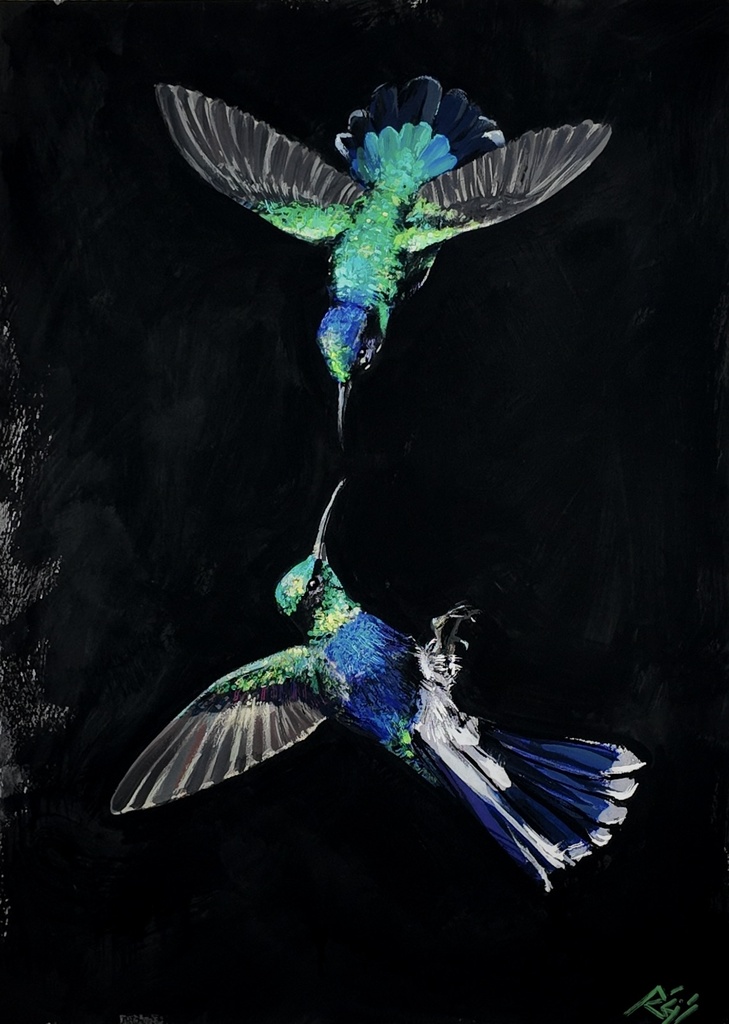
The black begins before the bird. It begins in gesso: dragged, ridged, interrupted, left to catch light unevenly. I build the ground until it holds its own weather. Only then can a wing arrive.
In my paintings, tropical birds on black are not an illustration of paradise. They are a pressure against disappearance. Color becomes more exact when darkness refuses to behave like empty space. A yellow can flare. A red can deepen. A contour can carry a whole history without explaining itself.
Tropical Birds on Black Are Never Decoration
A bird carries a dense visual history. In Brazil, tropical imagery has often been extracted, polished, and sold back as a postcard. I have no interest in repeating that flattening. The birds I paint do not stand in for an easy elsewhere. They arrive with excess, watchfulness, appetite, and escape.
Their color belongs to a specific visual inheritance. It recalls the saturated force of Brazilian street graphics, carnival surfaces, domestic fabrics, and the long afterimage of flora and fauna made consumable for foreign eyes. But memory is not a souvenir. It resists the frame placed around it.
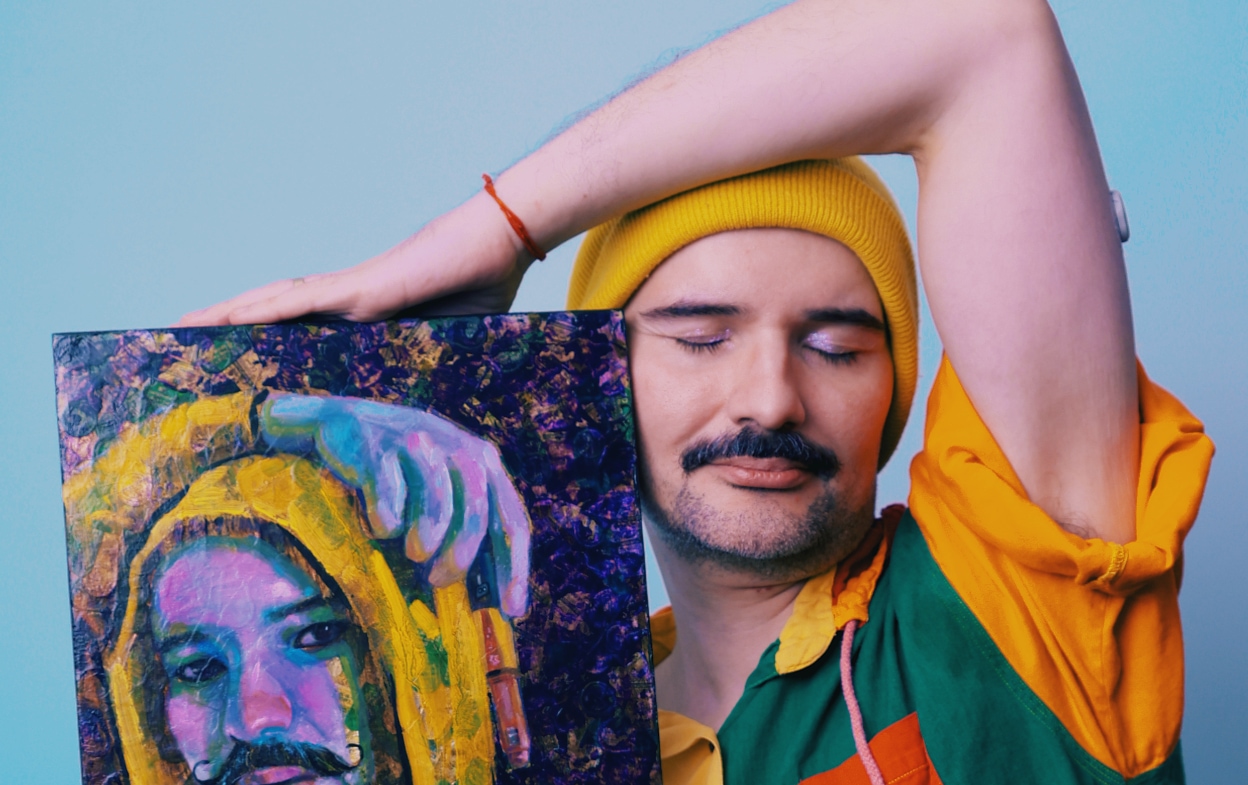
Against black, a bird can become a witness. It can also become a double. Its plumage may echo the figure beside it, or interrupt the figure's authority. This matters in a practice where the body is never singular. I build photographic montages from my own body, multiplying posture and gesture until one person becomes a crowd of possible selves. The bird enters that crowd without asking permission.
Black is not absence. It is a field with weight. It can hold a figure forward, absorb a color, or make a line feel newly exposed. It is both shelter and confrontation.
Matter Decides What the Image Can Say
Every work starts with a heavily textured gesso ground. I use ridges, drags, and built-up passages to decide how light will move across the surface long before a figure takes shape. Texture is never background. It is biography.
The next layers do not follow a fixed visual recipe. They follow the feeling demanded by the work. Colored pencil brings fine line and hesitation. Gouache offers opacity with a dry insistence. Acrylic establishes flat, matte passages. Markers sharpen graphic edges. Then gesso returns, not as correction but as construction.
These materials let the painting contain different speeds. A precise pencil mark can sit beside a blocked acrylic shape. A marker line can refuse the soft authority of paint. A scraped section can expose what the surface tried to bury. Sgraffito is one sensation cutting through another.
Only after this architecture is built do I finish the painting in oil. Oil is the final skin. It holds depth differently from every layer beneath it, allowing translucency, density, and reflection to coexist. Fat-over-lean governs this oil phase, but the painting's logic begins much earlier, in the physical fact of its ground.
For collectors, this is part of what an image on a screen cannot fully deliver. The black field may appear flat in reproduction. In person, it changes with position and light. A dark passage can reveal a dragged gesso edge. A wing can rise from an impasto mark. The surface has a life that cannot be reduced to color alone.
The Bird, the Figure, and the Black Contour
My figures are assembled from photographs of my own body. That choice gives the work a fixed source, but not a fixed identity. The body can be multiplied, fractured, softened, enlarged, or held inside a black contour that seems to protect it and contain it at once.
The contour line carries narrative. It tells the viewer where a form ends, then makes that ending unstable. Sometimes it behaves like drawing. Sometimes like a boundary. Sometimes like a declaration made under pressure.
Tropical birds sharpen this tension. A beak, a claw, or the arc of a wing can echo the figure's own line. The relationship is not always gentle. I am not interested in presenting nature as moral decoration, or the human figure as its calm center. The bird may claim more visual force than the person. It may become the loudest body in the painting.
That reversal has consequence. Queer life is often asked to remain legible, tasteful, and correctly placed. My work favors forms that exceed their assigned role. A figure does not need to be resolved to be present. A bird does not need to symbolize freedom in order to move through the painting with force.
Color Needs Darkness to Speak
My palette is grounded in raw umber, yellow ochre, burnt sienna, ivory black, buff titanium, titanium white, cadmium yellow, cadmium red, magenta, and ultramarine. These are not decorative choices. Each color has a role in the painting's internal temperature.
Raw umber can anchor a warm shadow without deadening it. Yellow ochre gives light an earthy register. Buff titanium creates a white that is not white. Ultramarine can push a dark edge outward, while magenta refuses politeness beside a muted field.
The red of pain is never cadmium red. I make it with transparent alizarin crimson and raw umber, so it glows from inside the layers. It is a red that has traveled through darkness rather than landed on top of it.
I desaturate with black or with complementaries, depending on what the painting needs. Black can make a color feel private, almost withheld. Complementary color can leave more vibration in the surface. Chromatic grays recur in backgrounds and skin because neutrality is rarely neutral. A gray can hold green, violet, rust, and blue at the same time.
This is why tropical birds on black can remain strange rather than ornamental. The black does not simply make the colors brighter. It asks them to account for themselves. A brilliant yellow must decide whether it is light, warning, joy, or refusal.
A Continuing Archive of Movement
These paintings belong to an ongoing arc in my practice: bodies making space where space has not been freely offered. The bird is one more body within that archive. It moves across a field that is dark but never empty, carrying Brazilian memory without becoming a cliché of Brazil.
Impasto marks what occupies physical space in a life. Accumulated glazes hold chronic, slow time. A black contour can be a limit, then become a route through it. Painting is a frontier because the surface never asks a body to remain only one thing.
For a collector, living with this work means living with its changes. Morning light will find a different ridge than evening light. A bird that first reads as color may later read as resistance. The figure may recede, then return. The painting continues its argument.
Original paintings and prints are available directly from my studio. Inquiries are open, and the collector list receives first access to new work. Choose the piece that keeps changing its terms in front of you.