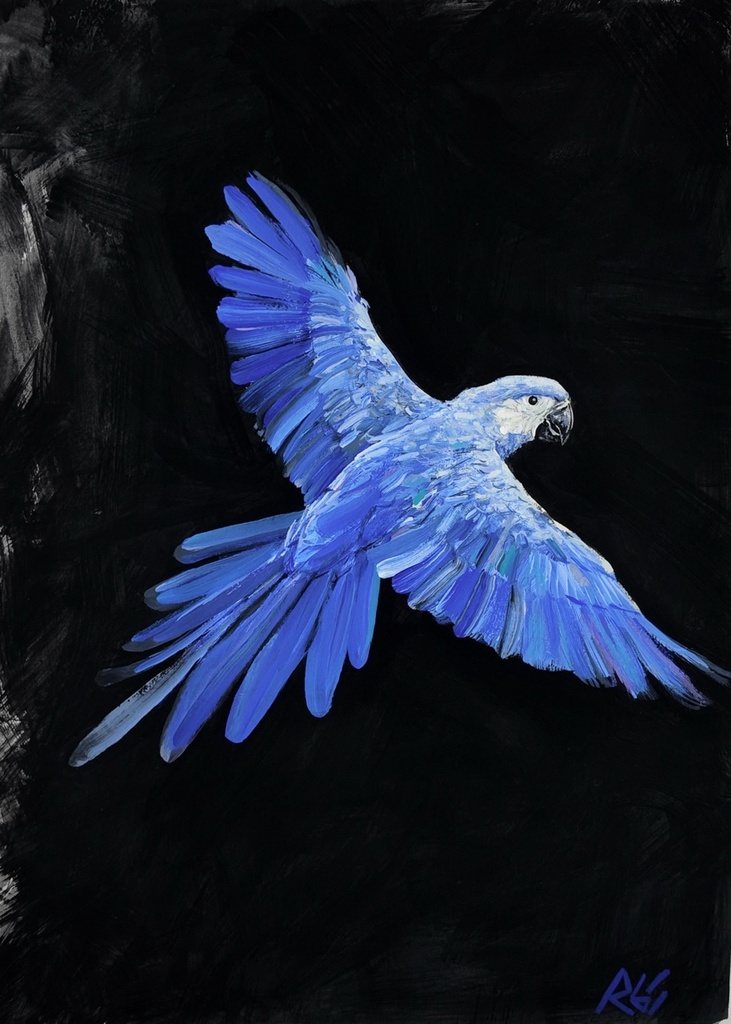
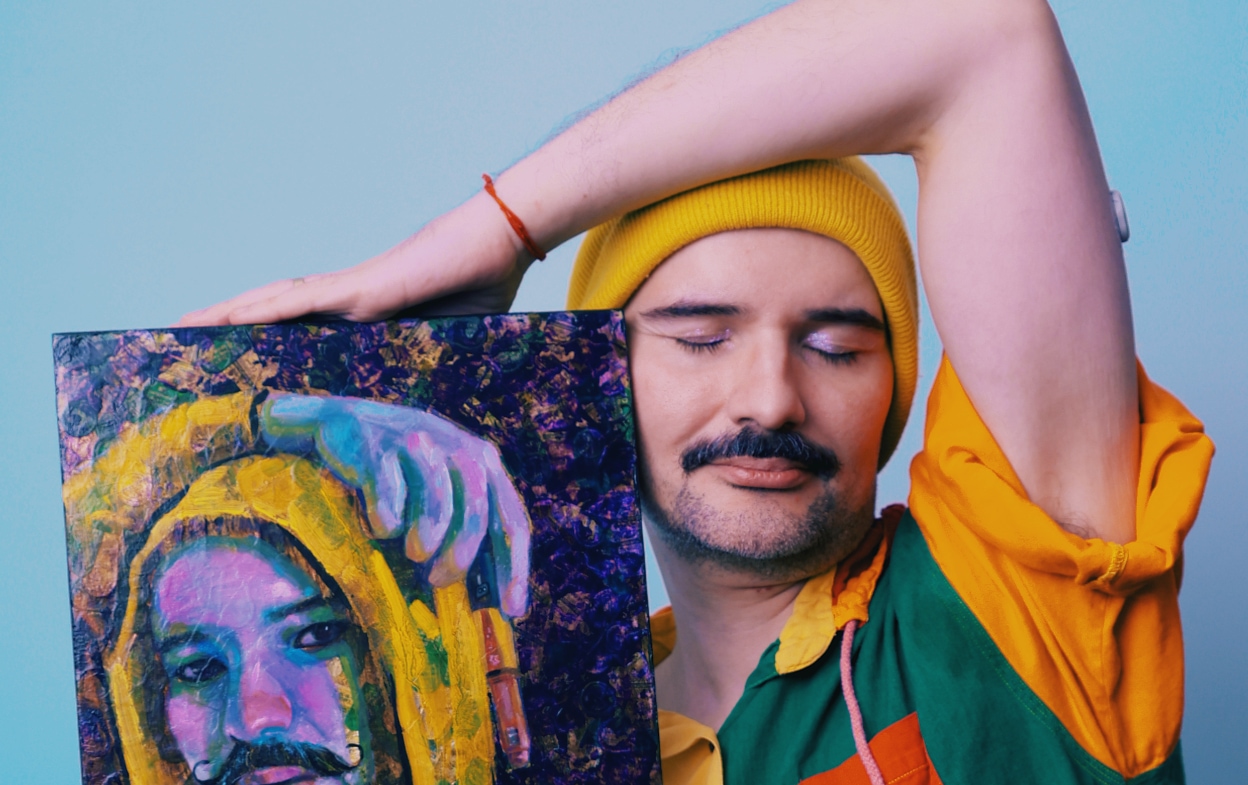
A ridge of gesso catches light before a figure appears. It interrupts the surface. It refuses neutrality. This is where symbolic contemporary portrait painting begins for me: not with a face to be recognized, but with matter that has already begun to speak.
The figure arrives later, assembled from photographic montages of my own body, multiplied and placed in relation to itself. Black contour lines hold the narrative together. They do not close the figure in. They make movement legible. A portrait can be a record of appearance. It can also be a site where desire, memory, contradiction, and self-authorship become visible at once.
Symbolic Contemporary Portrait Painting Starts With Matter
Texture is never background. It is biography.
Each painting begins with a heavily textured gesso ground. I build ridges, drags, dense interruptions. They determine how light will travel across the full surface long before color enters the work. A smooth ground offers one kind of promise. A resistant ground offers another. I am interested in resistance.
The surface carries its own past forward. Impasto occupies physical space, like what cannot be made small in a life. Sgraffito is one sensation cutting through another. Accumulated glazes hold slow time. These are not visual effects applied after the idea. They are the conditions that let the image mean what it means.
That is the first distinction worth making. Symbolic painting is not painting with a collection of coded objects scattered around a sitter. A flower does not become profound because it stands beside a face. Symbolism gains force when the material decisions, figure, palette, and composition all press toward the same emotional fact.
The Portrait Is Not a Fixed Identity
I use my own body as source material, but self-portraiture is not a closed room. Photographic montage lets a single figure become several presences: witness and protagonist, past self and projected self, a body held in tension with its own image. The result is not a stable identity. It is identity as movement.
This matters in queer figurative painting because visibility is never only about being seen. It is also about deciding the terms of that seeing. A black contour may carry protection, performance, insistence, or separation. Repeated limbs may suggest intimacy, labor, play, or a refusal to be reduced to one readable position.
The symbolic charge does not depend on a viewer knowing every biographical reference. A painting should remain open enough for another person to enter it. But openness is not vagueness. The work begins from lived specificity: Brazilian memory, queer presence, the visual pressure of public and private selves. It does not ask those histories to become universal by losing their texture.
Portuguese gives me certain rhythms that English cannot fully replace. Corpo is body, but it also lands with a density that I carry into paint. The body is not an illustration of an idea. It is the place where the idea has consequence.
A Symbol Is a Relationship, Not a Prop
A symbol works through relation. Raw umber against magenta can make a figure feel grounded and volatile at the same time. A field of chromatic gray can push a bright contour forward, then pull it back into ambiguity. A doubled figure can create a conversation without depicting a literal scene.
This is why the strongest contemporary portraits do not explain themselves too quickly. They offer evidence. They let a viewer feel the friction between what is shown and what remains unresolved.
For collectors, this is part of what allows a work to stay alive over time. A painting that gives everything away in one glance may still be decorative. A painting that continues to reorganize itself under different light, moods, and conversations becomes part of the life around it.
Color Carries the Argument
My palette is direct: raw umber, yellow ochre, burnt sienna, ivory black, buff titanium, titanium white, cadmium yellow, cadmium red, magenta, and ultramarine. These pigments are not chosen to make a world that is merely expressive. They build tensions between earth and heat, density and illumination, clarity and refusal.
A white is not always white. Buff titanium can hold warmth and sediment. Titanium white can arrive as glare, distance, or a cut across the surface. Black can deepen color, but it can also desaturate it into a chromatic gray that feels suspended rather than empty. Complementaries do this differently. Their gray keeps a hidden vibration.
The red of pain is not cadmium. It is transparent alizarin crimson mixed with raw umber, glowing from inside the layers. Cadmium red announces itself from the surface. Alizarin crimson can appear to have been there longer. It holds heat without surrendering complexity.
Color is therefore not an accessory to the portrait. It is part of the portrait's emotional structure. A yellow may be radiance, warning, or theatrical light. Ultramarine can make a shadow feel spacious rather than mute. The meaning changes with placement, opacity, and the marks beneath it.
The Image Is Built in a Necessary Order
After the gesso ground, I add mixed-media layers according to what the feeling demands. Colored pencil brings fine line. Gouache can establish a soft, absorbent shift. Acrylic creates flat matte passages. Markers sharpen a graphic line. Gesso returns as construction, covering, interrupting, and rebuilding what seemed settled.
Only then does oil become the final skin of the work. Fat-over-lean governs the oil phase, where paint moves with a different density and depth. Oil does not erase the earlier layers. It clarifies their pressure. A glazed passage can allow a pencil line to persist beneath it. An opaque plane can make a buried mark feel newly present.
This sequence matters because every medium asks a different question of the surface. Fine line can be intimate. Matte acrylic can be declarative. Oil can hold light in a way that seems to slow looking down. When these materials meet, the painting contains more than one register of time.
There is a trade-off. Too much control can make a symbol feel illustrated. Too much accident can make the surface busy without becoming meaningful. The work needs discipline, but it also needs the possibility that one mark will alter the whole decision.
What to Look for When Living With a Symbolic Portrait
A collector does not need a prescribed interpretation. Better questions are more useful. Where does the eye stop? Which passages sit on the surface, and which seem buried beneath it? Does the contour protect the figure, isolate it, or set it in motion? What changes when daylight falls across the gesso ridges?
Scale matters, too. A smaller painting can concentrate its pressure and reward close looking. A larger work can establish a physical relationship with a room, asking the viewer to meet it at the scale of presence. Neither is inherently more powerful. It depends on the architecture, the collection, and the kind of conversation the work is meant to hold.
Symbolic contemporary portrait painting asks for time, but it gives time back differently. Its meanings do not sit behind the image waiting to be solved. They move across the surface, in pigment, contour, and texture. They change as the viewer changes.
The current work continues through Prismatic Identity, Beyond the Contour, and Archive of Unstoppable Bodies. Each chapter returns to the same insistence: the figure is never finished by the outline around it. For collectors drawn to work with a lived point of view and formal consequence, inquiries are open for available original paintings and prints. Join the collector list for first access to new chapters from the studio.