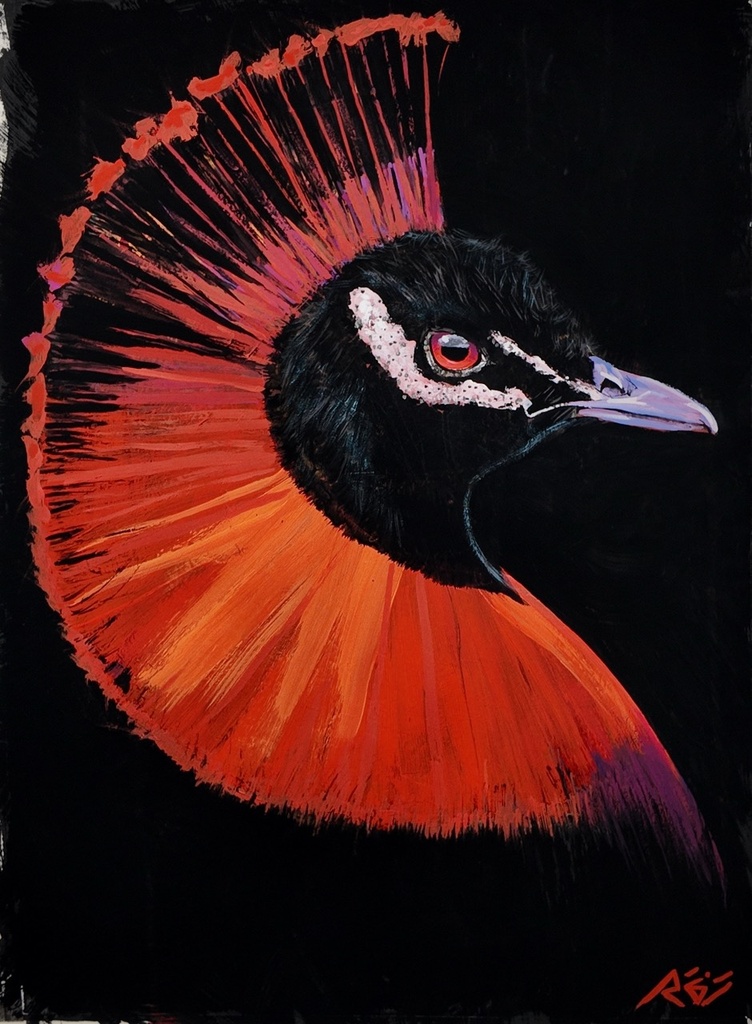
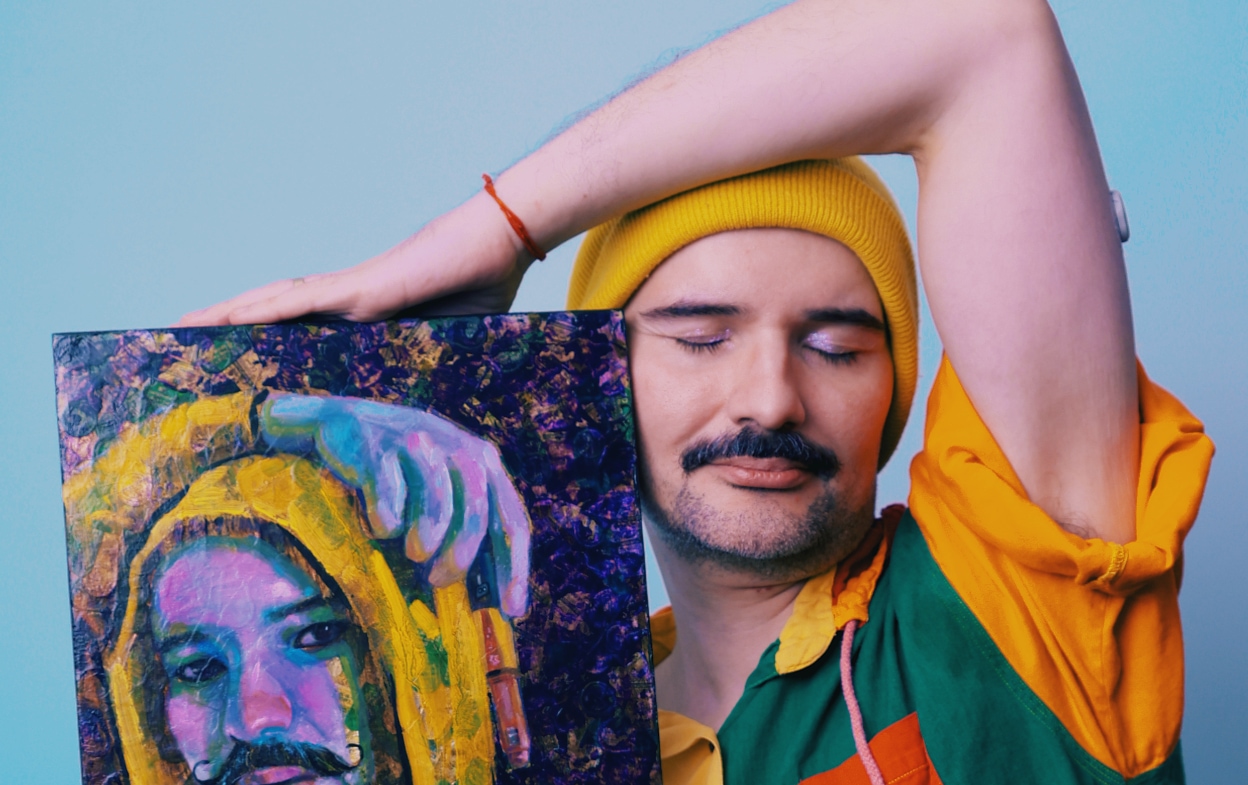
Before the figure, there is gesso. I drag it across the support until it rises into ridges, catches, and interruptions. Light has already been decided here, before a face, a hand, or a black contour line enters the painting. Queer resilience art begins for me in that physical resistance: texture is never background - it is biography.
A smooth surface can receive an image. A worked surface asks the image to negotiate. That difference matters. The figures I paint do not arrive as symbols of ease, nor as declarations made for a comfortable gaze. They occupy a field that has already endured pressure, revision, accumulation, and refusal.
Queer Resilience Art Is Not a Polished Story
Resilience is often made presentable. It becomes a clean arc: difficulty, triumph, closure. That version is useful to institutions because it is easy to display and easy to consume. It gives the viewer a finished lesson and lets everyone leave unchanged.
I am not interested in that resolution. Queer resilience art can hold force without pretending that force is painless. It can show pleasure beside vigilance, desire beside fatigue, glamour beside the marks of time. It can refuse the demand to become legible through suffering alone.
The queer figure has too often been asked to explain itself. To prove it belongs. To turn its complexity into an argument that someone else can approve. Painting offers me another condition. The figure does not ask permission to remain. It remains.
This is why the material life of a painting cannot be separated from its subject. An image of defiance on a passive surface would be too simple. I need the support to have its own weather. I need pigment to retain evidence of what came before it.
The Ground Carries the First Decision
Each work begins with a heavily textured gesso ground. I build it before the figure because the ground establishes the painting's first truth: nothing enters untouched. Ridges and drags determine how light will move across the entire surface. A raised passage may catch brightness while a recessed one keeps it withheld.
Then I work through mixed media in the order the feeling requires. Colored pencil brings a fine, intimate line. Gouache creates opacity. Acrylic establishes flat matte passages. Markers introduce graphic insistence. Gesso returns as construction, not correction. It may cover, interrupt, or open a new plane for the figure to inhabit.
Oil comes last. It is the final skin. Fat-over-lean governs only this oil phase, where the earlier materials remain embedded beneath glazes, opaque passages, and impasto. The painting does not conceal its structure. It lets structure become part of its emotional register.
Impasto is what occupies physical space in a life. It is presence that cannot be flattened. Accumulated glazes register slow time, one translucent decision holding over another. Sgraffito is one sensation cutting through another. These are formal choices, but they are never merely formal. They give the painting a way to speak before its figures are read.
A Figure Made From More Than One Image
My figures begin with photographic montages of my own body, multiplied and rearranged. One body becomes several positions. A shoulder may belong to one image while a face turns from another. The result is not fragmentation for its own sake. It is a refusal of the single, stable portrait.
Identity moves. It is revised by migration, language, memory, desire, labor, and the rooms where one has learned to take up space. As a Brazilian-born artist working in Toronto, I understand the self as something carried across borders without becoming less specific. The body brings its history with it. It also invents its next form.
Black contour lines carry the narrative through these shifting bodies. They do not simply define an edge. They create a decision between one color field and another, one gesture and the next. Sometimes they bind the figure together. Sometimes they expose the pressure of being held in view.
In the ongoing Prismatic Identity series, that pressure becomes chromatic and spatial. The figure is not a fixed emblem of queerness. It is a moving site of self-authorship. It can be intimate, theatrical, fragmented, direct. It can be all of these without becoming incoherent.
Color Refuses Innocence
My palette is built from earth and interruption: raw umber, yellow ochre, burnt sienna, ivory black, buff titanium, titanium white, cadmium yellow, cadmium red, magenta, and ultramarine. Color is not an accessory to the narrative. It is where the narrative gains temperature.
A white can be a white that is not white. Buff titanium may carry more silence than titanium white. A chromatic gray can be more alive than a bright field because it contains the tension of opposing colors. I desaturate with black or complementaries when the image needs restraint, density, or distance. These grays recur in backgrounds and skin because the world is rarely made of pure notes.
The red of pain is not cadmium. It is transparent alizarin crimson mixed with raw umber, glowing from inside the layers. Cadmium red announces itself. Alizarin crimson and raw umber remain interior. They allow heat to rise through the painting rather than sit on its surface.
That distinction is central to queer resilience art. Not every act of endurance needs to perform loudly. Some force is declarative. Some is private. Some appears as a saturated field; some arrives as a dark red held beneath a glaze. Painting can contain both without ranking one above the other.
Beyond Representation
Representation matters. Seeing queer life in a museum, a corporate center, a private collection, or a domestic space still changes the terms of visibility. But representation alone is not the horizon. A queer figure can be visible and still be made passive by the image around it.
I want the paintings to have agency at every level. The ground resists. The color complicates. The contour directs. The figure returns the viewer's gaze, or withholds it. This is not an illustration of identity. It is identity as movement.
That is the continuing arc behind Archive of Unstoppable Bodies and Beyond the Contour. Each chapter asks what happens when the body is allowed to exceed the frame assigned to it. Not by becoming abstract, and not by becoming exemplary, but by becoming more present. The paintings insist that a life can be dense, sensual, difficult, and fully authored at once.
For collectors, this is also where formal power and lived perspective meet. A painting must continue to give after its first impact. It should change with morning light, hold its own beside other works, and reveal a new decision at close range. The material complexity is not a supplement to the image. It is the reason the image remains active.
Original paintings and prints from this continuing body of work are available directly from my studio. For collectors and curators following new chapters as they emerge, the collector list offers first access.
Live with an image long enough to notice where the surface refuses to settle. That is often where the painting begins to tell the truth.