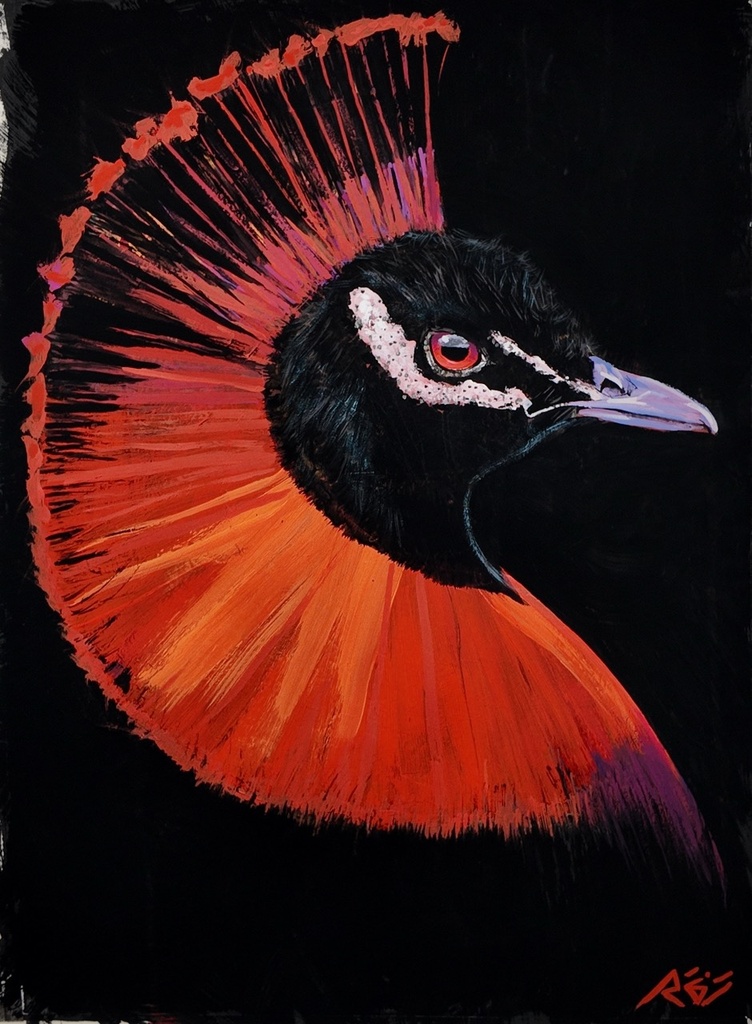
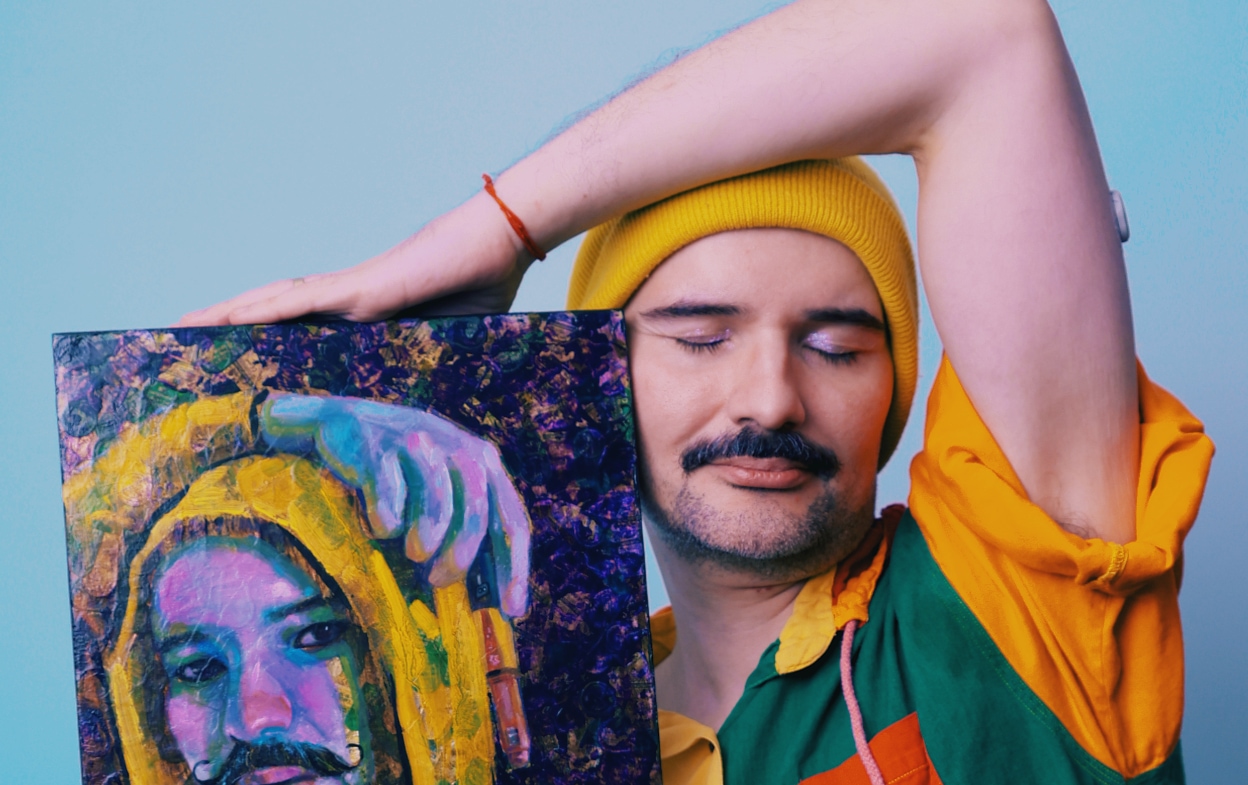
A ridge of gesso catches light before a face appears. It interrupts the clean promise of likeness. It makes the surface answer back. That is where portrait commission examples become useful: not as a catalog of poses, but as evidence of what a painting can hold when resemblance is only the beginning.
A commissioned portrait can record a person. It can also make room for their contradictions, their chosen family, their private symbols, and the history carried by a body in public. I am interested in the second possibility. The image must be recognizable, certainly. But recognition without pressure is only illustration.
What a Portrait Commission Can Be
The most compelling commission begins with a question sharper than “Can you paint this photograph?” A photograph is source material. A painting is an encounter with time, pigment, and scale.
My figures begin as photographic montages of my own body, multiplied and rearranged. For a commission, the equivalent is not a single perfect reference image. It is a constellation: photographs, gestures, clothing, a room, a color that belongs to memory, an image that keeps returning. The subject may be one person, a pair, or a family whose connection is not legible through conventional portraiture.
This matters for collectors who want a work that will remain active in a room. A portrait can be intimate without becoming sentimental. It can be elegant without becoming obedient.
Example: The Portrait as Self-Authorship
A collector may want a painting marking a decisive passage: a new city, a long-held identity finally spoken, a relationship made visible on its own terms. The brief does not need to narrate every event. One exact image can carry more charge than a complete chronology.
Imagine a standing figure against a field of chromatic gray. The posture is direct, but the body is interrupted by another version of itself: a hand repeated, a profile moving sideways, an eye placed where certainty breaks. Black contour lines bind the fragments without making them behave. This is not a portrait of fragmentation. It is a portrait of plurality.
The palette might begin with raw umber, yellow ochre, buff titanium, and ivory black. A red enters slowly, not cadmium red. Transparent alizarin crimson mixed with raw umber produces a red of pain that glows from inside the layers. It does not sit on the surface like a warning. It persists beneath it.
Example: The Couple Portrait Without Romance as Decoration
A portrait of two people can easily become a document of harmony. That may be true to a relationship. It may also be too small a truth.
A stronger commission might place the figures in proximity rather than symmetry. One body faces forward. The other turns, partially withholding itself. Their colors answer each other, but do not match. A shared yellow ochre could travel through a sleeve, a wall, and the edge of a cheek. A black line might cross both figures, not to trap them together, but to show where their histories touch.
For queer collectors especially, the couple portrait can refuse the demand to perform respectability. Desire is not a decorative flourish. It has weight. So does distance. The painting can hold both without resolving either.
Example: The Portrait as Diasporic Memory
A commission rooted in migration does not require a postcard version of origin. Specificity has more force.
Perhaps the painting begins with the dense green of a remembered Brazilian afternoon, then refuses landscape altogether. Perhaps a patterned shirt recalls a relative’s kitchen in São Paulo, while a tiled geometry shifts into the architecture of a Toronto apartment. The visual language does not have to translate one place into another. It can let both remain present, slightly out of register.
Diasporic memory is rarely linear. It arrives through texture, an overheard phrase, a color seen under different weather. In paint, these returns can accumulate as glazes. Each layer modifies the one beneath it. Nothing is erased. Nothing is unchanged.
How Material Changes the Commission
The image comes after the ground. Every painting begins with heavily textured gesso: ridges, drags, and raised interruptions that decide how light will move across the entire work. Texture is never background - it is biography.
Then come mixed-media layers in the order the feeling demands. Colored pencil offers fine line. Gouache introduces opacity and resistance. Acrylic creates flat matte passages. Markers establish a graphic edge. Gesso returns as construction, covering and reopening the surface. Oil arrives last as the final skin.
Fat-over-lean governs only the oil phase. The earlier layers follow a different logic: pressure, revision, interruption. This distinction matters in a commission because a collector is not simply choosing an image. They are choosing the physical behavior of a painting.
Impasto occupies real space. It is what refuses to stay symbolic. A raised passage can make a shoulder feel less like an outline and more like a presence that alters the room around it. Glazes carry chronic, slow time. Sgraffito is one sensation cutting through another.
A smooth portrait offers one kind of pleasure: clarity, polish, immediate access. A more worked surface asks more of the eye. It changes with daylight. It may be the better choice for a collector drawn to paintings that do not finish themselves at first look.
Portrait Commission Examples Begin With the Right Brief
The strongest briefs are precise but not restrictive. They identify what cannot be lost, then leave the painting room to become itself.
A useful starting point may include the desired scale, the room where the work will live, and whether the work should feel confrontational, quiet, celebratory, or unresolved. Reference photographs are valuable when they show more than a face: how someone stands, how their hands speak, what they wear when they are most themselves.
Color is equally revealing. A collector may know that no bright blue belongs in the work, or that magenta must appear because it has followed the subject for years. These are not minor preferences. They are compositional knowledge.
It also helps to name what the painting must avoid. A corporate headshot effect. Domestic sweetness. A flattened version of queerness. An inherited idea of who gets to be monumental. Negatives clarify the field.
The artist’s role is not to execute every instruction literally. It is to recognize which details are structural, then build a painting capable of carrying them. That requires trust on both sides. The collector brings lived knowledge. The artist brings form.
Scale, Placement, and the Life of the Work
A small portrait can behave like a secret. It asks a viewer to move close, to notice a pencil line beneath an oil glaze, to meet the painting at its own distance. It is often right for a private interior, a study, or a wall where the work can be encountered slowly.
A larger painting changes the terms. The figure becomes architectural. Black contours read from across the room, while the textured ground keeps offering new information at close range. For a collector placing work in an entry, living space, or public-facing collection, scale can make the subject feel less commemorative and more declarative.
There is no correct format. It depends on whether the work should whisper, confront, or remain in motion between the two.
Beyond Likeness
A commissioned portrait is not a neutral object. It enters a collection carrying the conditions of its making: who was seen, how they were seen, and what the painting permits them to become.
That is why I return to the body not as a fixed subject, but as a frontier. The contour gives it shape. The surface gives it history. The layers allow it to exceed the moment that first called for the painting.
For collectors drawn to a portrait with that kind of pressure, inquiries are open. The right commission does not merely preserve a person. It gives their presence another life in matter.