To start an art collection, buy the work that keeps returning to you and learn enough about its making to know why. Begin with one painting, not a theory of who you are supposed to be as a collector.
I think of Ararinha Azul, an available original from my studio: a tropical bird held against a black field. The black is not empty. It presses the color forward and gives the image its conditions. A first acquisition should do something similar in your space. It should alter the room without asking permission from it.
How to Start an Art Collection With One Clear Decision
Many people delay their first acquisition because they imagine a collection must announce itself as a finished point of view. It does not. A collection begins when you decide that living with an original work matters more than waiting for perfect certainty.
Start with attention. Notice which works remain in your mind after you have left an exhibition, closed a browser window, or returned to the ordinary pace of your day. The strongest first purchase is rarely the work that matches a sofa or fills an empty wall. It is the work whose choices continue to reveal themselves.
This is not an argument against scale, color, or placement. These are real considerations. A small work may be the right beginning because it lets you enter an artist's practice at a price and physical scale that feels possible. A larger painting may be right when the space can hold its visual force and you want the work to set the terms of a room.
Buy slowly, but do not confuse slowness with hesitation. A collection is private, but it is not solitary: it becomes legible through the sustained decisions you make around it. The first work gives you a question. The next work can answer it, complicate it, or refuse it.
Look for a Practice, Not Just an Image
An image may attract you immediately. A practice gives that attraction a longer life. Before acquiring, spend time with the artist's body of work. Look at recurring materials, figures, colors, titles, and the way one work carries forward into another.
My paintings begin with a heavily textured gesso ground. I build ridges and drags that decide how light behaves before an image is placed on the surface. Then the sequence changes according to the work: colored pencil, gouache, flat matte acrylic, marker, and gesso again. Oil is the final skin. Fat-over-lean governs the oil phase only.
That process matters because it changes what a collector receives. The final figure does not float on a neutral field. It meets a surface that has already established resistance. In works such as Stone Woman, Compassion, David, and Becoming, the body is part of a continuing investigation into presence, discipline, desire, and self-authorship.
Ask what the artist returns to and what changes from work to work. In my practice, the figures are photographic montages of my own body, multiplied. The black contour line carries the narrative. Brazilian memory enters through specific imagery and color, not as decoration. The palette includes raw umber, yellow ochre, burnt sienna, ivory black, buff titanium, titanium white, cadmium yellow, cadmium red, magenta, and ultramarine. The red associated with pain is transparent alizarin crimson mixed with raw umber, never cadmium red.
You do not need to become a conservator before you buy. You do need to recognize when material decisions are integral to the work rather than incidental to its appearance. Ask the artist about medium, year, dimensions, framing, and how the work should be installed and cared for. Direct questions are a sign of respect.
Let your response be specific
“I like it” is enough to begin, but it is useful to make that feeling more exact. Is it the contour? The relationship between the figure and the ground? The compressed palette? The way a title shifts the image? Specificity will help you distinguish a passing preference from an acquisition you will continue to live with.
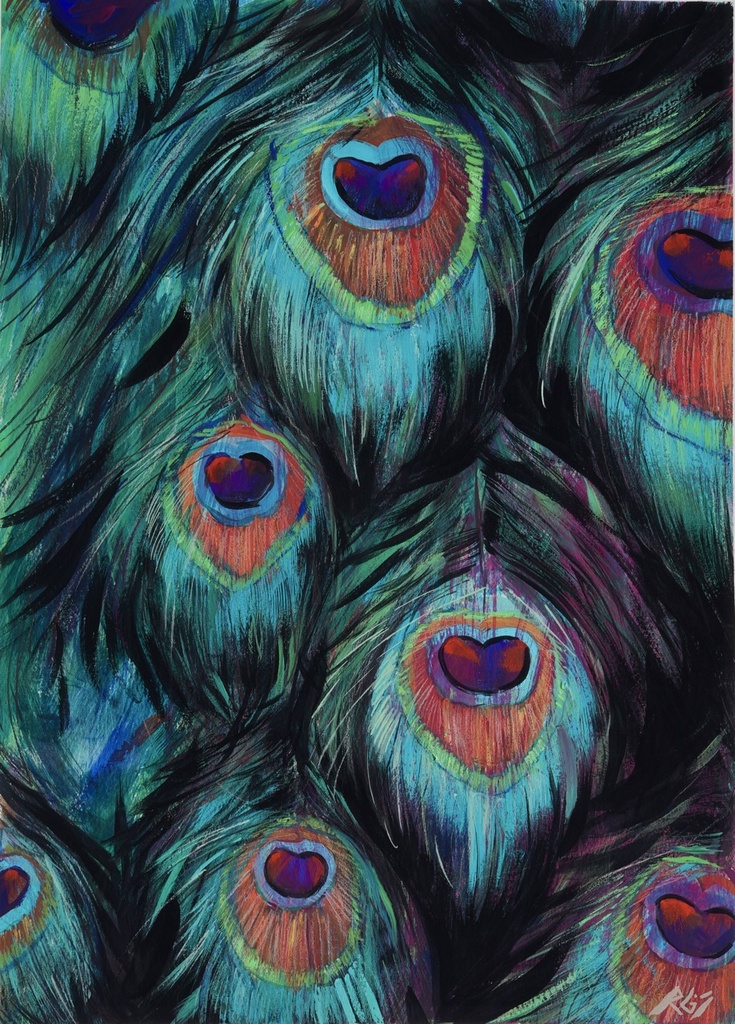
For a work like Hummingbirds, Tuiuiú, or Peacock Feathers, the bird is not simply a motif. Against the black field, color has to declare itself. That tension may be what holds your attention. Name it. A collection gains coherence when you understand the visual pressure you are choosing.
Set a Budget That Leaves Room to Return
A budget is not a test of seriousness. It is a structure that lets you collect with intention. Decide what you can spend on an original now, then consider whether you want to acquire one substantial work or begin with several smaller works over time.
Originals in my studio are priced by size. Prints of the same works offer another way to live with an image while you learn where your collecting appetite leads. Neither choice needs to be treated as a lesser version of the other. The distinction is clear: an original carries the physical decisions of its making, while a print extends access to the image.
For emerging collectors, small works can be an intelligent beginning. A painting such as Kratos or Zeus can establish a close relationship with scale, surface, and mark. Smaller does not mean minor. It may mean that the encounter is more intimate and that you have room to follow an artist over several chapters of their work.
Leave space in your budget for the realities around the acquisition: shipping, framing if the work is sold unframed, and appropriate installation. Ask before assuming. A clear exchange at the beginning protects both the work and the relationship.
Buy From the Work in Front of You
Collectors are often told to think ahead: resale, trends, what a room will look like in five years. These questions exist, but they should not be the first language you bring to an artist's studio. The first question is simpler: would you choose to encounter this work repeatedly?
Look at it at different distances. Consider where it will live. A painting with a black field can gather the room around it; a work built through chromatic grays may change as daylight shifts across its skin. These are not minor decorative details. They are part of the painting's behavior.
If you are buying directly from an artist, ask whether the work is available, whether there are related works in the studio, and whether a commission makes sense for your needs. A commission should not mean asking an artist to repeat a painting you already admire. It works best when there is a shared understanding of the artist's visual language and enough room for the new work to remain itself.
My commissions begin with a 50 percent non-refundable deposit and include two revision rounds. That structure keeps the conversation precise. A commissioned painting is still part of my ongoing practice, not an image engineered to satisfy every preference.
Build a Collection Through Attention
The best collections are not assembled in a weekend. They acquire rhythm. You may begin with a bird on black, then find yourself drawn toward a figure whose contour refuses containment. You may return to the same artist years later and recognize a new turn in the work.
Keep a record of what you acquire: title, year, medium, dimensions, and the circumstances in which you first saw it. Write down your own response, too. Not for future proof, but because your eye changes. The note may show you what you were looking for before you had language for it.
Visit exhibitions. Read artist statements with attention, then look again at the paintings. The work should not need to be reduced to a statement in order to matter. Still, context can sharpen what is already present in the material: queer resilience, painted; diasporic memory made visible; identity as movement rather than a fixed pose.
If you want to follow my work as it develops, join the collector list for first access to available originals, prints, and new chapters from the studio. A first acquisition does not need to explain your collection. It only needs to make you want to keep looking.