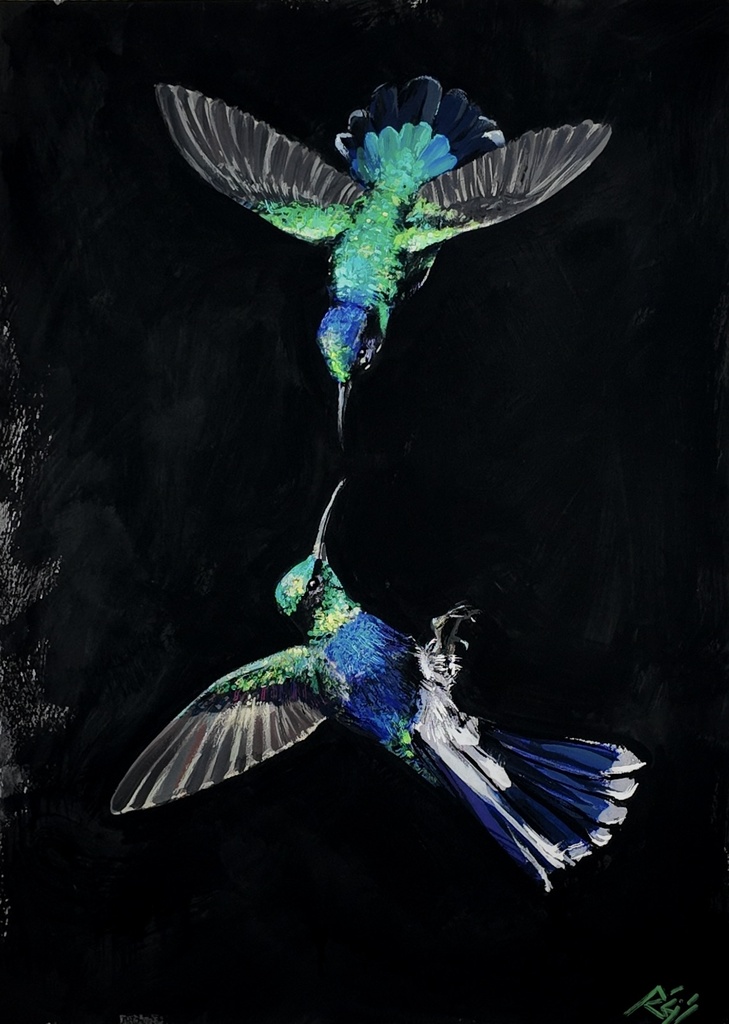
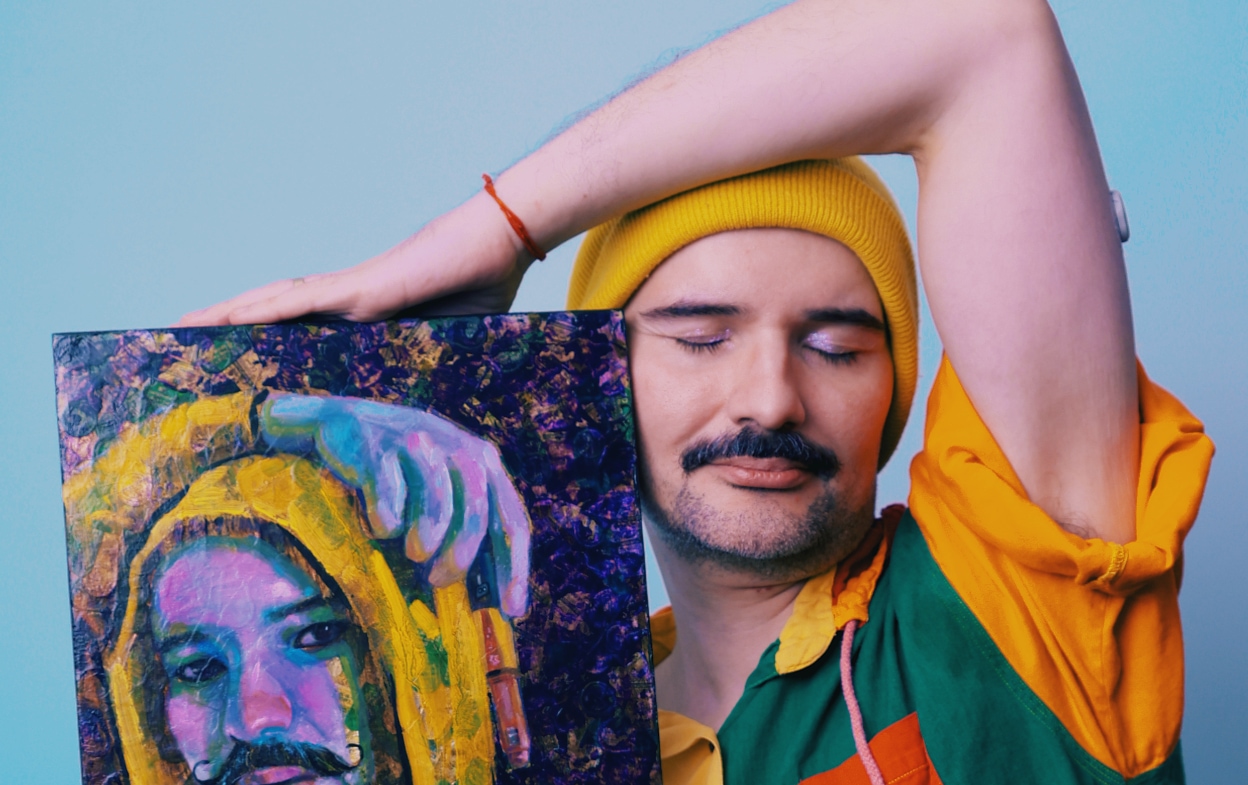
Before a figure arrives, there is a surface. Gesso catches light in ridges and drags. A graphite line interrupts a matte field. Oil gathers over what came before. A guide to contemporary portraiture collecting should begin here: not with whether a work matches a room, but with what the work asks matter to hold.
Contemporary portraiture can be immediate. A face, a stance, a charged look across the room. But the works that stay with a collector have another register beneath recognition. They hold decisions about material, authorship, history, and time. The figure may be the first encounter. It should not be the last.
Begin With Matter, Not Decoration
A portrait is not automatically meaningful because it is figurative. Its force comes from the relationship between image and construction. Look closely at the surface before you ask what the person depicted represents. Is the ground smooth, resistant, stained, scraped, built up? Does the paint sit lightly, or does it occupy physical space?
In my own paintings, texture begins before the figure. I build a heavily textured gesso ground first. Its ridges decide how light will behave across the entire work. Texture is never background. It is biography.
The layers follow the feeling rather than a fixed visual formula: colored pencil for fine line, gouache, acrylic for flat matte passages, markers for graphic interruption, then gesso again as construction. Oil is the final surface. Fat-over-lean governs the oil phase only. These distinctions matter when collecting because they reveal whether material is carrying thought or merely performing style.
Impasto can make duration physical. A thin glaze can hold what refuses to resolve quickly. Sgraffito can make one sensation cut through another. You do not need technical training to respond to these choices, but learning to see them will sharpen your collection. Stand close enough to notice the edge of a mark, then step back until the image re-forms. Good portraiture often changes register at those two distances.
Ask What the Surface Refuses to Hide
A perfectly polished surface may be right for one artist and false for another. There is no universal preference for visible brushwork, distortion, or finish. The question is coherence. Does the surface deepen the work's proposition? Does its material language feel necessary?
A portrait with a fractured ground may speak to memory, migration, performance, desire, or self-authorship without illustrating any of them. A smooth field may create distance and precision. Neither is inherently more serious. Collect the work whose formal decisions continue to give you information after the first encounter.
Collect the Artist's Position, Not a Category
Contemporary portraiture is not a single market. It includes painted figures, self-portraits, photographic constructions, digital interventions, works that borrow from archives, and images that test the instability of identity itself. The useful question is not whether a work is a portrait in the traditional sense. Ask whose terms shape the image.
For artists working through queer life, diasporic memory, race, gender, or cultural inheritance, representation is rarely neutral. The work may refuse a clean narrative. It may multiply a figure, obscure a face, or make intimacy difficult to consume. That resistance can be part of its value.
In my practice, the figures begin as photographic montages of my own form, multiplied and rearranged. Black contour lines carry the narrative. The image is personal, but it is not private in a sealed way. It belongs to a continuing investigation of identity as movement.
When you acquire work from an artist with a distinct position, you are not buying a theme. You are entering a body of work with its own internal logic. Look at the series, not only the individual piece. Notice recurring colors, gestures, spaces, and formal tensions. A painting is often a chapter, not a restart.
Read Color as Structure
Color is often where a portrait declares its emotional temperature. Ask whether it is descriptive or structural. A chromatic gray may make skin, architecture, and atmosphere collapse into the same field. Raw umber can steady a composition. Magenta can disrupt it. A white can be a white that is not white.
In my palette, raw umber, yellow ochre, burnt sienna, ivory black, buff titanium, titanium white, cadmium yellow, cadmium red, magenta, and ultramarine are not symbols waiting for a caption. They are tools with weight and behavior. The red of pain is transparent alizarin crimson mixed with raw umber, glowing from inside the layers. A collector need not decode every choice. But recognizing that color has been built, rather than simply selected, changes how a work is seen.
Establish Provenance Before You Fall Too Hard
Emotion is a valid reason to acquire art. It should be followed by clear questions. Provenance is not bureaucratic residue. It is the record that protects the relationship between artwork, artist, and collector.
For an original painting, confirm the title, year, medium, dimensions, and whether the work is signed. Ask for a certificate of authenticity and a clear invoice. If the work has been exhibited, request its exhibition history. If it belongs to a named series, understand where it sits within that sequence.
Condition matters as well, especially with layered surfaces. Ask how the work should be handled, framed, displayed, and transported. A textured painting needs different attention than a flat paper work. Light exposure, humidity, and placement are practical concerns, not afterthoughts.
When acquiring directly from an artist's studio, the exchange can offer unusual clarity. You can learn how the work was made, why a particular format matters, and how it relates to the artist's current arc. Direct acquisition also creates a durable line of provenance from the source.
Let Scale Change the Decision
A small portrait can behave like a secret. A large one can reorganize a room. Neither is a lesser choice, but scale changes the terms of living with the work.
Measure the wall, then consider viewing distance. A painting with intricate pencil work and layered marks may reward closeness. A larger composition may need space around it for its contours, color fields, and physical presence to breathe. Do not treat empty wall space as a problem to solve. Space can be part of the work's frame.
Consider the room's light throughout the day. Gesso ridges, gloss variations, and impasto will respond differently in morning light, evening lamps, and indirect daylight. If the work has a strong palette, let it remain active rather than asking it to disappear into a decorative scheme. Art can live with furniture. It does not need to behave like furniture.
Understand Originals, Prints, and Editions
Original paintings and prints offer different forms of proximity to an artist's practice. An original carries the singular surface: the pressure of a line, the accumulated layers, the accidental and deliberate marks that cannot be repeated. Its price reflects that singularity, scale, material, and place within the artist's work.
A print can be a serious acquisition, not a consolation prize. Its value depends on the edition size, process, paper, signature, and the artist's involvement in its production. A print may also be the right entry point for a new collector who wants to follow a practice over time.
What matters is transparency. Know whether a work is unique, part of a limited edition, or open edition. Know the exact dimensions of the image and paper. Ask how it is signed and whether it is accompanied by documentation. Clear information allows feeling and discernment to coexist.
Buy for the Long Conversation
Market attention can be useful context, but it is a poor substitute for attention of your own. Do not collect portraiture only because a subject is visible, a color is currently fashionable, or a work appears easy to place. Acquire what keeps becoming more precise in your mind.
The strongest collections hold tension. They make room for beauty and difficulty, familiarity and refusal, public image and private charge. A contemporary portrait can offer recognition, but it can also alter the conditions of recognition itself.
If a work continues to return to you after you leave it, take that seriously. Ask the practical questions. Study the surface. Learn the artist's larger arc. Then allow the acquisition to be direct: this piece is available, inquiries are open, and the collector list offers first access to new chapters from the studio.
A painting should not merely complete a wall. It should keep changing the room because it keeps changing what you are able to see.