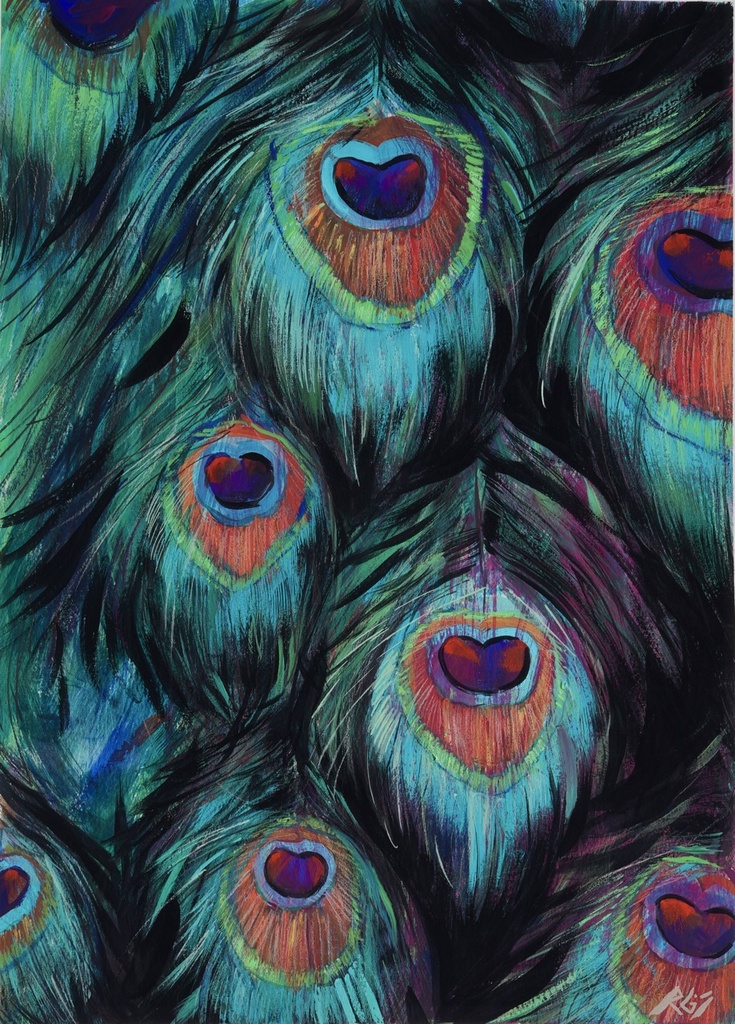
A ridge of gesso catches light before a figure does. It interrupts the eye. It refuses the smooth speed of the screen. That is where many of the most consequential figurative painting trends begin: not with likeness, but with matter.
The return of the figure has been discussed for years as if painting simply rediscovered a familiar subject. That misses the point. The figure never disappeared. What has changed is its authority. Contemporary painters are using it less as an illustration of a person and more as a site of pressure: history against desire, public image against private knowledge, inheritance against reinvention.
For collectors, this distinction matters. A painting can offer immediate visual force and still hold a longer argument. The works that remain with us tend to be the ones in which formal decisions carry the weight of the subject. Surface is not styling. Color is not decoration. A contour is not merely a boundary.
Figurative Painting Trends Begin With Surface
The flat, polished image has lost some of its monopoly. Across contemporary figurative painting, surfaces are becoming insistent: scraped, built, stained, abraded, and repeatedly revised. The viewer does not only recognize a figure. The viewer encounters the time it took to bring that figure forward.
In my own practice, each painting begins before the body appears. I build a heavily textured gesso ground, with ridges and drags that decide how light will move across the entire work. Texture is never background. It is biography.
That decision is part of a broader shift. Painters are treating the ground as an active field rather than a neutral support. Impasto occupies physical space, like the things a life cannot move around. Accumulated glazes hold chronic, slow time. Sgraffito is one sensation cutting through another. These are not effects placed on top of an image. They are the image’s conditions.
This attention to material has a particular force in a culture trained to consume pictures instantly. A textured painting cannot be fully received at a glance. It asks the eye to slow down, then rewards that attention with changing light, buried color, and decisions that remain visible.
The Figure Is No Longer Required to Behave
Another defining movement is the refusal of a single, stable figure. Bodies stretch, repeat, dissolve into pattern, multiply across a composition, or arrive as partial presences. This is not fragmentation for its own sake. It reflects a more honest understanding of identity as movement.
My figures begin as photographic montages of my own body, multiplied and repositioned until a new encounter appears. The black contour line carries the narrative. It may separate forms, but it also makes their intimacy visible. A line can contain a body. It can also show where containment fails.
For queer artists, diasporic artists, and artists working from lives shaped by migration, family archives, and social codes, the figure often bears several temporalities at once. It can be adult and remembered, witnessed and self-authored, solitary and collective. The strongest paintings do not resolve those tensions too neatly.
Brazilian visual memory enters my work in this way. It is not an ornamental citation. It is a living register of color, gesture, excess, discipline, and survival. A reference can carry a place without reducing that place to scenery. The difference lies in specificity.
Color Is Becoming More Psychological
The current appetite for vivid painting is real, but saturation alone is not the story. The most compelling color decisions often depend on restraint. A bright passage gains force because it is held against a chromatic gray. A yellow becomes unstable beside an umber. A white becomes a white that is not white.
My palette returns to raw umber, yellow ochre, burnt sienna, ivory black, buff titanium, titanium white, cadmium yellow, cadmium red, magenta, and ultramarine. These pigments do not function as a fixed code. They create friction. Skin, background, clothing, and air can move through the same family of tones without becoming the same thing.
The red associated with pain in my work is not cadmium red. It is transparent alizarin crimson mixed with raw umber, glowing from inside the layers. That distinction is formal and emotional. Cadmium declares itself at the surface. Alizarin crimson can seem to rise from underneath.
This is one reason color-rich figurative painting has such resonance now. It offers an alternative to the false clarity of much digital imagery. Color can be declarative without being simple. It can describe desire, conflict, memory, and refusal in the same passage.
Mixed Media Leaves the Argument Visible
Painting is becoming less invested in purity. The boundary between drawing, collage, digital image-making, and painting has grown productively porous. Yet the most convincing mixed-media work does not use many materials merely to prove range. Each material needs a reason to be there.
My layers arrive in the order the feeling demands: colored pencil for fine line, gouache, acrylic for flat matte passages, markers for graphic line, then gesso again as construction. Every painting is finished in oil, its final skin. Fat-over-lean governs the oil phase, not the entire history beneath it.
This sequence matters because it keeps the work open to interruption. Acrylic can flatten an area that has become too lyrical. Marker can impose a graphic refusal. Gesso can obscure an image while making a new structure possible. Oil then brings depth, reflection, and a slower atmosphere.
The result is a painting that acknowledges its own making. In a period when generated images can imitate a visual language in seconds, evidence of decision has new value. The hand is not valuable because it is sentimental. It is valuable because it records judgment.
What Collectors Should Look for Beyond the Trend
A trend can identify an energy in the field. It cannot tell you which painting will continue to matter in your space or collection. The better question is whether the work’s visual language is inseparable from its subject.
Look at how the figure inhabits the surface. Does texture deepen the encounter, or does it remain a decorative gesture? Does the color system create tension? Does the artist’s use of reference produce a specific world? A compelling painting should keep giving after the first encounter, especially when its scale, light, and proximity change.
It also depends on what you want a work to do. A large original can organize a room through physical presence. A smaller work can create a more private exchange. Prints can make an artist’s visual language part of a wider collection, while an original holds the distinct marks and material history of a singular object. These are different relationships, not lesser and greater versions of the same choice.
The market will continue to name new figurative painting trends. Some labels will be useful. Many will flatten artists into a temporary category. The work worth living with usually resists that compression. It is legible, but never exhausted by what it first appears to say.
My ongoing series, Prismatic Identity, and the chapters that follow it are built from that refusal. The figure is not a conclusion. It is a frontier. It changes as the surface changes, and the surface remembers every decision that brought it there.
For collectors drawn to painting with material consequence and a sustained point of view, inquiries are open. Join the collector list for first access to new work and forthcoming chapters from the studio.