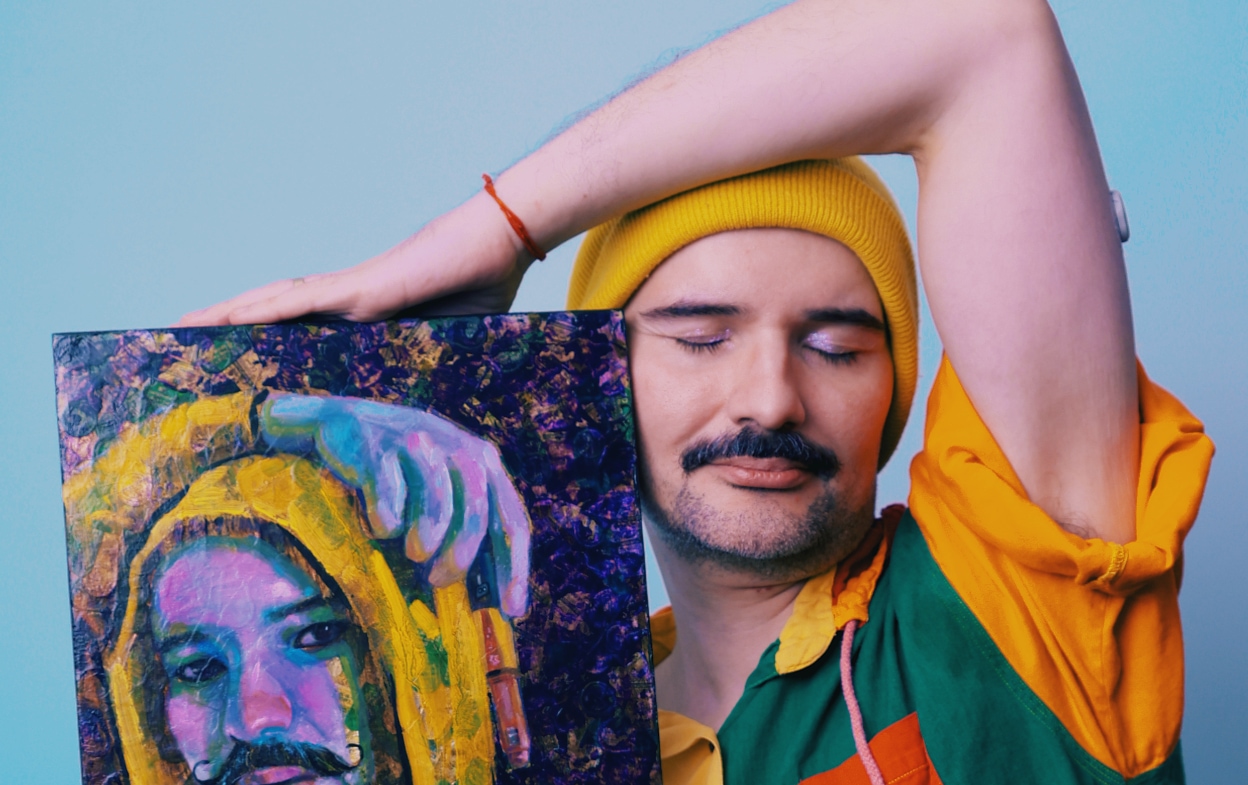
A ridge of gesso catches light before a figure appears. It changes the surface before color arrives. That physical fact also changes the question of direct sales versus galleries: a painting is never only an object moving through a market. It carries its making, its conversation, and the conditions under which it enters a life.
I finish every painting in oil, but its history begins earlier. Coloured pencil establishes a fine line. Gouache interrupts it. Acrylic holds a matte field. Marker creates graphic pressure. Gesso returns as construction. The oil becomes the final skin. A collector encountering the work through my studio can enter that sequence closely, including the decisions that made the image necessary.
A gallery can provide another kind of encounter. Neither route is morally superior. They serve different forms of attention, and a serious collector benefits from knowing the distinction.
What Direct Sales Make Possible
Buying directly from an artist brings the collector close to the source. Questions about surface, scale, palette, framing, editions, and the place of a work within a series can be answered by the person who made it. That proximity is not a shortcut around discernment. It is an invitation to practice it with more information.
For my work, material knowledge matters. Raw umber can cool a field beside buff titanium. Transparent alizarin crimson mixed with raw umber creates the red of pain - a red that glows from inside the layers rather than sitting on top of them. Black contour lines do not merely describe a body. They carry the narrative across it.
In a direct studio relationship, these choices remain attached to the painting. A collector can understand whether impasto is holding physical space, whether accumulated glazes are marking chronic, slow time, or whether sgraffito is one sensation cutting through another. Texture is never background. It is biography.
Direct acquisition also makes room for a longer relationship. Collectors may join an email-led list for first access to new paintings and prints, receive context as a series develops, and ask about available work without the pressure of a crowded opening. This is especially meaningful for collectors following an artist over years rather than making a single isolated purchase.
There is a practical dimension, too. The conversation around shipping, installation, payment, documentation, and timing happens in one place. For a first-time collector, that clarity can make an original work feel more reachable. For an experienced collector, it can make acquisition more precise.
Where Galleries Add Value
Galleries are not simply intermediaries. At their best, they build a rigorous public frame around an artist's work. They place paintings in dialogue with other practices, introduce them to curators and institutional audiences, and create exhibitions where scale, sequence, and visual friction can be experienced in person.
A strong gallery also brings its own eye. Its artists are selected, contextualized, and represented through a particular point of view. For collectors, that can be valuable research already underway: a program signals the conversations a gallery believes the work can sustain.
The exhibition itself matters. A painting viewed among related works may disclose a structure that does not appear in a single image. My figures are built from photographic montages of my own body, multiplied and reassembled. In a group, they become more than portraits. They become a grammar of recurrence, desire, refusal, and self-authorship.
Galleries can also offer confidence through established procedures, condition reporting, collection guidance, and professional networks. For collectors who want to build within a particular program, or who are acquiring work with institutional ambitions in mind, that framework can be decisive.
Yet a gallery presentation can be selective by necessity. It may show one chapter rather than the full arc. It may prioritize a particular body of work, scale, or market. This is not a flaw. It is the nature of curating. Direct contact with an artist can supplement that view with the wider studio context.
Direct Sales Versus Galleries Is Not a Binary Choice
Many collectors move naturally between both routes. They discover an artist in a gallery exhibition, then follow the studio for later work. Others begin with a print or small original acquired directly, then encounter a larger painting in a curated setting. The most thoughtful collections often grow through both kinds of proximity.
The question is not which route is more legitimate. Ask instead what you need to know before the work enters your space. Do you want to see the painting within a broader curatorial proposition? Do you want to speak directly with the artist about how it was built? Are you looking for a specific series, a particular scale, or an ongoing relationship with a practice?
The answer can change from one acquisition to the next.
A gallery may be the right place when you want the concentrated force of an exhibition and the perspective of a program you trust. A direct sale may be the right place when you are drawn to a specific work, want access to the artist's process, or wish to follow a practice as it changes in real time.
For emerging collectors, the false divide can be particularly limiting. Buying directly is not lesser collecting. Buying through a gallery is not automatically more serious. Seriousness comes from attention: looking closely, asking informed questions, and choosing work you are prepared to live with beyond the first impact.
What to Ask Before You Acquire
Begin with the work itself. Look at the surface, not only the image. Ask how the painting changes with daylight and artificial light. Consider whether the scale will hold its presence in your space. A screen can flatten a textured gesso ground into a photograph. In person, ridges and drags decide how light moves across the entire painting.
Then ask where the piece belongs in the artist's practice. Is it a pivotal work, a variation, or part of an ongoing series? What materials were used? How should it be installed and cared for? Is there documentation of title, date, medium, dimensions, and provenance? These questions are not administrative afterthoughts. They are part of seeing the work accurately.
It also helps to name what you respond to without trying to reduce it. Perhaps a chromatic gray in the skin stays with you. Perhaps ultramarine beside cadmium yellow creates a tension you cannot dismiss. Perhaps the multiplied body reads as private memory and public declaration at once. The reasons can be formal and personal. They should be allowed to be both.
For collectors in Toronto and beyond, direct contact can be especially useful when a work needs to travel. It creates a clear conversation about packing, delivery, installation, and the practical conditions of receiving art across distance. The relationship remains personal even when the painting moves worldwide.
The Work Must Hold After the Transaction
A painting should not be asked to perform certainty. It should be allowed to remain active. The right work may keep changing as light changes, as your room changes, as your own language for it becomes more exact.
That is why I think of acquisition as a continuation rather than an endpoint. The painting leaves the studio, but its material history remains present: the matte interruption of acrylic, the oil's final skin, the line that refuses to disappear. Whether you encounter it through a gallery or directly from my studio, choose the work that continues to look back.