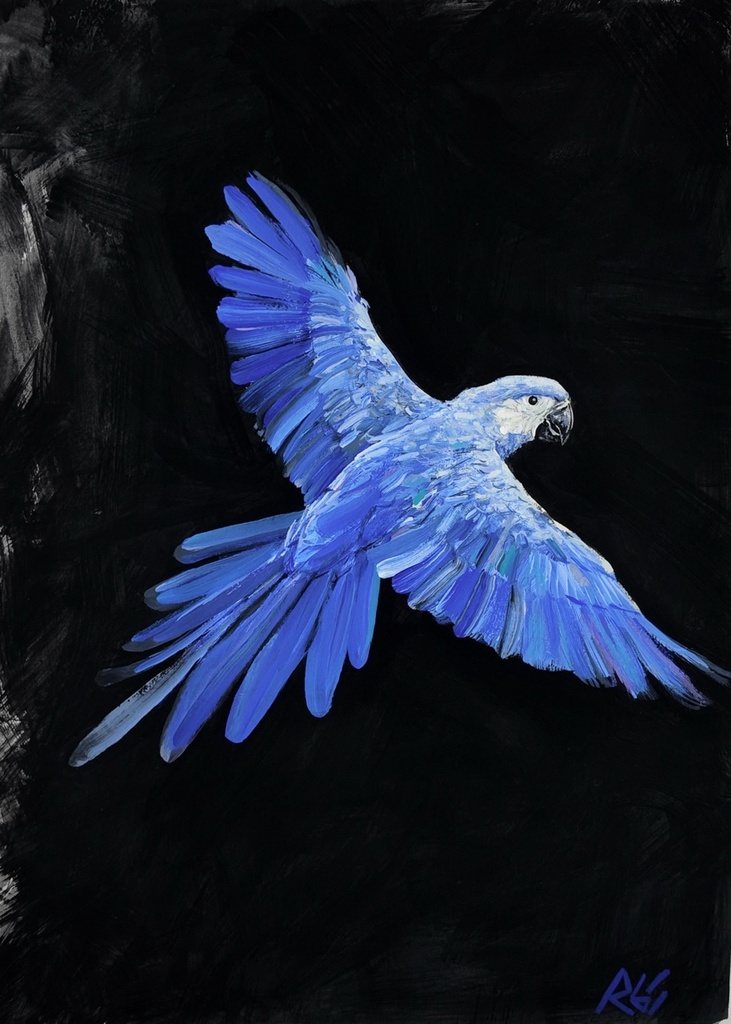
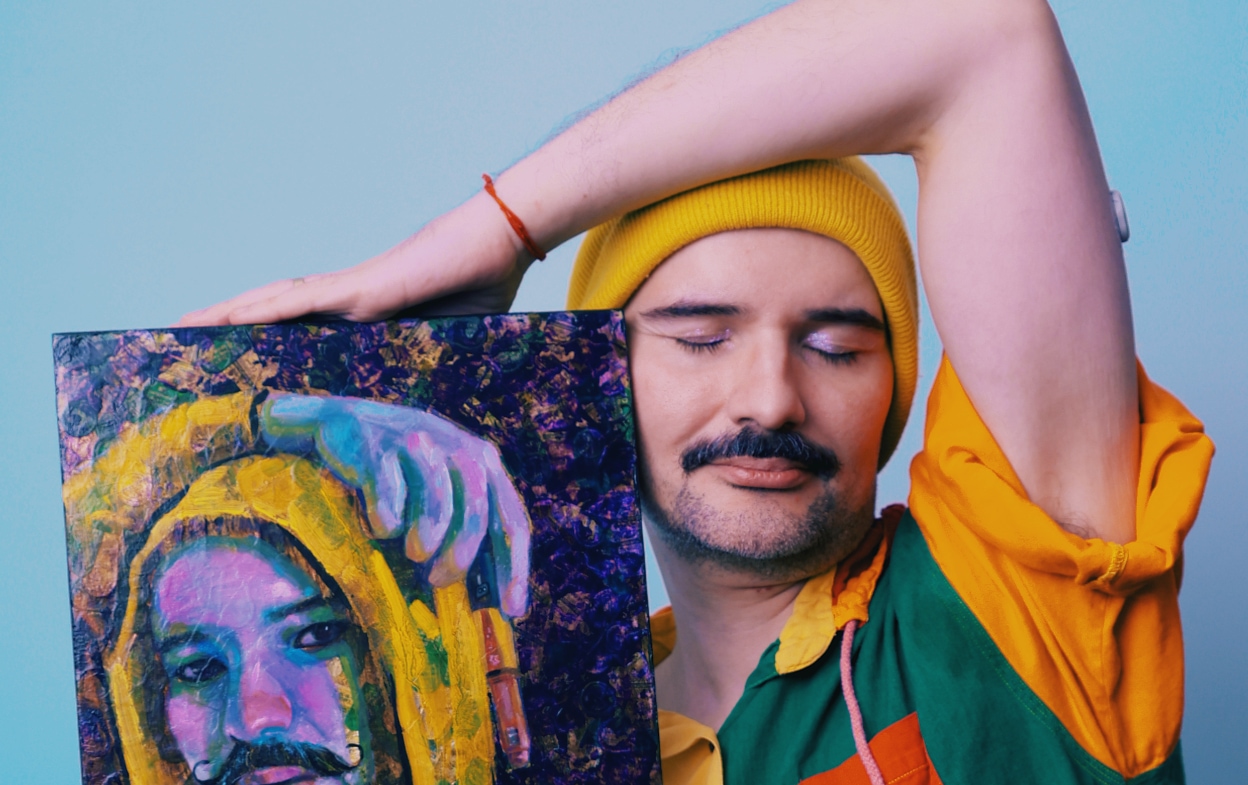
A ridge of gesso catches light before a figure arrives. It interrupts the surface, then directs it. The painting begins there: with drag, pressure, resistance, and a ground that has already decided it will not be neutral.
As a contemporary Brazilian artist working in Toronto, I do not treat texture as a preliminary gesture. Texture is never background - it is biography. It carries what language leaves unfinished: the accumulations of place, desire, migration, and self-authorship. The figure comes later, built into a surface that already has a history.
Brazil is not a visual accessory in this work. It is cadence, color memory, contradiction, and a way of holding many realities at once. Queer life is not an illustration either. It is the condition through which the painting moves.
Matter comes before the figure
Every painting starts with a heavily textured gesso ground. I build ridges and drags into the surface, allowing the material to determine how light will travel across the work. Some passages hold the light. Others break it. This is the first composition, long before an eye, a hand, or a black contour line appears.
That ground has physical authority. It refuses the fantasy of a clean beginning. A life does not arrive smooth, and neither should a painting concerned with what a life carries.
The layers that follow do not obey a fixed decorative sequence. They answer the feeling of the work. Colored pencil brings a fine, searching line. Gouache introduces opacity. Acrylic makes flat matte passages that can push against the density of oil. Markers create a graphic insistence. Gesso returns as construction, not correction.
Only then does oil complete the painting. Oil is the final skin. Within that final phase, I work fat over lean, allowing the paint to settle with the structural patience it requires. The process is material first, body second, meaning last. Yet all three remain inseparable.
A surface that keeps its evidence
Impasto is what occupies physical space in a life. It is weight made visible. It catches a shadow that a flat surface cannot hold.
Glazes do something else. Their accumulation creates chronic, slow time. A transparent alizarin crimson mixed with raw umber produces the red of pain in my work. It is not cadmium red. It glows from inside the layers, because certain feelings do not sit on the surface. They remain beneath it, active and unresolved.
Sgraffito enters as interruption. One sensation cuts through another. A line scratched back into paint can be tender or severe, depending on what the surface has already endured.
These choices are formal, but they are never merely formal. The physical behavior of pigment becomes a record of pressure, desire, and refusal.
Contemporary Brazilian artist, beyond a single image
The figures in my paintings begin with photographic montages of my own body, multiplied and rearranged. One self becomes several. A gesture repeats with a difference. A face may turn away while another confronts the viewer. This is not fragmentation for its own sake. It is a more faithful account of identity as movement.
Black contour lines carry the narrative. They define, divide, and sometimes contradict the painted form beneath them. A contour can look protective until it becomes a boundary. It can hold a figure together while revealing how much force that holding requires.
I work through a palette that stays close to earth and heat: raw umber, yellow ochre, burnt sienna, ivory black, buff titanium, titanium white, cadmium yellow, cadmium red, magenta, and ultramarine. The colors are specific, but certainty is not the goal. I often desaturate with black or with complementaries, building chromatic grays into backgrounds and skin.
A gray is never only gray. It can contain yellow ochre, ultramarine, magenta, and the memory of a brighter color beneath. It is a color that has lived through other colors.
This matters because Brazilian visual culture is often expected to perform saturation, ease, or spectacle. I refuse that narrow demand. Brazil contains brightness, certainly. It also contains shadow, domestic intimacy, social performance, religious image-making, tropical excess, discipline, and loss. The work does not flatten these tensions into an exportable atmosphere.
I carry references as cultural memory. The heat of Rio de Janeiro. The particular theatricality of Carnaval. The devotional density of Catholic iconography. The invented intimacy of telenovela. The directness of Brazilian popular graphics. None of these arrives as quotation. They remain sediment, altered by distance and by time.
Queer figuration as a formal decision
Queer resilience, painted, cannot be reduced to a recognizable symbol or a prescribed palette. It is present in the way a figure claims room. In the way a hand refuses to disappear. In the tension between exposure and authorship.
Figurative painting has always involved power: who is pictured, who looks, who gets to remain complicated. For a queer artist, the figure is never innocent. It arrives with histories of projection, desire, censorship, performance, and longing. The question is not whether the body is political. The question is whether the painting can give it formal complexity equal to its lived complexity.
That is why multiplication matters in my work. A single figure may be too easily contained. Several versions of the self can create a different field: intimate but not confessional in the usual sense, visible but not available for easy consumption. The painting becomes a place where identity can expand without asking permission.
There is a trade-off. Direct imagery can offer immediate recognition, but it can also close meaning too quickly. Abstraction can preserve ambiguity, but it can evade the stakes of representation. I work between those positions. A figure must be felt as particular, while the painting remains open enough to exceed biography.
Painting as an archive in motion
My ongoing series, Prismatic Identity, treats the self as unstable light: present, refracted, and never singular. The series does not search for a final portrait. It follows the shifts in how a person appears to himself, to others, and through culture.
Archive of Unstoppable Bodies, presented with Pride Toronto at CF Eaton Centre in 2026, extends this inquiry into public space. An archive can preserve. It can also exclude. I am interested in what happens when queer presence insists on being recorded in full view, not as a brief exception but as a continuing visual fact.
In Beyond the Contour, my 2026 solo exhibition in Toronto, the line becomes both structure and question. What does it mean to be held by an image? What escapes when the outline is no longer enough?
These are chapters in one practice, not separate departures. The ground, the line, the repeated figure, and the layered color continue to return because they are still asking something of me.
What collectors are acquiring
An original painting is not simply an image transferred to a wall. It is a record of decisions held in material: the gesso ridge that changes across the day, the pencil line that remains partly buried, the glaze that alters as light moves, the black contour that gives a figure its charge.
For collectors, that physical presence matters. A print can carry composition, color, and graphic force with clarity. An original holds the surface itself. Neither replaces the other. They create different relationships to the work.
I make work for spaces that can sustain looking. A collector may first respond to color, a curator to the construction of the figure, and a visitor to the tension of a line. The painting has room for each encounter because it was built slowly, layer by layer, with no interest in becoming simple.
Original paintings and prints are available directly from my studio. Inquiries are open, and the collector list receives first access to new work. Begin with the surface. Let it tell you what the figure has had to carry.