A queer figure against a grey ground is never only a figure. It carries what has been withheld, performed, desired, protected, and remade. Contemporary art about queer bodies matters because it refuses the old demand that queer life explain itself before it can be seen.
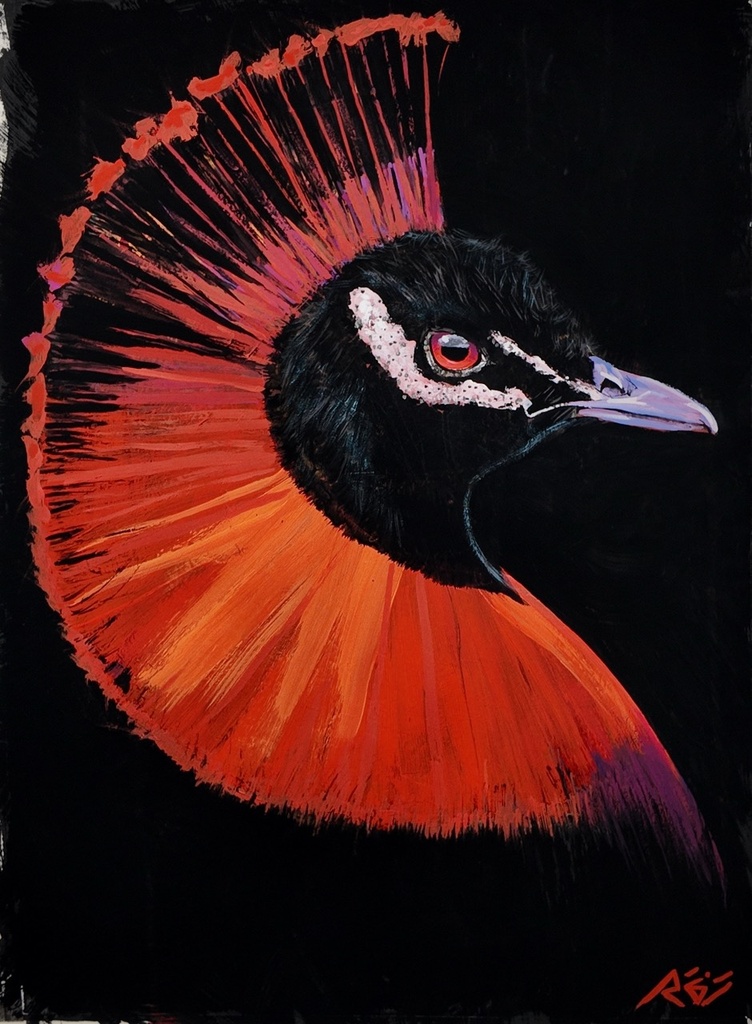
The strongest work does not treat identity as a lesson. It gives identity weight, color, tension, atmosphere. It lets a tilted head, a guarded hand, a bright bird against absolute black, or a quiet grey ground hold an entire history of looking. Painting becomes a frontier — not a neutral surface, but a place where self-definition can take form.
The Queer Body Is Not a Symbol to Be Solved
For much of art history, queer presence was coded, displaced, or rendered safely indirect. Desire could enter through mythology, allegory, theatrical gesture, or the charged space between two figures, but rarely on its own terms. Even now, the queer body is often asked to stand for an argument before it is allowed complexity.
Contemporary figurative painting can interrupt that arrangement. It can hold a person as particular rather than exemplary: composed yet unsettled, visible yet withholding, adorned yet uncontained. The figure does not have to become proof of an identity category. It can remain a person in motion, shaped by private memory and public pressure at once.
That distinction matters to collectors and curators. Representation alone is not the measure of a work's force. A painting becomes lasting when its formal decisions carry the subject: the temperature of its color, the compression of its space, the insistence of its line, the scars left in the gesso before the figure ever arrives. Queer resilience, painted, is not an illustration of resilience. It is a visual structure that makes resilience felt — in the matter first, and through the matter, in the body.
Contemporary Art About Queer Bodies Changes the Gaze
The gaze is not only about who appears in an image. It is about who is granted interiority, who is allowed desire, and who is permitted to look back. In contemporary art about queer bodies, the return of the gaze is often the central event.
A painted subject may meet the viewer directly. Just as often, the subject turns away, drifts into a private world, or appears behind a deliberate mask of pattern and color. None of these choices is passive. Each reorders the familiar relationship between viewer and figure. The body is no longer simply available for consumption. It establishes terms.
This is where queer figurative work can become especially precise. It understands that visibility is not automatically liberation. Being seen can be intimate, affirming, invasive, or dangerous. A painting that holds this contradiction has more to offer than a clean statement of pride. It acknowledges that self-presentation is an art in itself: learned, revised, and sometimes fiercely defended.
For artists working through migration, diaspora, race, class, and sexuality, this complexity deepens. The figure may carry multiple geographies without resolving them into a single origin story. A tropical bird, a carnival reference, a saturated color field, or a formal pose can call up inherited imagery while changing its meaning. So can the spiritual: in Brazilian popular culture, the energy body — its centres, its subtle currents — is not an exotic import but inherited memory, as ordinary as a Sunday table. Cultural memory is not presented as a museum object. It moves through the present tense.
Form Is Where the Politics Lives
It is tempting to discuss queer art only through subject matter. Who is pictured? What identity does the work name? What social condition does it address? These questions have value, but they are incomplete without form.
Form is where a painting decides how it will be encountered. A sharply outlined face can feel defiant, like a boundary drawn in plain sight. A grey ground can make a figure appear suspended, unsettled, exposed, or sovereign — while an absolute black ground can isolate a bird until it becomes the only thing memory allows to remain. Dense color can turn ornament into a field of pressure. Thick paint can behave like light itself: on some canvases, the brightest point is where the matter is thickest. Fragmented space can suggest a self that refuses a single, settled outline.
These choices are not decoration around a message. They are the message becoming material.
Consider the difference between a body painted to appear legible and a body painted to remain charged. Legibility can offer recognition, but it can also flatten a figure into what the viewer already expects. Charge leaves room for contradiction. It lets beauty sit beside vigilance. It lets sensuality remain self-possessed. It lets a portrait become an encounter rather than an answer.
This is one reason original paintings retain such force in a collection. Their scale, surface, and accumulated marks cannot be reduced to an image on a screen. A collector does not only acquire a subject. They live with a set of formal decisions that keep unfolding: a line that grows more insistent over time, an area of grey that changes with the room, a ridge of impasto that catches the evening light, a figure that refuses to become familiar in a simple way.
Beyond Visibility: Queerness as Self-Authorship
There is a narrow version of representation that treats inclusion as the final goal. Put queer subjects on the wall, and the work is done. But queer artistic practice asks a more difficult question: What happens after visibility? Who gets to create the image, control its atmosphere, and decide what cannot be translated for an outside audience?
Self-authorship begins there. It is the authority to make work that does not soften itself for easy approval. It is the right to be sensual without being reduced to spectacle, political without becoming propaganda, and autobiographical without becoming confession on demand.
A painting can make room for ambiguity without surrendering its position. In fact, ambiguity is often part of its strength. Queer experience contains adaptation, coded language, chosen family, reinvention, pleasure, grief, and refusal. No single image can hold all of it. A sustained body of work can build a visual language expansive enough to let these forces speak to one another.
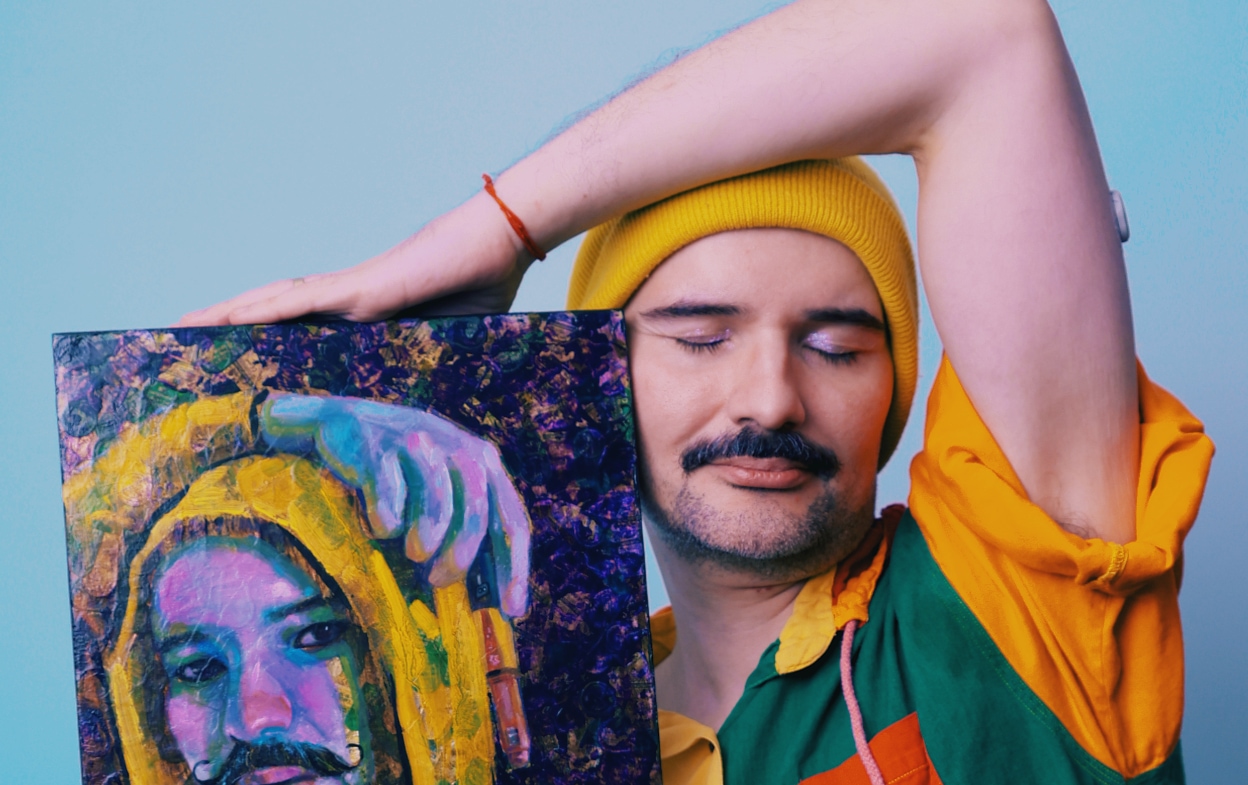
Régis Souto's practice approaches this terrain through figures multiplied from his own body, grey grounds, black lines that turn like the hands of a clock, carnival echoes, tropical birds held against black, and points of light built from the thickest paint on the canvas, marking the energy centres of the body. The paintings do not offer queerness as a fixed identity to be observed from a distance. They stage identity as movement — an ongoing negotiation between inheritance and chosen becoming, a migration that crosses countries, languages, and finally consciousness itself.
What Collectors Can Look For
When considering contemporary queer figurative work, it helps to look beyond immediate recognition. Ask what the painting is doing with space and attention. Does the figure simply occupy the canvas, or does it alter the conditions of the room around it? Are the symbols attached as references, or have they become necessary parts of the work's visual grammar?
Look also for an artist's relationship to repetition. Recurring motifs can signal limitation, but they can also reveal a discipline. A bird, a profile, an elongated hand, or a grey ground gains power when it changes across paintings. The motif becomes a site of pressure and variation, carrying different emotional weather each time it returns.
Context matters, too. An original painting may enter a home, a corporate collection, or an institutional setting differently. In a private interior, it can become a daily confrontation with presence and intimacy. In a public setting, it may reshape who feels addressed by the space. Neither context is more valid, but each asks different things of the work and its owner.
The best acquisition is rarely the one that merely matches a wall. It is the work that expands the terms of the collection around it.
A Painting Can Hold Its Ground
Queer bodies have long been made to carry other people's projections. Contemporary art can return that weight to the viewer. It can ask: What assumptions enter the room before the painting does? What forms of beauty are granted seriousness? Whose complexity has been treated as excessive, unreadable, or inconvenient?
A powerful painting does not resolve these questions. It holds its ground long enough for them to become unavoidable.
Available originals, prints, and new studio releases offer different ways to bring that encounter into a collection. Inquiries are open for works currently available, and the collector list receives first access to new paintings and releases. The invitation is simple: spend time with work that does not ask queer life to become smaller in order to be understood.