Why My Carnival Paintings Begin With a Song
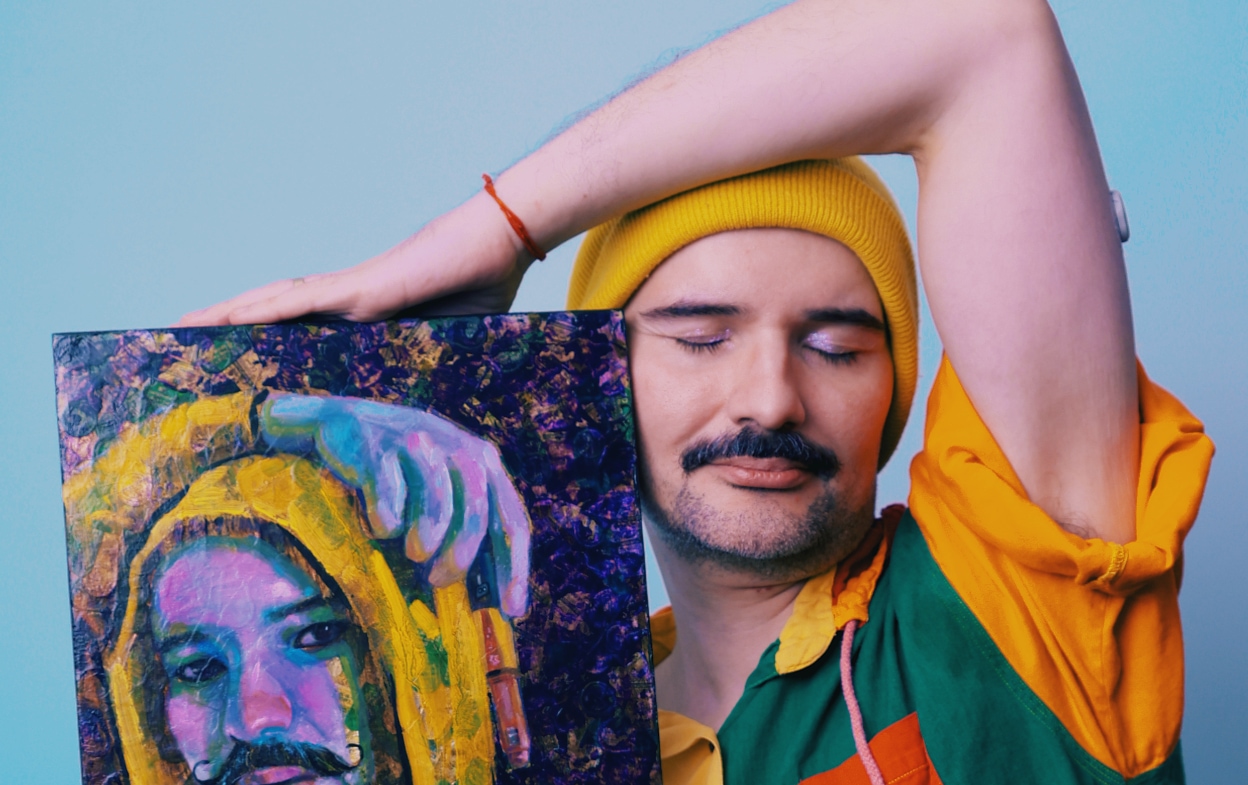
My carnival inspired contemporary art begins with words you will never read. Before any face arrives, I prepare the ground in acrylic and handwrite lines of Brazilian songs and poems directly onto the surface — then paint over them. The writing becomes an invisible but structural layer. The figures that emerge are literally standing on the music.
I call these paintings Brasilian Poems. They are Act II of Beyond the Contour.
The Songs Under the Paint
Music has always been the catalyst of my process — the resource I return to when I need to access memory, emotion, and artistic direction. It was through music that I slowly re-encountered my own country from a distance, after immigration rearranged everything I thought was fixed.
Three voices recur under these surfaces. Marisa Monte, who took the refinement of Brazilian song and carried it into the present without losing the samba in its spine. Adriana Calcanhotto, the most literary of songwriters — a woman who titled an album A Fábrica do Poema, the poem factory, which is more or less what these paintings want to be. And Chico Buarque, who spent a dictatorship proving that a song can say what is forbidden to say: his "Cálice" hides a demand to speak inside a word that sounds like an order to be silent.
That last example is the whole logic of the series. Words that survive underneath. Meaning that keeps working even when covered. A painting where the lyric is buried is not a painting that silenced the lyric — it is a painting built on top of a voice that refuses to stop.
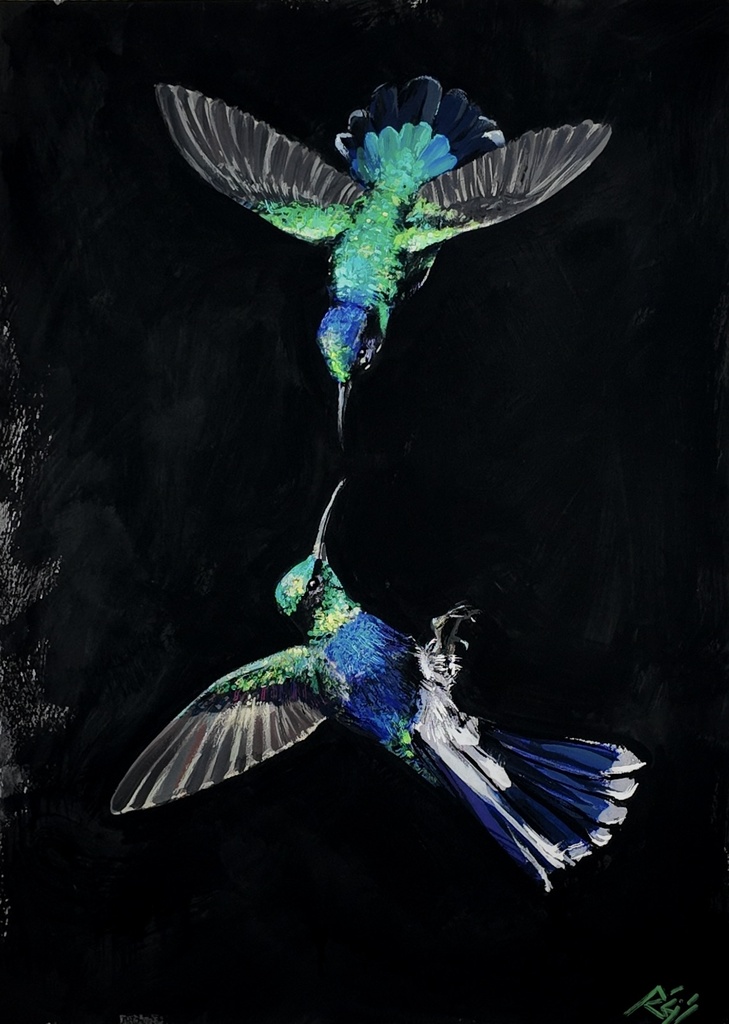
I paint over the handwriting with acrylic abstractions, building history and texture before the final phase: oil impasto, generous and luminous, applied to capture light and throw it back toward the viewer. The works are finished with a brilliant gloss varnish. Where the gouache birds of Act I are matte and withheld, these surfaces shine on purpose. Carnival is not a matte event.
The Cocar: Coronation, Not Costume
In these paintings, headdresses — cocares — rise from the figures as a kind of symbolic coronation. They declare that all of us are participants in this continuous celebration, not spectators of it.
Their elements come from a specific and complicated inheritance. The feathers of tropical birds. The pedrarias — ornamental stones — that evoke Brazil as one of the great territories of extraction and circulation of natural stone. Indigenous visual heritage runs through the cocar itself, and carnival's own history of borrowing runs through everything. I do not paint these elements as exotic accessories, because they are not accessories to me — they are memory, and memory carries debts. A parade has scaffolding. A samba school has labor. A feather in a headdress has a forest behind it. The painting has to be accountable to the layered realities its imagery comes from.
The faces beneath the cocares are often hidden or turned away. That displacement is deliberate: it moves the focus from the individual portrait to the vibration of color and the wealth the ornament carries. The crowned figure becomes anyone. Becomes everyone at the party.
Public Joy, Private Contradiction
Carnaval taught me that public joy can hold private contradiction. It can be precise, excessive, collective, and lonely in the same street. A bloco is not merely a crowd in costume — it is rhythm, rehearsal, class, desire, heat, improvisation, and the temporary rearrangement of who gets to occupy space.
This is where carnival imagery becomes politically exact. Public celebration gives permission to be seen, but permission can be temporary. Queer life knows that tension well: visibility can feel expansive and conditional at once. I do not paint identity as a fixed declaration. I paint it as movement — a body negotiating its own outline, crowned and hidden in the same gesture.
Carnaval is frequently imagined as maximal color, and my paintings do not reject that excess. They ask what excess can disclose when it is slowed down into paint. Celebration has intelligence. Ornament can contain critique. A painting may offer visual abundance while keeping its structure severe. It may be queer without becoming a symbol for someone else's comfort.
The Shine Is the Point
Everything in this series builds toward light. The oil impasto rises from the surface and catches actual illumination in the room; the gloss varnish amplifies it, so the painting changes as you move and as the day moves. What occupies physical space in a life occupies physical space on the board. These are mostly small-format works on wood — concentrated, dense, made to be encountered close, the way a song is.
Portuguese remains close to the work because some feelings arrive first in its sound. The handwriting under the paint is in Portuguese. The shine on top speaks every language.
This is the continuing arc of Beyond the Contour — Act II, between the remembered perfection of the gouache birds and the charged contour lines that follow — and it extends toward the bodies gathered in Archive of Unstoppable Bodies and the rest of Beyond the Contour. The chapters change. The question remains: how does a body become visible on its own terms?
Collecting the Afterimage
For collectors, these works have two tempos. From across a room, the gloss and the impasto assert a graphic, celebratory force. Close up, the surface slows down — the ridges of oil, the acrylic history beneath, and somewhere under all of it, a line of Chico or Marisa or Adriana that only the painting knows in full. Each work comes with its buried song; owning one means living with a voice you cannot quite hear but can always feel.
Carnaval ends. The paint does not.
Selected works are available directly from my studio. Inquiries are open for original paintings and prints, and the collector list offers first access to new chapters as they emerge.