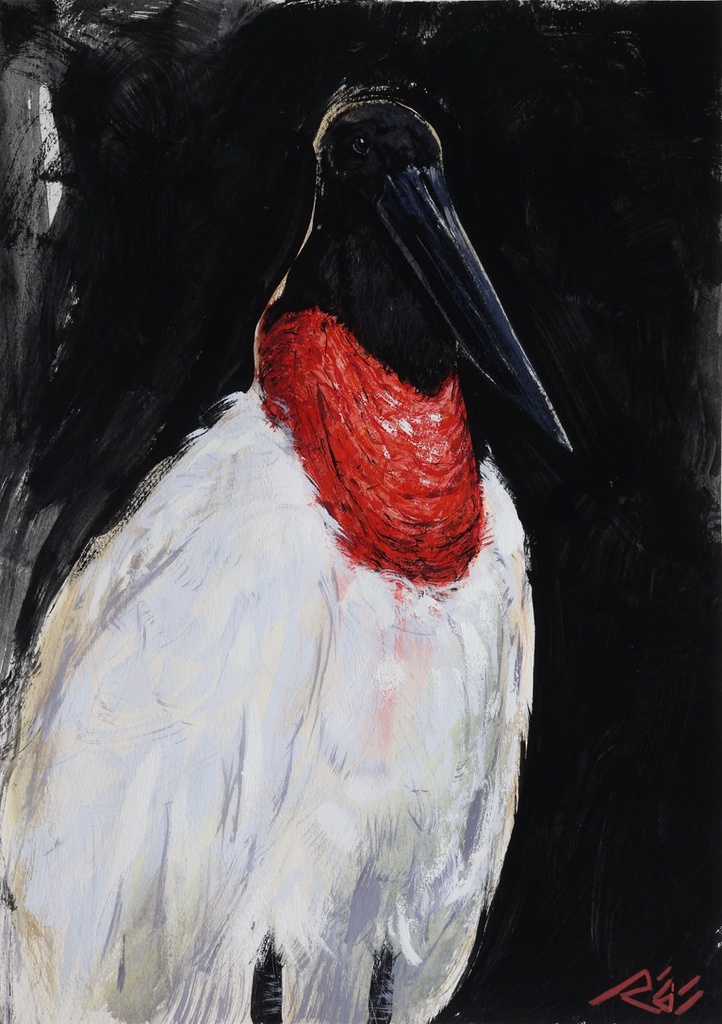
A painting begins with a surface that resists. Gesso is dragged, built up, interrupted. Light catches the ridges before it reaches the figure. This is where I would begin when considering the best paintings for first collectors: not with a famous name, a fashionable color, or a promise of future value, but with the physical fact of the work.
A first acquisition should keep giving. It should change with the hour, hold its ground in a room, and reveal more than its image on a screen can carry. You are not choosing decoration for an empty wall. You are choosing a presence that will become part of the way you live.
The Best Paintings for First Collectors Have a Point of View
The right first painting is rarely the one that tries hardest to be agreeable. Safe work can make a room feel finished for a moment, then disappear into it. A painting with a distinct visual language does something else. It makes demands. It returns your attention.
Look for decisions that feel specific. A figure placed against a chromatic gray. A line that refuses to soften. A raw umber beneath a brighter passage. A face made from fragments rather than a single settled view. These choices tell you that the artist is building a world, not merely delivering an image.
This does not mean your first work must be difficult to live with. It means it should be alive. There is a difference. A painting can be immediately beautiful and still hold complexity. It can be sensual without becoming passive. It can speak clearly while leaving room for your own reading.
Ask yourself a direct question: if this painting were moved from the room where you first saw it, would it still feel necessary? If the answer is yes, pay attention.
Start With Matter, Not Market Noise
Collectors are often told to begin with research. Research matters. But first, look long enough to notice how the work is made.
In my paintings, texture is never background - it is biography. The ground is heavily worked before the figure arrives. Colored pencil establishes fine line. Gouache interrupts it. Acrylic creates flat, matte passages. Markers bring graphic pressure. Gesso returns as construction. Oil is the final skin.
That sequence produces a painting that cannot be reduced to its subject. The figure may be recognizable, but the surface has its own memory. Impasto occupies physical space, like something in a life that will not be moved aside. Glazes accumulate slowly. Sgraffito lets one sensation cut through another.
You do not need technical training to respond to this. You only need to look closely. Does the surface feel resolved, or merely filled? Are marks doing different kinds of work? Does the paint hold light in unexpected places? The answers will tell you more than a short-lived market conversation.
A reproduction can be a meaningful entry into collecting, particularly when you are drawn to an artist’s work but are not ready for an original. But prints and paintings offer different encounters. A print carries the image. An original carries the record of decisions, revisions, pressure, and time. Neither is morally superior. They simply belong to different relationships with the work.
Choose Scale for Your Actual Life
The most common first-collector mistake is buying for an imagined home rather than the room you have. A small painting can have enormous force. A large work can transform a space, but only if it has enough air around it.
Before you decide, measure the wall. Then consider viewing distance. A painting above a sofa is seen from across the room. A work near a desk or hallway can reward close looking. Scale changes how color lands, how a contour reads, and how much of the artist’s hand you can perceive.
Do not let matching become the only criterion. A painting does not need to repeat the colors of your rug. In fact, a work that introduces tension can give a room its center. Buff titanium beside ivory black. Magenta held against a dulled yellow ochre. A red made from transparent alizarin crimson and raw umber, glowing from within its layers. These are not simply colors to coordinate. They are structures of feeling.
Light is equally decisive. Visit the work in person when possible. If you are acquiring from a distance, ask for clear images in natural and interior light, along with dimensions, medium, and year. A good studio can tell you whether a surface is matte, glossy, textured, or quiet from afar and dense up close. That is practical information, not a luxury.
Buy the Work You Want to Keep Looking At
Your first painting does not have to announce your identity to every visitor. It can hold something private. Still, it should meet you where your attention is honest.
I return to multiplied figures because a single body is never singular. The image is built from photographic montages of my own body, then pushed through contour, abrasion, color, and paint. Queer life appears here not as a slogan but as structure: identity as movement, self-authorship under pressure, a body refusing to become fixed.
The work you choose may concern desire, landscape, family archive, abstraction, or a particular social history. The subject is not a checklist. What matters is whether the artist has something at stake in it. First collectors often worry that they need the correct explanation before they can buy. You do not. Curiosity is enough, provided it is serious curiosity.
Read the artist’s statement. Look at several works, not just one. Notice recurring forms, materials, and questions. A strong painting usually belongs to an ongoing investigation. It is a chapter, not an isolated performance.
Let Provenance Begin With a Real Conversation
Buying directly from an artist can make a first acquisition less opaque. You can ask about process, framing, care, editioning, availability, and where the work sits within a series. You can understand what is on the back of the canvas as well as what is on the front.
This is not about turning art into a transaction without mystery. It is the opposite. Context deepens the encounter. Knowing that a black contour carries the narrative, or that a gray was built by desaturating color rather than reaching for a ready-made neutral, lets you see the work with greater precision.
There are trade-offs. An emerging artist’s original may be more accessible than a work from an established gallery program, but the price alone should not decide the matter. A smaller work may fit your budget and still be central to an artist’s practice. A larger work may be the right choice if it genuinely changes your relationship to a room. Buy within your means, then buy with conviction.
Keep your invoice, artwork details, condition notes, and any certificate or studio documentation together. This is basic stewardship. It also honors the fact that an artwork has a history before it reaches you and a life after it enters your care.
Give the Painting Time Before You Need an Answer
The best first acquisition may not feel like certainty. It may feel like recognition with a question still inside it.
Live with the image in your mind for a few days. Return to it. See whether the first attraction becomes more exact. Does the composition stay with you? Do you remember a particular edge, a shadow, a passage of paint? If so, you may be responding to the work itself rather than to the occasion of seeing it.
A painting is not an investment app and not a personality test. It is matter arranged by a consciousness, then placed in your world. Let it complicate the room. Let it resist becoming background.
For collectors drawn to this ongoing arc of contour, layered pigment, and unstoppable bodies, original paintings and prints are available directly from my studio. Inquiries are open, and the collector list receives first access to new work.
Choose the painting that still has something to say after the room has gone quiet.