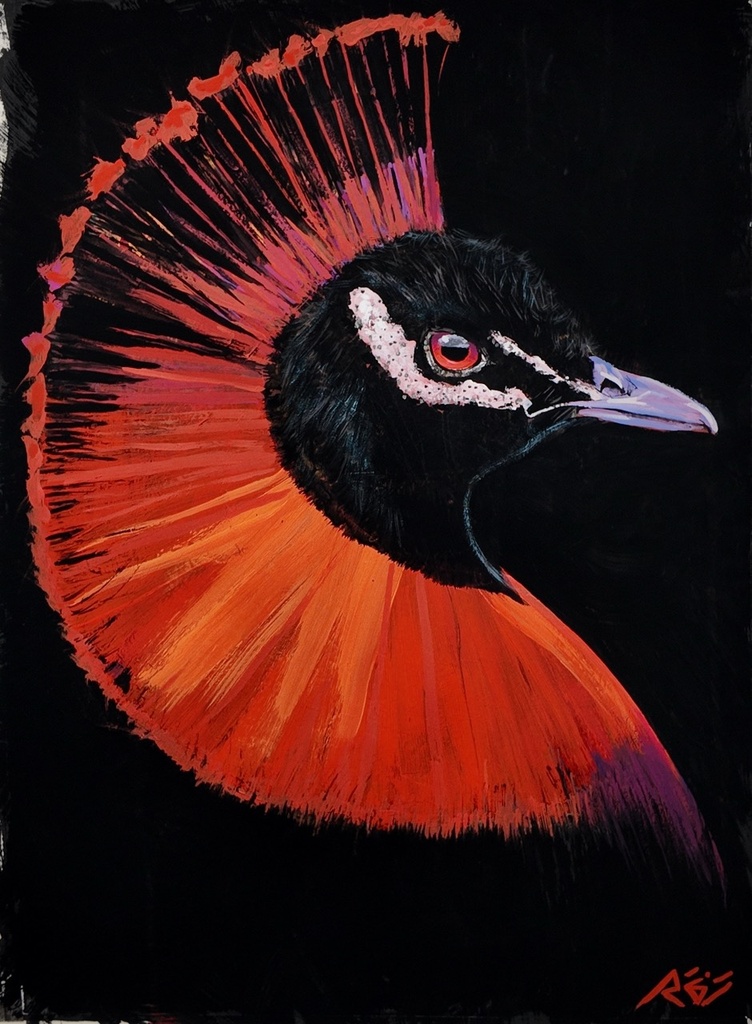
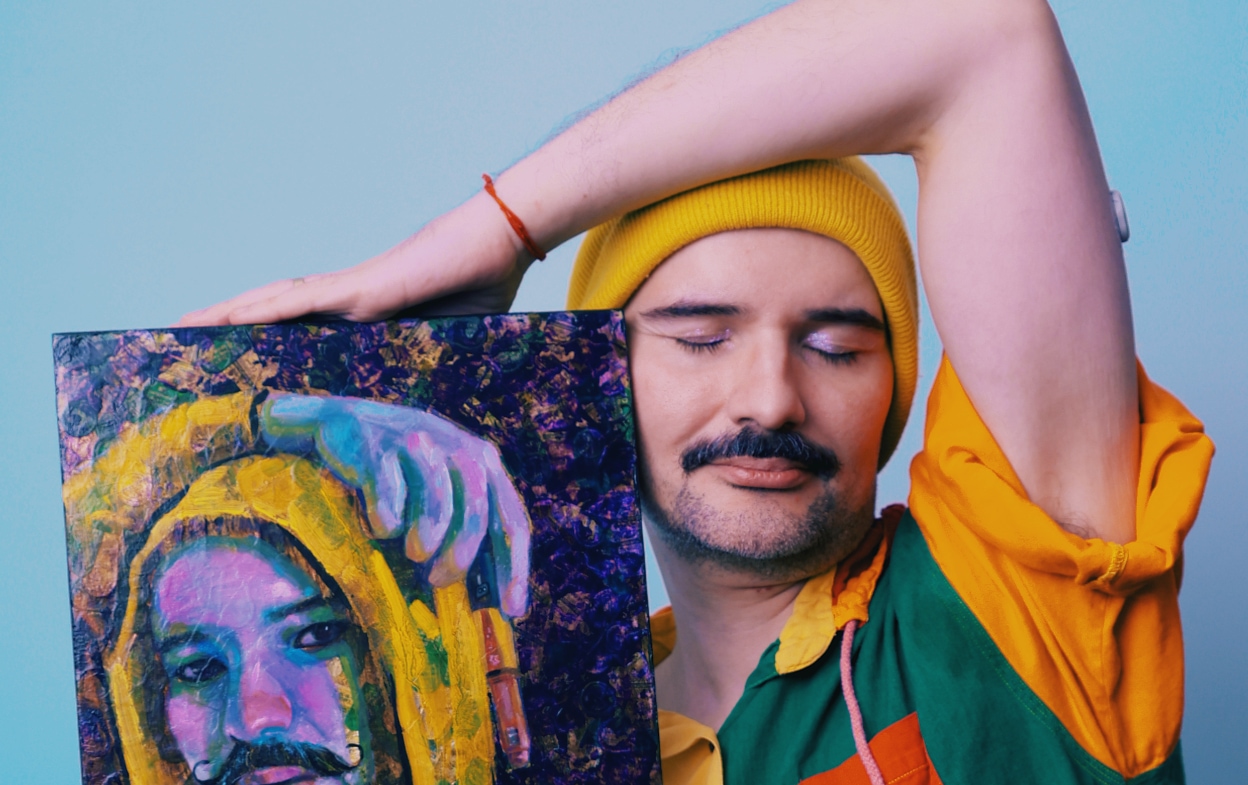
A painting begins with resistance. Gesso dragged across a surface. A ridge that catches light. A field that refuses to stay quiet beneath the figure. By the time a work enters an art fair booth or a gallery room, it has already accumulated decisions that cannot be reduced to a price list or a wall label.
Art fairs versus galleries is not a contest with a universal winner. They are distinct conditions for encounter. Each changes the speed at which work is seen, the language around it, and the kind of relationship a collector can build with an artist.
For artists whose work moves through material, memory, desire, and self-authorship, that distinction matters. Context is not decoration. It can determine whether a painting registers as an image to acquire or a presence that keeps unfolding.
Art Fairs Versus Galleries: Two Different Speeds
An art fair is compressed time. Hundreds of artists and galleries occupy a few days, often under the same bright architecture of carpet, partitions, badges, and movement. The experience has force. A collector can encounter an extraordinary range of practices in one afternoon, compare approaches, see what galleries are championing, and recognize patterns across a market.
That density can create genuine discovery. It can also make attention scarce. A painting is asked to hold its ground beside many others, often in close visual proximity. Scale, palette, and immediate formal tension become especially audible. Work has to announce itself without becoming simplistic.
A gallery moves differently. The best exhibitions create enough room for a painting to change as the viewer stays with it. The first reading may be color or contour. Then the surface begins to speak. A chromatic gray shifts against buff titanium. A black line becomes less graphic and more insistent. What seemed flat declares its accumulated layers.
Neither pace is inherently more serious. A fair can introduce work with precision and charge. A gallery can flatten work when its framing is weak. But the environments make different demands. One privileges the encounter. The other can sustain the return.
The fair as a concentrated field
At a fair, the gallery often functions as an editor. Its booth is a proposition about what belongs together. This can be clarifying for collectors, particularly when a gallery has built a program over time and can place an emerging artist within a larger conversation.
Fairs are also useful for seeing scale in the market without relying on abstraction. You can notice which kinds of work are receiving institutional attention, how artists are being presented, and whether a gallery speaks about process with knowledge or merely with polish. The strongest booths make a position visible. They do not simply fill walls.
Still, the fair has limits. Conversations are brief. Sightlines are interrupted. A work made through slow looking may have to survive a fast room. For collectors, this does not mean avoiding fairs. It means resisting the idea that speed equals certainty.
The gallery as a sustained proposition
A gallery exhibition can give a body of work its grammar. It can establish sequence, scale, relation, and friction between pieces. A small oil can become essential beside a larger painting. A recurring figure can read as a family, a witness, or a fracture across the room.
The gallery’s deeper value is often continuity. When representation is thoughtful, it means an artist’s work is not treated as an isolated event. There is advocacy, placement, institutional dialogue, and a long view of the practice. For collectors, that continuity can offer confidence, especially when acquiring significant work.
But a gallery is not the only place where depth exists. Artist-led studios can hold a rigorous archive too. Direct contact can reveal material decisions, references, and the chronology of a series with unusual clarity. The question is not whether there is a white cube. The question is whether the work is being cared for as a practice rather than handled as inventory.
What Collectors Should Look for in Both
The most useful question is not, “Where should I buy?” It is, “What kind of relationship with this work am I trying to begin?”
If you are encountering a painting at a fair, ask for the conditions around it. Has it been made within an ongoing series? What is the artist returning to? Where has the work been shown? Is the gallery able to speak specifically about its materials, not only its subject? A serious conversation does not need theatrics. It needs facts, attention, and room for uncertainty.
At a gallery, look beyond the calm of the installation. Consider how the exhibition has been constructed. Are the works given enough space to speak? Does the curatorial language sharpen what is present, or does it cover the paintings with borrowed vocabulary? A clean room can still contain a shallow reading.
In either setting, spend time with the surface. Paintings are not posters. Stand close enough to see where a mark breaks. Step back far enough to see how the structure holds. Notice whether the work continues to offer information after the first impact.
For my own paintings, the ground comes first. Heavily textured gesso establishes the behavior of light before the figure arrives. Colored pencil, gouache, acrylic, marker, and gesso return in the order feeling requires. Oil is the final skin. Impasto occupies physical space. Glazes carry slow time. Sgraffito is one sensation cutting through another.
That material history can be encountered at a fair, in a gallery, or directly in the studio. Yet it must be encountered, not assumed. The red may look immediate from across a room, but the red of pain is transparent alizarin crimson joined with raw umber. It glows from inside the layers. A photograph cannot fully deliver that fact. Neither can a hurried glance.
Direct From the Artist Is Its Own Context
The old hierarchy that treats gallery acquisition as the only serious route to collecting no longer describes the whole field. Artists have always maintained studios, relationships, archives, and private conversations. What has changed is the visibility of those channels.
Buying directly from an artist can be especially meaningful when the practice is serial and materially specific. You can understand where a work sits within a continuing arc. You can ask what came before it. You can learn why a contour repeats, why a palette has narrowed, why a figure has multiplied. The exchange is not an interruption of the artwork’s value. It can be part of its provenance.
Direct acquisition also requires discernment. Collectors should expect clear documentation, accurate dimensions and materials, professional packing, and a straightforward account of availability. Intimacy is not a substitute for rigor. The studio relationship should be both personal and exact.
For emerging collectors, a print can be an intelligent beginning. It offers a way to live with an image, learn the visual language of a practice, and follow the development of a series. An original painting is a different material event. Neither choice needs to perform status. The right choice is the one that can remain alive in your space and attention.
Choose the Encounter That Lets the Work Continue
An art fair may give you the first shock of recognition. A gallery may give you the silence required to understand why it happened. A studio may show you the raw umber under the brightness, the construction beneath the image, the labor that a finished surface carries without explanation.
Collect slowly when you can. Ask direct questions. Return to the work in memory after you leave the room. If it continues to press against the day, it may already be asking for a place in your life.
For collectors following my ongoing practice, inquiries are open for original paintings and prints. Join the collector list for first access to new chapters as they enter the world.