A face can be inherited before it is understood. A gesture can carry family history, public expectation, desire, danger, and joy at once. Art about self definition begins in that charged space: the distance between the identities assigned to us and the selves we insist on making.
For queer people, migrants, and anyone whose life has required translation, self-definition is not a private exercise in confidence. It is a lived negotiation. It happens in language, clothing, intimacy, movement, and the rooms where one is seen or refused recognition. Painting can hold that negotiation without reducing it to a slogan. It can let contradiction remain visible.
Art About Self Definition Is Not Portraiture Alone
A figurative painting may offer a face, a body, or a recognizable scene, yet its subject can exceed likeness. The figure becomes a site of authorship. How it stands, where it directs its gaze, what color surrounds it, and what symbols enter the frame all declare a position.
This is why self-definition in art is not simply autobiography. The artist may begin with lived experience, but the work must make an image capable of meeting someone else's life. A painting can be unmistakably queer without treating queerness as a category to be explained. It can be Brazilian without becoming a postcard. It can carry migration without illustrating a departure gate or a border line.
The strongest work makes room for specificity and leaves room for the viewer's own unfinished questions. It refuses the false choice between personal truth and formal ambition.
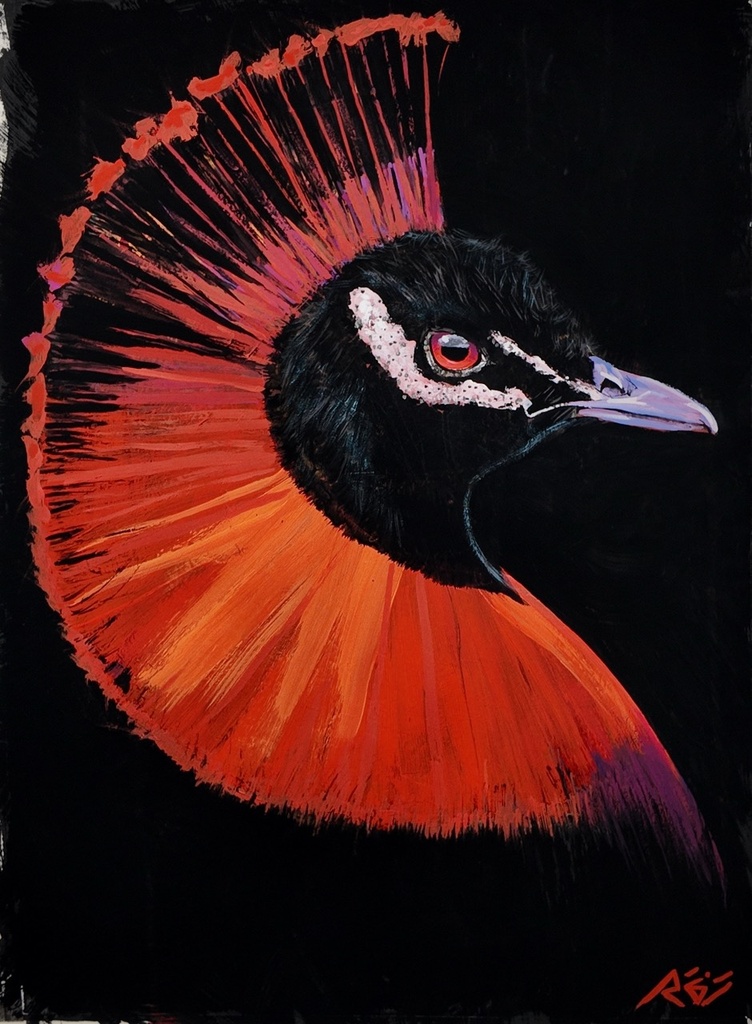
In Régis Souto's practice, outlined faces and psychologically charged figures hold their ground against dark, open fields. Tropical birds, carnival references, saturated color, and stark black are not decorative additions. They operate as a visual vocabulary of visibility, performance, inheritance, and escape. The image does not ask permission to be complex.
Chosen Identity Has a Formal Language
Identity is often discussed as content, as though the message of a painting can be separated from the way it is made. But a chosen self is carried through form. A hard contour can make a figure feel defended, ceremonial, or newly declared. A field of black can create isolation, theater, night, or infinite space. A burst of color can signal pleasure while refusing innocence.
These decisions matter because self-definition is never only verbal. People define themselves through what they repeat, reject, conceal, stage, and transform. Painting has its own grammar for those acts.
Consider the outline around a face. It may seem like a simple graphic device, but it sets a boundary. It says: this figure has an edge. It cannot be absorbed into the background, softened for someone else's comfort, or made anonymous. The contour becomes both an aesthetic choice and a declaration of presence.
The same is true of symbolic imagery. A bird may suggest freedom, but that reading is too easy if it ends there. In a painting concerned with self-authorship, a bird can also signal ornament, spectacle, migration, instinct, or a watchful double. Carnival imagery can carry excess and liberation, but also the discipline of performance and the risk of being consumed as display. Meaning gathers through placement, repetition, scale, and color.
The Body Is a Record, Not a Verdict
Figurative art has always been entangled with power. Who is allowed to appear? Who is idealized, eroticized, disciplined, hidden, or treated as a symbol rather than a person? A contemporary queer figurative painter works inside that history, not outside it.
To paint the body as a record is to acknowledge that it holds experience. Posture can register vigilance. A tilted head can carry defiance. A hand placed against the chest or held just beyond the frame can introduce tenderness, restraint, or refusal. None of these gestures needs a fixed interpretation. Their force lies in their ability to remain active.
That openness is not vagueness. It is precision without overexposure. The work can honor intimacy while withholding the demand for confession. For audiences trained to look carefully, that restraint is often where the painting becomes most powerful.
There is also a trade-off. Work that makes identity immediately legible can meet viewers quickly, particularly in a culture that rewards instant recognition. Yet it may flatten the subject into a familiar sign. Work that stays too opaque can protect complexity, but may deny the viewer a point of entry. The most enduring paintings manage both pressures. They offer an invitation, then keep unfolding.
Memory Arrives Through Color and Collision
Memory is rarely orderly. It returns through a color that recalls a room, a texture that echoes a garment, a song implied by a pose, or a familiar image shifted into an unfamiliar setting. In this sense, self-definition is not a clean break from the past. It is an editing practice.
For diasporic artists, the visual language of home can be especially charged. Cultural references may be sources of attachment, pleasure, and pride. They may also arrive burdened by how outsiders have simplified, exoticized, or sold them back. Reclaiming those references in painting means changing the terms of encounter.
A tropical palette, for example, does not have to perform cheerfulness. Placed against black, vivid color can become confrontational. It can appear as survival, ceremony, appetite, or insistence. A carnival reference can hold glamour and pressure in the same frame. The painting does not resolve that tension because the lived experience does not resolve it either.
This is where art about self definition becomes culturally significant. It makes a case for identity as movement, not a finished label. It shows that belonging can be made from fragments without becoming less real.
What Collectors Are Really Acquiring
Collectors often respond first to visual impact: a figure that commands the room, a color relationship that changes a wall, a composition that remains vivid from across the space. Those are valid responses. A painting should have formal presence.
But the deeper acquisition is a sustained encounter. A strong work continues to ask something of its owner. It changes under different light, beside different objects, and across different seasons of a life. It introduces a point of view into a collection rather than merely matching its palette.
For a collector building with intention, a painting about self-definition can create a vital tension among other works. It can bring queer experience into view without turning it into an educational display. It can speak to migration, desire, and reinvention while remaining unmistakably an artwork, not an illustration of a theme.
Original paintings carry the physical decisions of the studio: layered surfaces, marks, edges, revisions, and the scale of the artist's hand. Prints can offer another way to live with the image and enter the visual language of a practice. Available originals and prints are part of that continuing conversation, not an afterthought to it. Inquiries are open for works currently available.
A Painting Can Hold Its Own Name
Self-definition is sometimes mistaken for an individual act with no relation to the world. The opposite is closer to the truth. To name oneself clearly is to confront the names imposed by family, nation, desire, class, race, and culture. It is personal, but never solitary.
Painting offers a rare form of evidence. It does not need to prove a life is valid. It gives that life scale, color, silhouette, and duration. It lets the figure occupy the frame on its own terms.
For those following an artist's work over time, the collector list offers first access to new paintings, print releases, and studio developments. The deeper invitation is simply to keep looking. A painting that refuses inherited limits may also sharpen the way you see your own.