Why I Paint Belonging and Migration Before I Paint a Face
A ridge of gesso catches light before a face exists. It holds a drag, a hesitation, a refusal to lie flat. This is where my art about belonging and migration begins: not with a map, not with an explanation, but with a surface that has already survived pressure.
I build the ground heavily. Gesso is pulled, scraped, and left to make its own topography. Its marks determine how light will move across the finished painting. Texture is never background — it is biography. Before a figure arrives, the painting already carries a history of resistance in its skin.
Migration is often described as movement between places. That's true, but incomplete. It's also movement within language, memory, desire, and the image one is permitted to make of oneself. Belonging isn't the opposite of movement. For many of us, it's what we assemble while moving.
Art About Belonging and Migration Starts With Matter
A smooth surface can imply certainty. I'm not interested in certainty as a visual promise. The ground has to keep its frictions. It has to leave room for what can't be resolved into a clean arrival.
Over the gesso, I work through mixed-media layers in whatever order the feeling demands. Colored pencil lays down a fine, searching line. Gouache enters as an opaque interruption. Acrylic builds flat, matte passages that hold graphic force without pretending to be atmosphere. Markers sharpen the edge. Gesso comes back as construction — covering and reopening what came before.
Only then does oil arrive. Oil is the final skin, and fat-over-lean governs only this last phase — not the build underneath it. This is where the painting gathers its slower forms of light. A glaze holds chronic, accumulated time. Impasto claims physical space. Sgraffito is one sensation cutting through another.
None of this is decoration added to illustrate a subject. It's the subject's condition. A painting about displacement that has no resistance in its own material risks becoming an image of displacement rather than an encounter with it. I want the surface to insist on its own passage.
The Figure Is Never a Single Witness
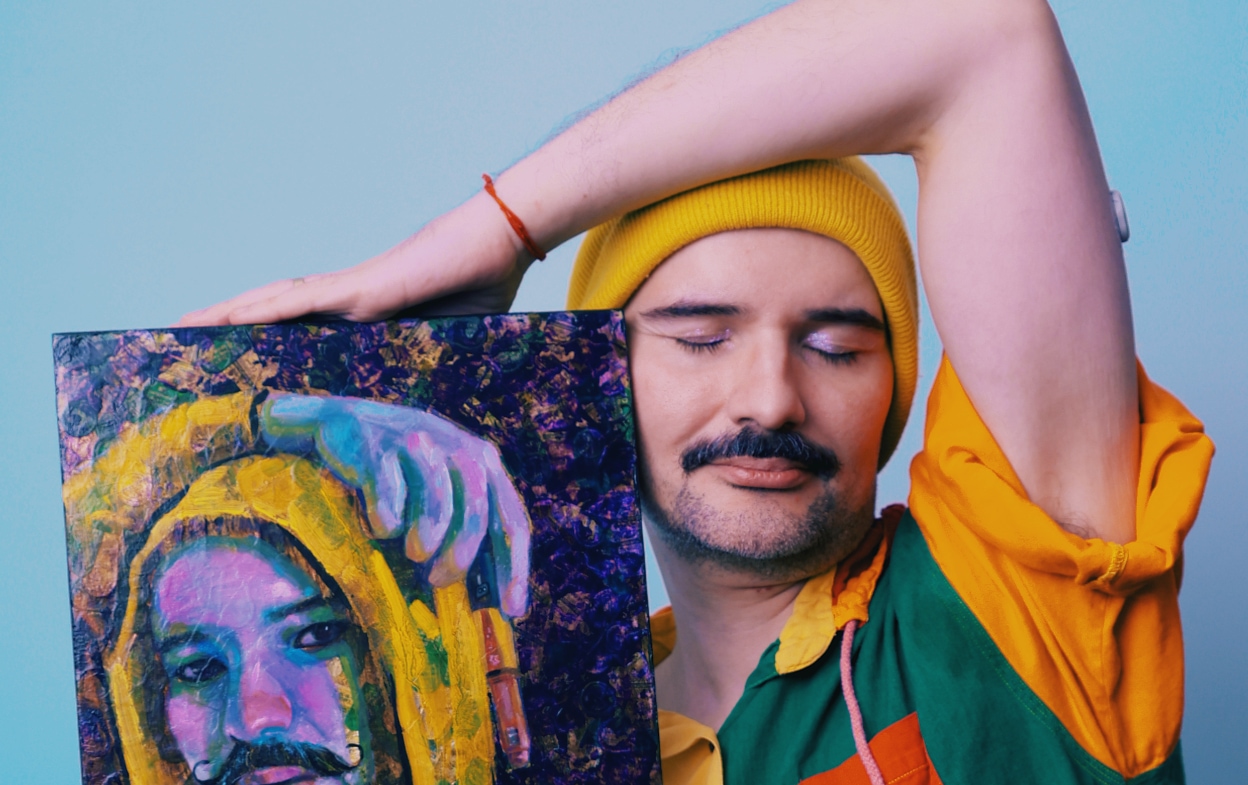
My figures start as photographic montages of my own body. I multiply it. I fracture it. I set one version beside another until the image refuses the lonely logic of a single portrait.
That multiplication comes from lived experience, but it isn't autobiography reduced to confession — it's a formal decision. One body becomes a crowd, an archive, a chorus. It can carry Brazil, Toronto, a room remembered in Portuguese, a gesture learned in public, a desire that had to invent its own language.
Black contour lines carry the narrative. They're graphic, declarative, often insistent. They don't just contain the figure — they ask what a border does. A contour can protect. It can isolate. It can become a route back to oneself.
In diasporic life, the self is often read from the outside before it gets to speak. Accent, skin, posture, clothing, gesture — each becomes material for someone else's story. The painted contour reverses that pressure. I decide where the line goes. I decide where it breaks. Self-authorship isn't a private act here — it's compositional.
Color Carries What Language Leaves Behind
My palette is built on raw umber, yellow ochre, burnt sienna, ivory black, buff titanium, titanium white, cadmium yellow, cadmium red, magenta, and ultramarine. These colors don't stand in for identity. They create a climate identity can be felt inside.
Brazilian memory shows up through color without becoming scenery. Yellow ochre can recall heat, dust, architecture, the worn brightness of a familiar street. Raw umber can make an image feel excavated rather than nostalgic. Ultramarine can make distance active. These aren't postcards — they're pressures of recall.
The red of pain isn't cadmium red. It's transparent alizarin crimson mixed with raw umber, glowing from inside the layers. It has depth because it isn't announced all at once. Some feelings work that way — they stay present below the visible account.
I desaturate with black or with complementaries. Chromatic grays recur in the backgrounds and in the skin. A gray here is never neutral — it's crowded. It carries what remains after opposing tones have met and neither one has disappeared.
Belonging Is Not Assimilation
There's a persistent demand placed on migrants and queer people: become legible enough to be welcomed. The bargain is usually quiet. Be grateful. Be simple. Be representative in a way that makes others comfortable.
Painting can refuse that bargain. The figures in my work don't seek purity, and they don't perform a polished arrival. They're composed from overlap — their edges meet, slip, and return. Their presence is deliberate. Queer resilience, painted, isn't a claim that difficulty disappears. It's the decision to stay visible without becoming easy to consume.
This matters for collectors and institutions because art about migration can get flattened into a category before it's allowed to be a painting. The subject becomes the credential. The artist becomes a spokesperson. The formal intelligence of the work gets treated as secondary.
I reject that hierarchy. Material comes first. The painting has to work through texture, line, palette, scale, rhythm. The body follows as a force inside that structure. Only then do the larger themes surface: diaspora, desire, race, national memory, chosen kinship, the unstable architecture of home.
The order matters. When the work is materially convincing, it asks more of the viewer than agreement. It asks for attention. It makes belonging tangible without pinning it down.
A Home Can Be Built in Layers
Home is sometimes a place. Sometimes it's an arrangement of gestures that survives relocation — the cadence of Portuguese, a family image carried across years, a color that returns before its source can be named. Sometimes home is the people who recognize a part of you that was never granted public space.
That's why the paintings don't offer a single destination. They hold passages. A scraped line beneath a glaze stays beneath it. A concealed form still alters the surface above it. Earlier layers aren't erased by later ones — they become the conditions the final image depends on.
This is also how a continuing practice develops. Each series is a chapter, not a restart. Beyond the Contour extends my attention to the line as boundary and release. Archive of Unstoppable Bodies gathers visibility as collective force. Prismatic Identity stays open, because identity is movement, not a completed portrait.
For a collector, living with this kind of work means living with an image that doesn't finish itself at first glance. The figure may command a room immediately, but the surface keeps changing as daylight moves across its ridges, glazes, and marks — what reads as direct on day one gets more complicated by day thirty. That's not ambiguity for its own sake. It's duration.
Original paintings and prints are available directly from my studio. Inquiries are open, and the collector list receives first access as each new chapter forms.
The question isn't whether a person belongs to one place or another. The more useful question is what they've made from the passage between them. Let the painting keep that answer open. Let it hold its ridges. Let it stay visible in the light.