This is the second of two posts about Beyond the Contour, my solo exhibition at The Show Gallery in Toronto. This one is about Act III - the part that was hardest to make, and the part that stayed with people the longest.
I was diagnosed with diabetes when I was still young.
For years after that, I did what a lot of people do. I tested the limits. I ignored the numbers. I ate what I wanted, skipped what I should not have skipped, and treated my own condition as something that existed in the background - a inconvenience, not a reality.
Looking back, I understand what that was. It was not carelessness. It was grief. The kind that arrives when your body stops feeling entirely like yours.
What the paintings are made of
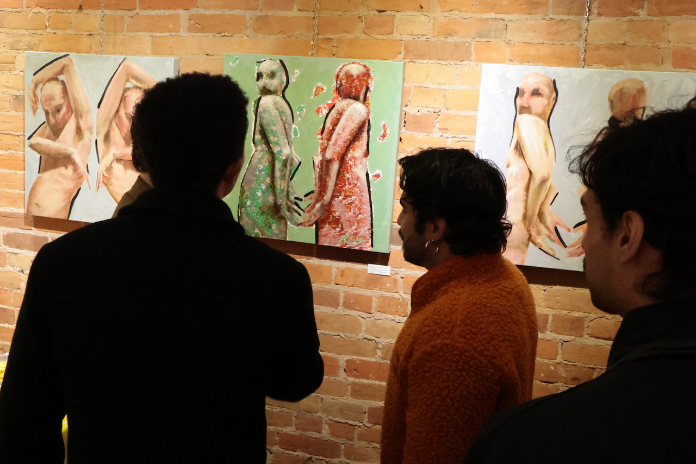
The works in Act III are oil on canvas. But embedded into the paint surface are objects from my actual daily life, like insulin needle caps, chocolate wrappers, packaging from the things I eat and the things I use to manage what I eat.
That was a deliberate decision. Not symbolic. Literal.
I wanted the material reality of living with diabetes to be physically present in the work, not represented, not illustrated, but there. Pressed into the surface. Held inside the image.
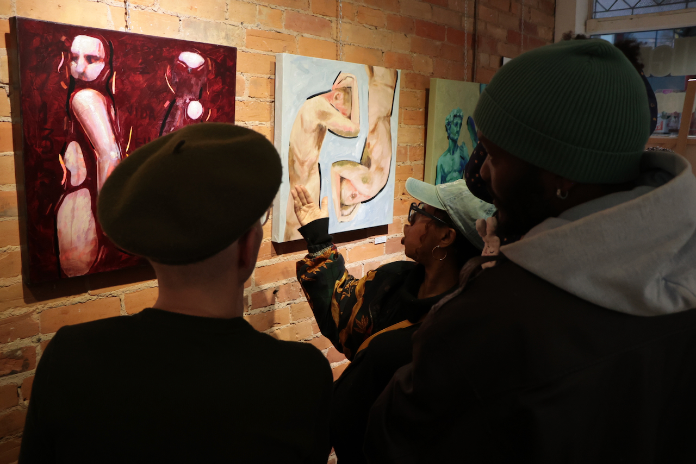
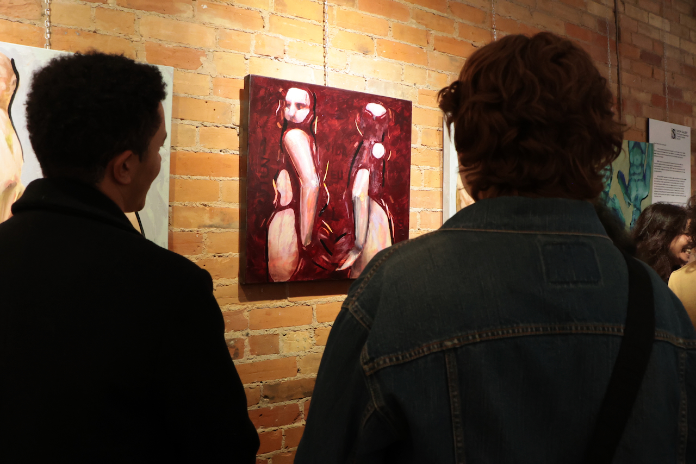
The body in these paintings is duplicated, facing itself. Two versions of the same figure, suspended in the moment just before a choice is made. That gap (the instant between impulse and decision, between desire and discipline) is where I have spent a significant part of my life.
Most people who live with a chronic condition know that gap intimately. It is not dramatic. It is quiet. It happens at a restaurant, in a kitchen, at a birthday party. Every single day.
What happened in the gallery
I did not know what to expect when people encountered these works.
What I did not anticipate was how quickly the conversation became personal.
People with diabetes stopped in front of these paintings and started talking - not about the technique, not about the composition, but about their own bodies. Their own negotiations. Their own versions of that gap between impulse and care.
One person told me they had never seen their experience with diabetes represented as something complex and human rather than a medical condition to be managed or a personal failure to be ashamed of.
That sentence has stayed with me.
Because that is precisely what these paintings were trying to do. Not to educate. Not to raise awareness in the campaign sense. But to make the lived experience visible, in a way that feels true to the people who are actually living it.
Why visibility matters
There is a particular kind of loneliness that comes with chronic illness. Not the loneliness of being alone, but the loneliness of carrying something that other people cannot easily see.
Diabetes is largely invisible. The negotiations happen inside the body, inside the mind, in private moments that rarely make it into public conversation. When the condition does appear publicly, it is usually framed as a health statistic, a risk factor, a lifestyle issue.
What it rarely gets framed as is a human experience. Layered, contradictory, exhausting, sometimes funny, often isolating, and entirely real.
That is what I was trying to paint.
And when I watched people recognize themselves in those images, stand still, say nothing, or say everything, I understood that the need for that visibility is larger than I had realized.
The question the work keeps asking
At the center of Act III is a question I have been asking myself for years:
Does the body have to earn the right to exist as it is?
The ideal of the perfect body (disciplined, functional, controlled ) runs deep. I grew up with it. I internalized it long before my diagnosis made it feel like a moral obligation rather than an aesthetic preference.
These paintings push back against that. Not by celebrating illness, but by refusing to treat the body as a problem to be solved. The figure in these works is not a cautionary tale. It is not an inspiration story either. It is simply a person, mid-negotiation, trying to live honestly inside a body that requires constant attention.
That, to me, is worth painting.
What comes next
I am currently exploring ways to bring this work into spaces where it can reach people living with diabetes more directly. community settings, healthcare spaces, awareness programming.
If that kind of collaboration is something that interests you or your organization, I would welcome the conversation.
You can reach me at info@regissoutoarts.com
_Régis Souto
Beyond the Contour ran April 6–12, 2026 at The Show Gallery, Toronto. Works from Act III and the full exhibition are documented on this site.