I am still processing the past few days.
When the exhibition ended and the works came down, I felt something I did not expect. Not relief. Not pride. Something closer to grief, the particular kind that arrives not from loss, but from fullness. The silence after months of preparation felt strangely loud.
I kept walking mentally through the gallery. Replaying conversations. Faces. The pauses people made in front of certain paintings.
That is what stayed with me most. The pauses.
How it began
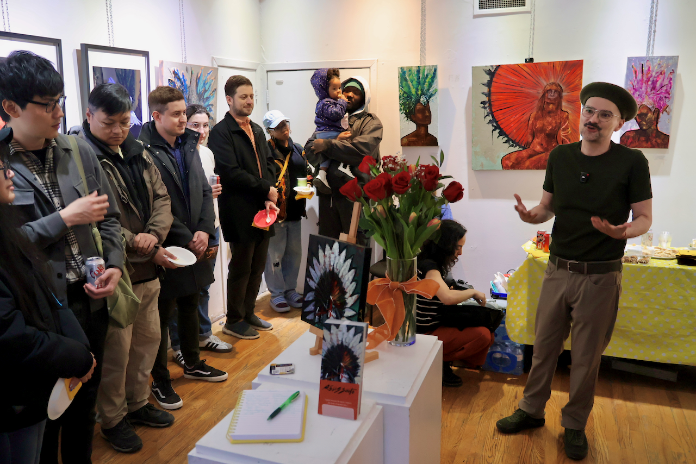
Beyond the Contour opened on April 6th at The Show Gallery on Queen Street West in Toronto. Seven days. Three acts. Around 130 people walked through that space.
The exhibition was built around a question I had been carrying for a long time: what do we choose to remember, and what do those choices reveal about who we are?
The answer, for me, lived inside the black lines that run through almost all of my work. Lines that began as graphic decisions and slowly became something else, acts of preservation, confrontation, and survival.
Each act of the exhibition followed that line as it changed function.
Act I — Ten Seconds of Light
The first act began with birds.
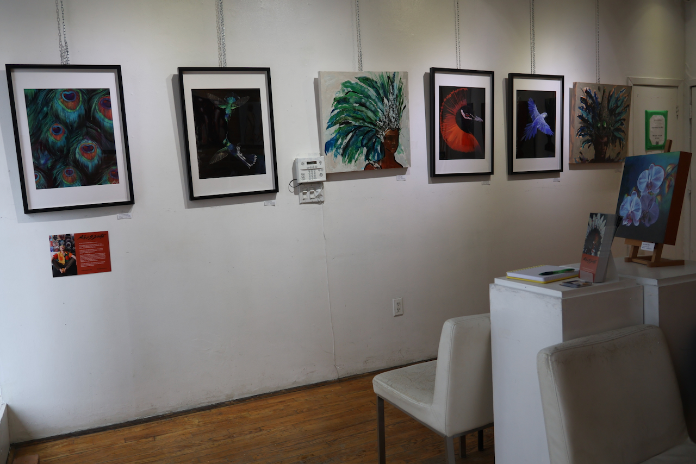
Specifically, hummingbirds painted in gouache against absolute black - isolated, luminous, suspended. They came from a memory I have carried since childhood: lying on my grandmother's sofa in Brazil on a Sunday afternoon, watching hummingbirds hover outside the window while family voices echoed from the kitchen. Ten seconds, maybe thirty, of pure suspended beauty before someone called from another room and the moment dissolved.
Those paintings were my attempt to freeze that sensation before it disappeared completely.
But the series carried a second layer. The idea of perfection not just as natural beauty, but as a social role, being the perfect one in the family, the one who holds everything together, who places himself last. The meticulous technique was intentional. Precision as both gift and burden.
The black background was a choice about memory. It removes everything that does not matter, insisting that the eye rests only on what is most precious.
They don't stay. That's what makes them perfect.
Act II — Brazilian Poems
The second act moved into portraiture.
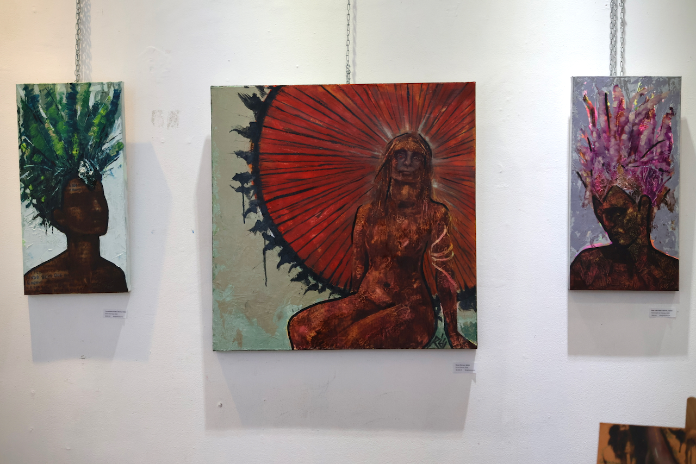
Faces emerging from layers of acrylic and oil, built over surfaces where I had written poems and song lyrics (Adriana Calcanhotto, Chico Buarque, Tom Jobim and others) invisible structures beneath the paint. Music as foundation. Memory as material.
These were my Brazilian Poems: carnival ornaments, tropical feathers, bold graphic lines defining faces that sometimes had no eyes. Not absence, suspension. Figures caught between what was inherited and what was reconstructed from a distance.
Immigration changed my relationship with Brazil permanently. The country I carry inside me is not a geography. It is an emotional atmosphere now edited by nostalgia, shaped by separation, continuously rebuilt through color and gesture.
The black lines here became acts of remembrance. Choosing what to keep. Choosing what the image needs to hold.
Act III — The Line of Choice
The final act was the hardest to make and, I think, the most necessary.
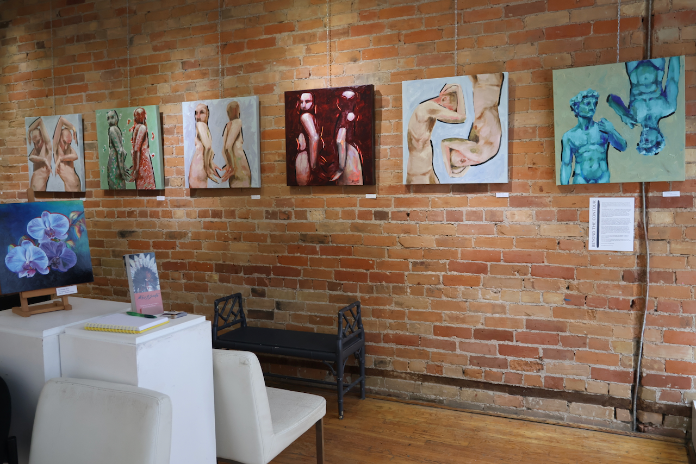
I will write about this act in depth in a separate post. But briefly: these paintings confronted the body directly (diabetes, self-image, masculinity, the daily negotiation between care and self-destruction). Insulin needle caps and chocolate wrappers embedded in the paint surface. The body duplicated, facing itself, suspended in the moment just before a choice is made.
Here the black line stopped protecting beauty and started defining limits. Discipline. Resistance. The distance between who I was and who I insist on becoming.
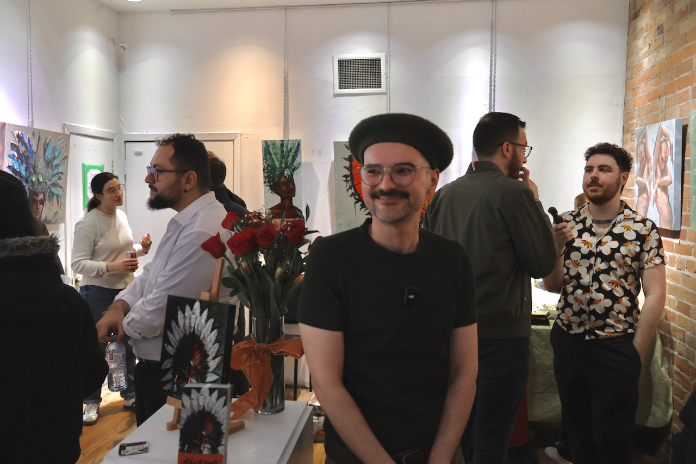
The opening
The opening night brought around 70 people into that space.
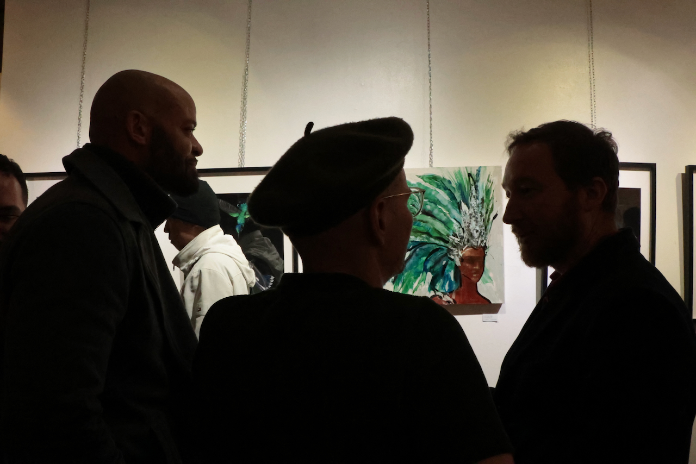
What I did not anticipate was how quickly the conversations moved past the work itself and into something more personal. People I had never met spoke to me as if we already knew each other. Technique became vulnerability. Migration became family. Color became grief.
Some people cried.
Some stood quietly in front of a painting for a long time without saying anything.
Others came back more than once during the week.
I have been making work alone for long enough that I sometimes forget what happens when someone else enters it. Watching people project themselves into the paintings, recognizing something of their own lives in the images, reminded me that art is not completed in the studio. It is activated in the encounter.
What we built in that gallery was not simply a show. It was a space where memory moved collectively. Briefly, the distance between inner world and outer world disappeared.
What remains
The paintings are no longer on those walls. The lights are off. The week has passed.
But I carry the memory of every conversation, every face, every silence inside that space.
And I think that is what this exhibition was truly about from the beginning, not the works themselves, but the recognition they made possible. The moment a stranger sees something of themselves in an image and understands, without needing to explain it, that they are not alone in what they carry.
We are not only what happened to us.
We are what we decide to preserve.
That, in the end, is what the black lines were always about. Not separation. Holding things close enough so they never disappear completely.
Beyond the Contour ran from April 6–12, 2026 at The Show Gallery, 978 Queen St. W., Toronto.
The full artist statement and works from each act are available on this site.
Régis Souto